
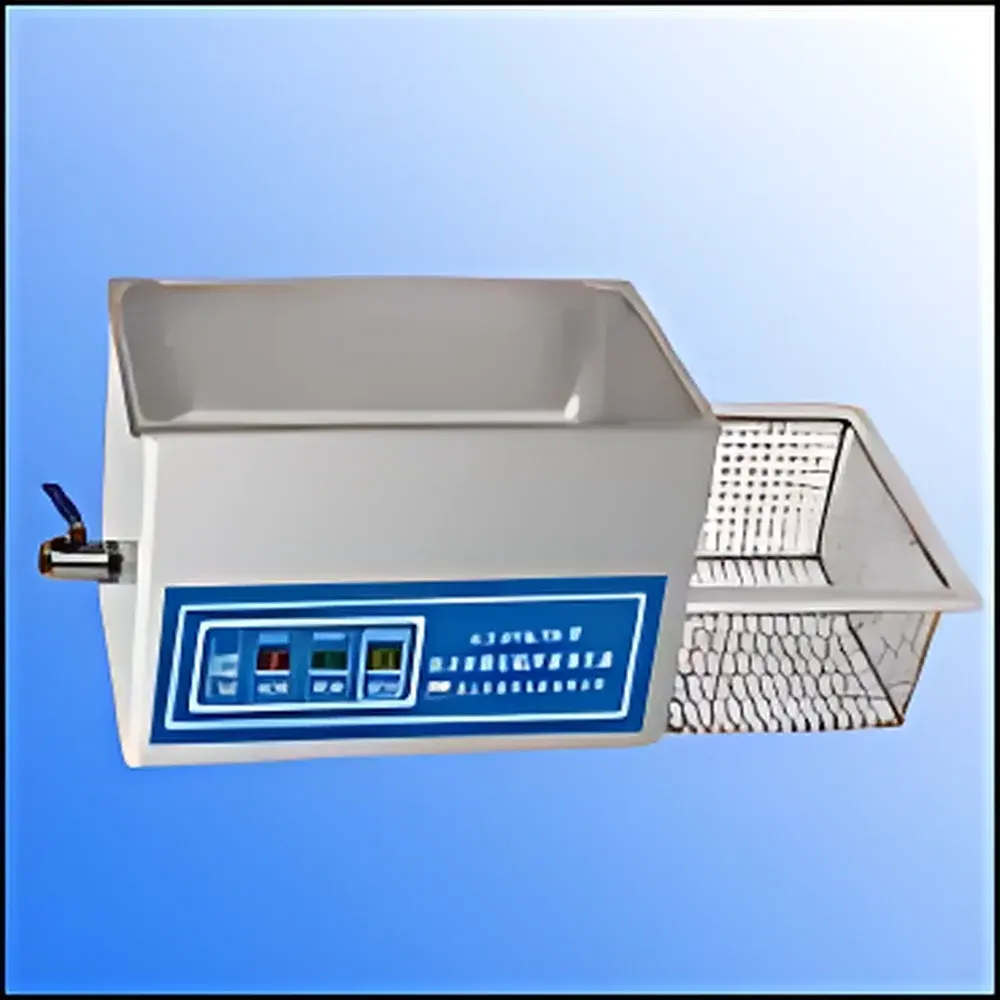
Shumei KQ5200DE Benchtop Digital Ultrasonic Cleaner
| Brand | Shumei |
|---|---|
| Model | KQ5200DE |
| Tank Capacity | 10 L |
| Ultrasonic Frequency | 40 kHz |
| Total Ultrasonic Power | 200 W (4 × 50 W transducers) |
| Power Adjustment Range | 40–100% |
| Heating Power | 600 W |
| Temperature Control Range | 20–80 °C |
| Timer Range | 1–480 min |
| Internal Tank Dimensions | 300 × 240 × 150 mm |
| Overall Dimensions | 320 × 264 × 340 mm |
| Material | Stainless Steel 304 inner tank and housing |
| Features | Digital display for time, temperature, power, cumulative operation hours (up to 999,999 h), low-level liquid protection, over-temperature/voltage/current safety cutoffs, built-in mesh basket, sound-reducing lid, and drain valve |
Overview
The Shumei KQ5200DE is a benchtop digital ultrasonic cleaner engineered for precision cleaning, degassing, deagglomeration, and sample preparation in academic laboratories, R&D centers, quality control environments, and industrial maintenance facilities. It operates on the principle of high-frequency ultrasonic cavitation—generating microscopic vacuum bubbles in aqueous or solvent-based cleaning solutions that collapse violently upon contact with surfaces, delivering mechanical energy sufficient to remove sub-micron particulates, organic residues, oxides, and biofilms without mechanical abrasion. With a fixed 40 kHz frequency and 200 W total ultrasonic output distributed across four independently mounted 50 W transducers, the unit ensures uniform energy distribution throughout the 10 L stainless steel tank. Integrated heating (20–80 °C) and programmable timing (1–480 min) enable optimized cleaning protocols for diverse substrates—including optical components, semiconductor wafers, surgical instruments, metal parts, glassware, and biological samples—while maintaining reproducibility across repeated cycles.
Key Features
- Digital microprocessor-controlled interface with real-time display of set and actual values for ultrasonic power (%), heating temperature (°C), elapsed/remaining time (min), cumulative operating hours (up to 999,999 h), and system status alerts.
- Robust 304 stainless steel construction: seamless inner tank, reinforced outer chassis, and argon-welded stainless steel mesh basket for long-term corrosion resistance and mechanical stability.
- Comprehensive safety architecture: automatic shutdown triggered by low liquid level detection, over-temperature (≥85 °C), over-voltage (>±10% nominal), and over-current conditions—fully compliant with IEC 61010-1 requirements for laboratory electrical equipment.
- Adjustable ultrasonic intensity (40–100%) allows fine-tuning for delicate samples (e.g., MEMS devices or tissue sections) versus robust contaminants (e.g., machining oils or solder flux).
- Integrated sound-dampening lid reduces ambient noise to ≤65 dB(A) at 1 m distance, supporting shared lab environments where acoustic compliance is required.
- Drain valve and removable basket facilitate rapid solution exchange and residue removal—critical for multi-step cleaning protocols involving sequential solvents or enzymatic baths.
Sample Compatibility & Compliance
The KQ5200DE accommodates a broad range of sample types and geometries, including but not limited to: glass vials, cuvettes, pipette tips, watch components, printed circuit boards (PCBs), dental tools, filtration membranes, and centrifuge tubes up to 50 mL. Its 300 × 240 × 150 mm internal dimensions support standard labware stacking while ensuring adequate solution depth for effective cavitation. The unit meets CE marking requirements and conforms to ISO 13485–aligned manufacturing practices. While not certified for sterile processing per EN ISO 17664 or FDA 21 CFR Part 820, it supports GLP-compliant documentation when paired with external audit-ready software (see Software & Data Management). For applications requiring validated cleaning efficacy—such as pharmaceutical component preparation—the device may be integrated into IQ/OQ protocols under user-defined SOPs aligned with USP and ASTM D2603 standards.
Software & Data Management
The KQ5200DE operates via embedded firmware running on an industrial-grade 8-bit microcontroller, eliminating dependency on external PCs or proprietary drivers. All operational parameters—including start time, duration, temperature setpoint, power level, and fault logs—are stored non-volatilely and accessible via the front-panel interface. Though no native PC connectivity is provided, users may implement external data logging using RS-232 or USB-to-serial adapters (third-party) interfaced with LabVIEW, Python-based SCADA systems, or Excel-linked macros. For regulated environments, the unit’s deterministic behavior, repeatable parameter recall, and immutable cumulative hour counter support traceability requirements under ISO/IEC 17025 and GMP Annex 11 when documented within a formal calibration and maintenance schedule.
Applications
- Precision Cleaning: Removal of polishing compounds from optics, flux residues from electronics assemblies, and lubricants from precision machined parts.
- Sample Preparation: Cell lysis for protein extraction, nanoparticle dispersion stabilization, and homogenization of heterogeneous suspensions prior to HPLC or SEM analysis.
- Degassing & Deaeration: Elimination of dissolved air bubbles from solvents used in chromatography mobile phases or adhesive formulations.
- Surface Activation: Enhancement of surface wettability for improved coating adhesion on polymers and metals prior to plating or bonding.
- Quality Assurance: Routine validation of cleanliness levels per ASTM F312-17 (microscopic particle counting) or visual inspection per MIL-STD-1246C.
FAQ
What is the recommended cleaning solution for general laboratory use?
Aqueous alkaline detergents (e.g., Alconox® or Liquinox®) are preferred for most organic and particulate contamination; avoid chlorinated solvents unless explicitly approved for 304 stainless steel compatibility.
Can the KQ5200DE be used for sterilization?
No—ultrasonic cleaning is a physical cleaning modality, not a sterilization process. Sterilization requires validated thermal, chemical, or radiation methods per ISO 17665 or AAMI ST58.
Is the unit suitable for cleaning delicate MEMS or microfluidic devices?
Yes—when operated at 40–60% power with degassed DI water and short cycle durations (≤5 min), it achieves effective cleaning without structural damage, provided devices are secured in the mesh basket to prevent direct transducer contact.
How often should the transducers be recalibrated?
Transducers do not require periodic recalibration; however, annual verification of ultrasonic output uniformity using aluminum foil erosion test (per ASTM E1774-19) is recommended for critical applications.
Does the unit support continuous operation mode?
Yes—the timer can be disabled to enable indefinite operation, though thermal management and solution evaporation must be monitored manually when exceeding 60-minute cycles.



