
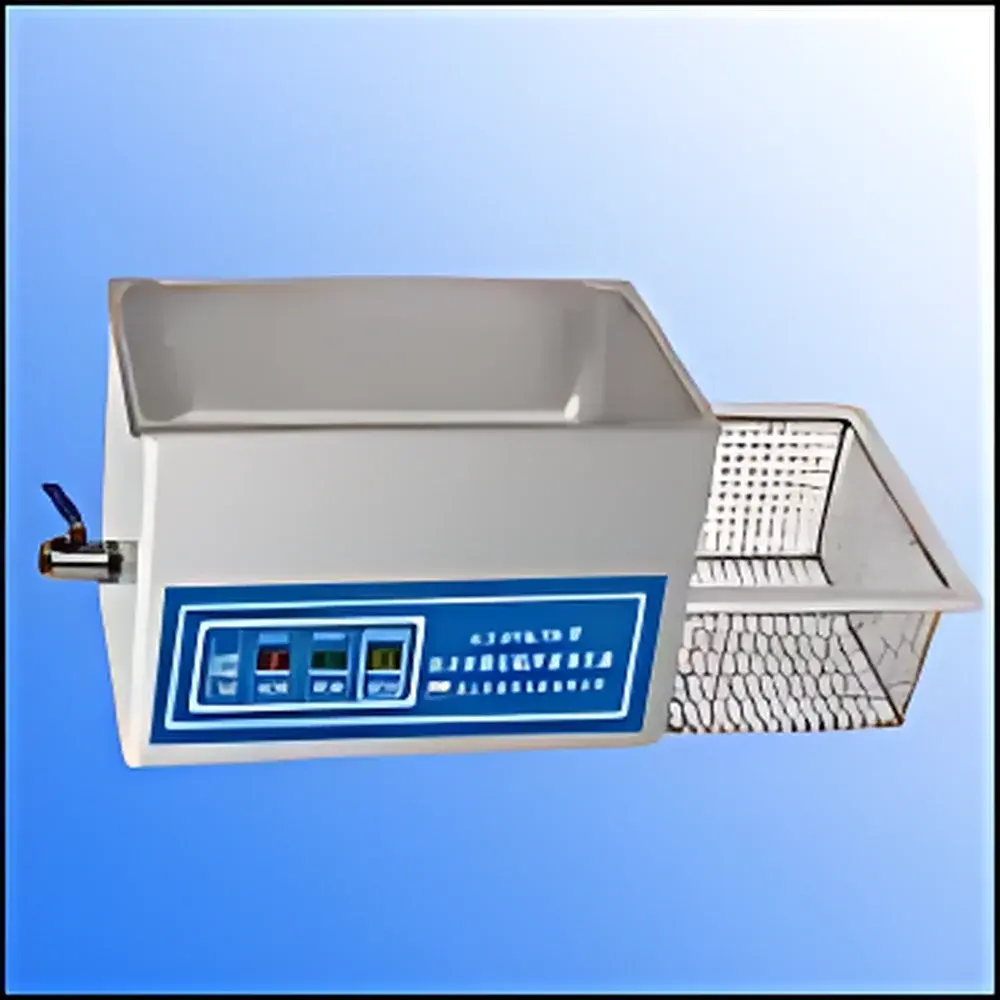
Shumei KQ2200B Benchtop Ultrasonic Cleaner
| Brand | Shumei |
|---|---|
| Model | KQ2200B |
| Type | Benchtop Ultrasonic Cleaner |
| Dimensions (L×W×H) | 260×160×260 mm |
| Tank Internal Dimensions (L×W×H) | 230×140×100 mm |
| Capacity | 3 L |
| Ultrasonic Frequency | 40 kHz |
| Total Ultrasonic Power | 100 W |
| Heating Power | 800 W |
| Temperature Range | 0–80 °C |
| Timer Range | 1–20 min |
| Tank Material | Stainless Steel (SUS304) |
| Housing Material | Stainless Steel |
| Basket Included | Yes |
| Drain Valve | Yes |
| Lid | No Sound-Dampening Cover |
Overview
The Shumei KQ2200B Benchtop Ultrasonic Cleaner is an integrated, compact ultrasonic cleaning system engineered for precision laboratory and light industrial applications. It operates on the principle of high-frequency ultrasonic cavitation—generating microscopic vacuum bubbles in liquid media that collapse violently upon reaching resonance, producing localized energy sufficient to dislodge contaminants from surfaces, disrupt aggregates, and enhance mass transfer. With a fixed frequency of 40 kHz and a total acoustic output of 100 W distributed across dual 50 W transducers bonded directly to the stainless steel tank, the KQ2200B delivers consistent, reproducible cleaning performance ideal for small-batch processing. Its all-stainless-steel construction (SUS304), combined with a dedicated 800 W immersion heating element and digital temperature control (0–80 °C), supports thermally assisted cleaning protocols essential for removing organic residues, waxes, or biofilms. Designed for reliability in academic labs, QC environments, R&D facilities, and pilot-scale production settings, the unit meets fundamental mechanical and electrical safety requirements aligned with IEC 61010-1 for laboratory equipment.
Key Features
- Integrated ultrasonic generator and tank design eliminates external cabling and reduces footprint—ideal for benchtop use in space-constrained laboratories.
- Dual 50 W piezoelectric transducers mounted directly to the tank bottom ensure uniform energy distribution and high cavitation density across the full 3 L working volume.
- Precision digital temperature controller with ±2 °C accuracy over 0–80 °C range enables repeatable thermal-assisted cleaning, critical for solvent-based or enzymatic decontamination workflows.
- Programmable timer (1–20 minutes) with audible end-of-cycle alert ensures process consistency and prevents overexposure of sensitive samples to ultrasonic energy.
- Stainless steel tank (230 × 140 × 100 mm internal) formed via deep-drawing process offers superior corrosion resistance, dimensional stability, and ease of cleaning—compliant with ISO 15190:2020 laboratory infrastructure standards.
- Front-mounted drain valve facilitates rapid, spill-free solution exchange—reducing downtime between cleaning cycles and minimizing manual handling risks.
- Robust stainless steel housing (excluding select entry-level models) provides mechanical durability and chemical resistance in multi-user lab environments.
Sample Compatibility & Compliance
The KQ2200B accommodates a broad spectrum of sample types and vessel formats, including glassware (vials, beakers, cuvettes), metal components (surgical instruments, precision optics mounts), ceramic substrates, and polymer-based microfluidic chips. Its 3 L capacity and optimized geometry support immersion of standard 50 mL centrifuge tubes, microscope slides, and PCB assemblies up to 230 mm in length. While not certified for sterile processing under ISO 13485 or FDA 21 CFR Part 820, the unit’s materials and construction are compatible with common laboratory disinfectants (e.g., 70% ethanol, 0.5% sodium hypochlorite) and aqueous alkaline detergents. Users performing GLP- or GMP-aligned cleaning validation should document temperature uniformity profiles, ultrasonic power stability (via calorimetric verification), and cycle reproducibility per ASTM D2603-20 and USP guidelines for ultrasonic cleaning systems.
Software & Data Management
The KQ2200B operates via a dedicated front-panel interface with LED indicators for power, heating status, and timer countdown—requiring no external software or driver installation. All operational parameters (temperature setpoint, timer duration, on/off state) are retained after power cycling. Though it lacks USB/RS-232 connectivity or audit-trail functionality, its deterministic analog-digital hybrid control architecture ensures stable, drift-free operation without firmware dependencies. For laboratories requiring electronic recordkeeping, integration with external environmental monitoring systems (e.g., Vaisala viewLinc, DeltaTrak) is feasible using optional dry-contact relay outputs (available via OEM modification). The absence of network interfaces aligns with cybersecurity best practices for non-critical lab assets as recommended in NIST SP 800-53 Rev. 5 (RA-5, SI-2).
Applications
- Labware Decontamination: Removal of protein residues, grease, and particulate matter from pipette tips, HPLC vials, and chromatography columns prior to reuse or sterilization.
- Materials Preparation: Dispersion of nanomaterials (e.g., graphene oxide, TiO₂ nanoparticles) in aqueous or organic solvents; deagglomeration of ceramic powders for sintering feedstock.
- Biological Sample Processing: Gentle cell lysis of bacterial cultures (e.g., E. coli) and tissue homogenization at sub-lethal amplitudes; extraction of intracellular metabolites under controlled thermal conditions.
- Electronics Cleaning: Residue removal from printed circuit boards (PCBs), solder paste inspection substrates, and MEMS devices without mechanical abrasion.
- Surface Pretreatment: Activation of polymer surfaces (e.g., PDMS, PET) prior to plasma treatment or coating adhesion testing.
FAQ
Is the KQ2200B suitable for cleaning delicate optical lenses or semiconductor wafers?
Yes—when operated at lower time/temperature settings (e.g., 5 min, 35 °C) with low-surface-tension, non-corrosive solvents (e.g., IPA/water mixtures), the 40 kHz frequency provides effective particle removal without surface pitting.
Does the unit include a degassing function?
While not labeled as “degas mode,” the 40 kHz ultrasonic field inherently promotes dissolved gas nucleation; running the unit empty for 2–3 minutes before loading samples significantly reduces bubble interference during subsequent cleaning cycles.
Can the heating element be disabled independently of ultrasonic operation?
Yes—the temperature control and ultrasonic activation are fully decoupled; users may run cold ultrasonic cleaning or heat-only bath protocols as needed.
What maintenance is required for long-term reliability?
Routine cleaning of the tank interior with mild detergent and periodic inspection of the drain valve seal are sufficient; transducer bonding integrity remains stable over >5,000 operating hours under normal load conditions.
Is calibration documentation provided with the unit?
Factory calibration certificates for temperature sensor accuracy and timer deviation (±0.5%) are available upon request and comply with ISO/IEC 17025 traceability requirements when issued by accredited third-party labs.



