
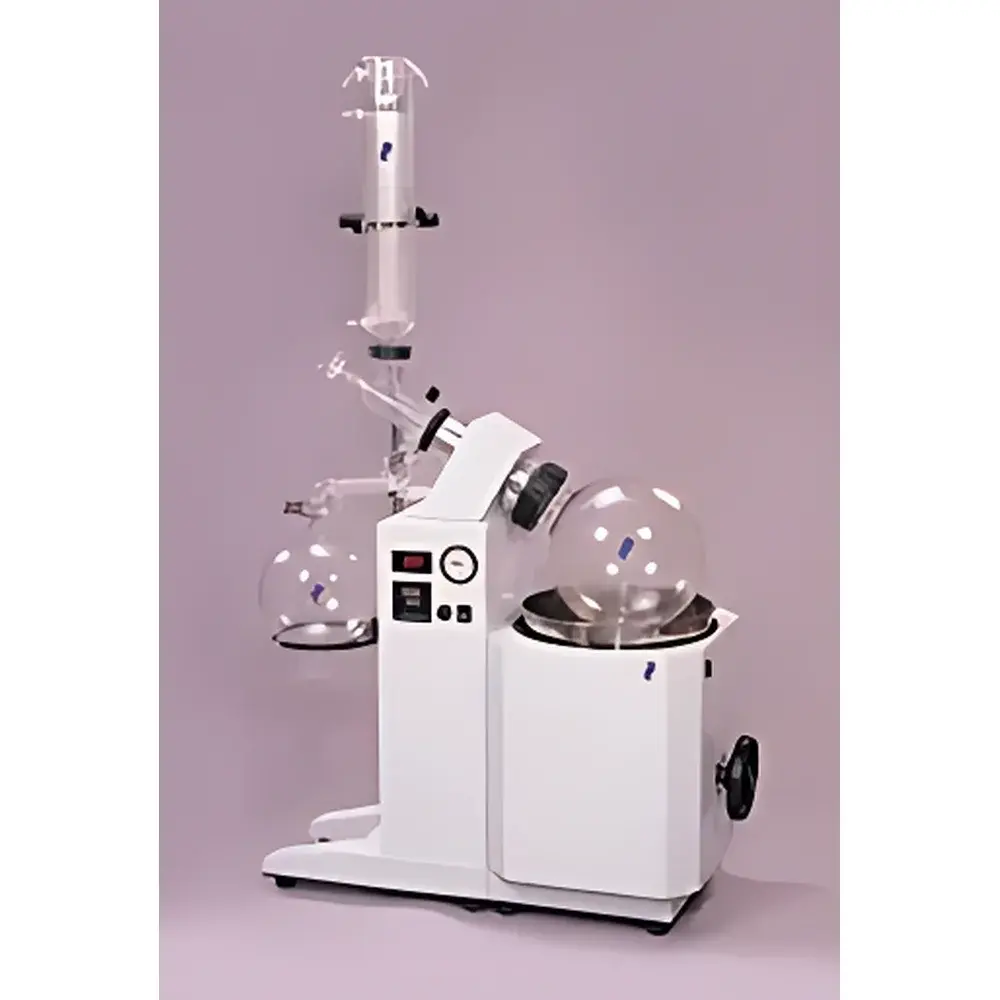
RE5220 Rotary Evaporator
| Origin | Shanghai, China |
|---|---|
| Manufacturer Type | Authorized Distributor |
| Origin Category | Domestic (China-made) |
| Model | RE5220 |
| Price | USD 4,700 (FOB Shanghai) |
| Rotation Speed Range | 20–110 rpm (digital display, frequency-controlled) |
| Heating Bath Temperature Range (water) | RT to 98 °C |
| Condenser Type | Vertical large-bore dual-coil serpentine condenser |
| Rotating Flask Capacity | 20 L |
| Collection Flask Capacity (standard ground-glass joint) | 10 L |
| Total Power Consumption | 5,180 W |
| Dimensions (W×D×H) | 1100 × 650 × 1900 mm |
Overview
The RE5220 Rotary Evaporator is an industrial-grade benchtop purification system engineered for high-efficiency solvent removal, concentration, and gentle compound recovery under reduced pressure. Based on the fundamental principle of rotary evaporation—where simultaneous rotation, vacuum application, and controlled bath heating lower the boiling point of solvents while maximizing surface area and heat transfer—the RE5220 delivers reproducible, scalable performance for laboratories processing medium-to-large-volume samples (up to 20 L). Its robust stainless-steel frame, integrated digital control panel, and precision-engineered vertical dual-coil condenser ensure stable operation across extended duty cycles. Designed for compatibility with standard ISO/KG 29/32 and KG 45/50 ground-glass joints, the system supports seamless integration into existing lab workflows involving extraction, natural product isolation, polymer synthesis, and pharmaceutical intermediate purification.
Key Features
- Motor-driven vertical lift mechanism with smooth, repeatable positioning—enabling safe, hands-free flask immersion and withdrawal during operation.
- Digital frequency-controlled rotation drive delivering precise, low-vibration speed regulation from 20 to 110 rpm—critical for maintaining film stability and preventing bumping in high-viscosity or foaming solutions.
- High-capacity water-heated bath (RT to 98 °C) with PID temperature control and over-temperature cut-off protection—optimized for aqueous and low-boiling organic solvents including acetone, ethanol, ethyl acetate, and dichloromethane.
- Vertical large-bore dual-serpentine condenser fabricated from high-conductivity borosilicate glass—providing enhanced cooling surface area and condensate reflux efficiency even at elevated vacuum levels (≤10 mbar).
- 20 L rotating flask and 10 L collection flask with standardized KG 45/50 ground-glass interfaces—ensuring leak-tight vacuum integrity and interchangeability with auxiliary traps, cold traps, or inert gas manifolds.
- Integrated vacuum seal monitoring and power management circuitry—compliant with IEC 61010-1 safety standards for laboratory electrical equipment.
Sample Compatibility & Compliance
The RE5220 accommodates a broad range of sample matrices, including aqueous extracts, ethanolic botanical concentrates, polymer solutions (e.g., PLA, PVP), and reaction mixtures containing thermolabile APIs. Its sealed glass train and chemically resistant PTFE/glass stopcocks resist corrosion from halogenated solvents, strong acids (e.g., HCl up to 6 M), and alkaline media (e.g., NaOH up to 2 M) when operated within specified temperature and vacuum limits. The system conforms to ISO 8573-1 (compressed air purity, where applicable for vacuum assist), meets CE marking requirements for electromagnetic compatibility (EMC Directive 2014/30/EU) and low-voltage safety (LVD Directive 2014/35/EU), and supports documentation traceability aligned with GLP and GMP Annex 11 principles for instrument qualification (IQ/OQ/PQ).
Software & Data Management
While the RE5220 operates via standalone digital controls (no embedded microprocessor or PC interface), its analog-digital hybrid architecture ensures full auditability: all setpoints (rotation speed, bath temperature) are displayed in real time on a backlit LCD; manual adjustments are logged via operator-initiated timestamped notes in lab notebooks. For regulated environments requiring electronic records, optional third-party data loggers (e.g., Omega OM-DAQPRO-5300) may be connected to the bath’s PT100 output and motor tachometer signal—enabling CSV export compliant with FDA 21 CFR Part 11 when paired with validated software platforms such as LabArchives ELN or DeltaV DCS.
Applications
- Concentration of natural product extracts (e.g., curcuminoids, flavonoids, essential oils) without thermal degradation.
- Removal of residual solvents from API crystallization slurries prior to lyophilization or milling.
- Recovery and recycling of high-purity THF, toluene, or DMF in multi-step organic synthesis campaigns.
- Preparative-scale dehydration of hydrogels and biopolymer solutions under mild vacuum conditions.
- Parallel evaporation support when integrated with vacuum controllers (e.g., Vacuubrand VRV) and secondary chillers (−20 °C glycol circulation).
FAQ
What vacuum level is recommended for optimal performance with the RE5220?
A base pressure of 10–50 mbar is typical for most organic solvents; use a two-stage diaphragm pump or oil-sealed rotary vane pump calibrated to ≤5 mbar for low-boiling fractions.
Can the RE5220 be used with corrosive solvents like concentrated HNO₃?
No—only corrosion-resistant solvents within pH 2–12 and non-oxidizing conditions are permitted; avoid halogenated acids, peroxides, and supercritical CO₂ without validated accessory kits.
Is the heating bath compatible with silicone oil or ethylene glycol as heat transfer fluids?
Yes—bath fluid selection must match the required temperature range and flash point; maximum operational limit remains 98 °C regardless of medium.
Does the RE5220 include vacuum regulation or require an external controller?
It features a manual vacuum release valve only; for programmable ramping or endpoint detection, integrate with a digital vacuum controller (e.g., KNF NRP series) via the standard 6 mm vacuum port.
What maintenance intervals are recommended for long-term reliability?
Inspect PTFE seals and condenser O-rings every 200 operating hours; clean the bath chamber quarterly; calibrate bath temperature annually using a NIST-traceable thermometer.



