
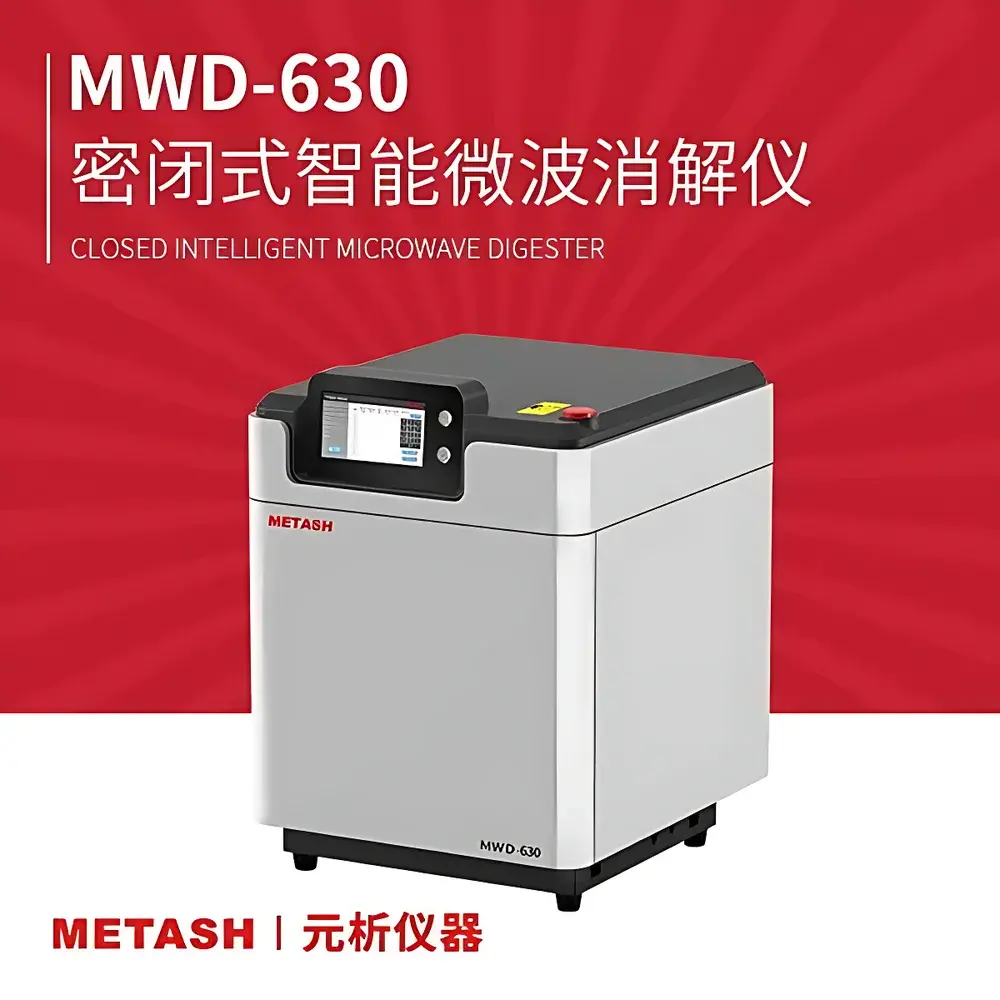
Metash MWD-630 Industrial-Grade Microwave Digestion System
| Brand | Metash Instruments |
|---|---|
| Origin | Shanghai, China |
| Manufacturer Type | Original Equipment Manufacturer (OEM) |
| Product Category | Domestic |
| Model | MWD-630 |
| Price Range | USD 28,000 – 42,500 |
| Cavity Class | Industrial-Grade |
| Batch Capacity | 1–12 samples |
| Microwave Source | Single Magnetron |
| Max Temperature | 300 °C |
| Max Pressure | 15 MPa |
| Temperature Control | Non-contact mid-infrared scanning |
| Pressure Control | Multi-fiber optic non-contact scanning |
| Inner Vessel Volume | 100 mL |
| Vessel Material | TFM fluoropolymer inner vessel |
| Microwave Power Output | 0–1000 W continuous |
| Display | 7-inch capacitive touchscreen |
| Dimensions (W×D×H) | 490 × 560 × 630 mm |
Overview
The Metash MWD-630 is an industrial-grade microwave digestion system engineered for high-throughput, high-reliability sample preparation in regulated analytical laboratories. It operates on the principle of controlled microwave energy absorption by polar molecules—primarily water and acids—in closed-vessel configurations, enabling rapid, uniform thermal decomposition of organic matrices under precisely regulated temperature and pressure conditions. Designed to meet the rigorous demands of environmental testing, food safety analysis, clinical toxicology, and geochemical research, the MWD-630 delivers reproducible digestion performance across diverse sample types—including soils, biological tissues, polymers, and pharmaceutical excipients—while maintaining full compliance with international digestion protocol standards such as EPA Method 3051A/3052, ISO 11466, and ASTM D5511.
Key Features
- True dual-parameter monitoring and control: Simultaneous non-contact mid-infrared scanning for real-time temperature profiling across all vessels, coupled with multi-fiber optic pressure sensing for per-vessel pressure validation—eliminating thermal lag and ensuring reaction fidelity.
- Industrial cavity architecture: Constructed from 316L stainless steel with multi-layer PFA coating to resist corrosion from aggressive acid mixtures (e.g., HNO₃/HF/HCl) and withstand repeated thermal cycling up to 300 °C and 15 MPa.
- Dual-mode safety engineering: Includes redundant interlock systems (mechanical + electronic), explosion-sensing perimeter sensors, emergency power cutoff via front-panel stop button, and self-resetting dual-pressure relief mechanisms that preserve sample integrity during overpressure events.
- Zero-consumable digestion vessel design: Eliminates disposable sealing gaskets, burst disks, or silicone O-rings—reducing long-term operational cost and minimizing cross-contamination risk.
- Optimized microwave delivery: Continuous non-pulsed magnetron output (0–1000 W) with dynamic linear power modulation based on real-time temperature/pressure feedback—enabling fine-grained kinetic control without overshoot or thermal shock.
- Vertically oriented rupture containment: Outer vessels fabricated from PEEK-glass fiber composite using 3D directional anti-explosion geometry—designed to channel overpressure release exclusively along the vertical axis, preserving lateral structural integrity and operator safety.
Sample Compatibility & Compliance
The MWD-630 accommodates a broad spectrum of solid and semi-solid matrices through its modular rotor configuration (8-, 10-, or 12-position options). Each 100 mL TFM inner vessel exhibits exceptional chemical inertness against hydrofluoric acid, aqua regia, and alkaline fusion reagents, while the reinforced PEEK-glass fiber outer vessel has been validated through accelerated lifetime testing: 100+ cycles at 230 °C for 45 minutes each, with zero measurable deformation or loss of pressure seal. The system supports GLP/GMP-aligned workflows via audit-trail-capable method storage, user-access-level permissions, and traceable parameter logging—fully compatible with FDA 21 CFR Part 11 requirements when integrated with compliant LIMS environments.
Software & Data Management
The embedded 7-inch capacitive touchscreen interface provides intuitive, tool-free operation with real-time visualization of temperature, pressure, power, and time profiles for every vessel. Users may create, edit, save, and recall digestion methods directly on-device—no external PC required. All method parameters and run logs are timestamped and stored locally with optional USB export for integration into laboratory data management systems. The controller firmware includes built-in diagnostics for magnetron health, cavity resonance stability, and sensor calibration drift detection—supporting preventive maintenance scheduling aligned with ISO/IEC 17025 quality management frameworks.
Applications
- Environmental laboratories: Heavy metal extraction from sediments, sludges, and airborne particulates per EPA SW-846 Methods.
- Food and agriculture labs: Total arsenic, lead, cadmium, and mercury quantification in plant tissues, dairy products, and fortified cereals.
- Clinical and forensic toxicology: Digestion of hair, bone, and tissue samples prior to ICP-MS or AAS analysis.
- Materials science: Decomposition of catalysts, battery cathode materials, and polymer composites for elemental impurity screening.
- Geochemistry: Rare earth element (REE) dissolution from silicate rocks using HF-based protocols under inert atmosphere compatibility.
FAQ
What safety certifications does the MWD-630 hold?
The system complies with IEC 61000-4 electromagnetic compatibility standards and meets mechanical safety requirements per EN 61010-1. While not CE-marked for EU market placement, it satisfies technical prerequisites for third-party certification under local regulatory pathways.
Can the MWD-630 be integrated with automated sample introduction systems?
Yes—the instrument features RS-232 and optional Ethernet interfaces for bidirectional communication with robotic autosamplers and LIMS platforms.
Is method validation support available for regulatory submissions?
Metash provides comprehensive application notes, digestion recovery data sheets, and SOP templates aligned with USP , ISO 17025, and CLIA guidelines—available upon request to qualified laboratories.
What is the expected service life of the digestion vessels?
TFM inner vessels typically exceed 500 digestion cycles under standard operating conditions; PEEK-glass fiber outer vessels demonstrate >1,000-cycle durability when operated within specified pressure/temperature limits.
Does the system support programmable ramp-hold-cool sequences?
Yes—up to 10-step customizable programs including variable ramp rates, dwell times at target temperature/pressure, and active cooling phases post-digestion.



