
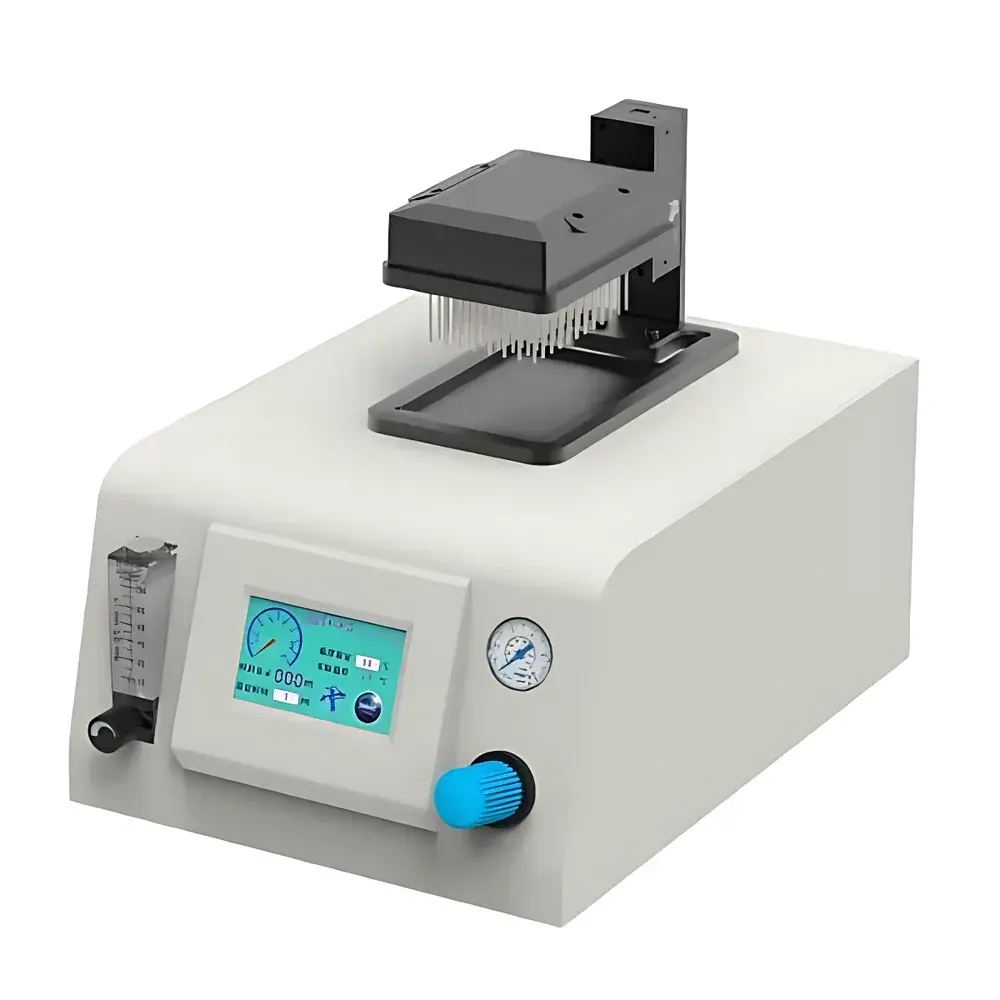
Chengmeng CM-V96 96-Well Plate Nitrogen Evaporator with Dry-Block Heating
| Brand | Chengmeng |
|---|---|
| Origin | Beijing, China |
| Model | CM-V96 |
| Heating Method | Dry-block heating |
| Temperature Range | Ambient +5°C to 80°C |
| Temperature Uniformity | ±0.5°C |
| Sample Capacity | 96-position (compatible with standard 96-well collection plates) |
| Gas Flow Rate | 10–100 L/min |
| Heating Power | 450 W |
| Dimensions (L×W×H) | 360 × 287 × 367 mm |
| Net Weight | ~7 kg |
| Power Supply | 110/220 V, 50–60 Hz |
| Operating Environment | 10–30°C, ≤85% RH |
Overview
The Chengmeng CM-V96 96-Well Plate Nitrogen Evaporator is an engineered solution for high-throughput solvent evaporation and sample concentration in analytical laboratories performing LC-MS, GC-MS, clinical toxicology, pharmaceutical bioanalysis, and environmental residue testing. Unlike traditional water-bath or open-air nitrogen blow-down systems, the CM-V96 employs a precisely controlled dry-block heating architecture combined with regulated nitrogen gas delivery to each well of a 96-well plate. This dual-mode thermal-gas coupling ensures uniform heat transfer across all 96 positions—eliminating edge effects and positional bias commonly observed in non-integrated evaporators. The system operates on the principle of inert gas-assisted surface evaporation: nitrogen flow displaces ambient vapor above the liquid meniscus while conductive heating from the aluminum block maintains consistent sample temperature, thereby accelerating solvent removal without thermal degradation of thermolabile analytes such as peptides, glucuronides, or labile metabolites.
Key Features
- Dry-block heating system with ±0.5°C temperature uniformity across the entire 96-well footprint—validated per ASTM E2251 for thermal stability in laboratory heating devices.
- Independent gas flow control (10–100 L/min) with real-time pressure regulation; integrated flow metering ensures reproducible gas delivery per well under variable backpressure conditions.
- Smart “Energy-Saving Mode”: nitrogen flow initiates only after block temperature reaches the user-defined setpoint—reducing unnecessary gas consumption by up to 40% during ramp-up phases.
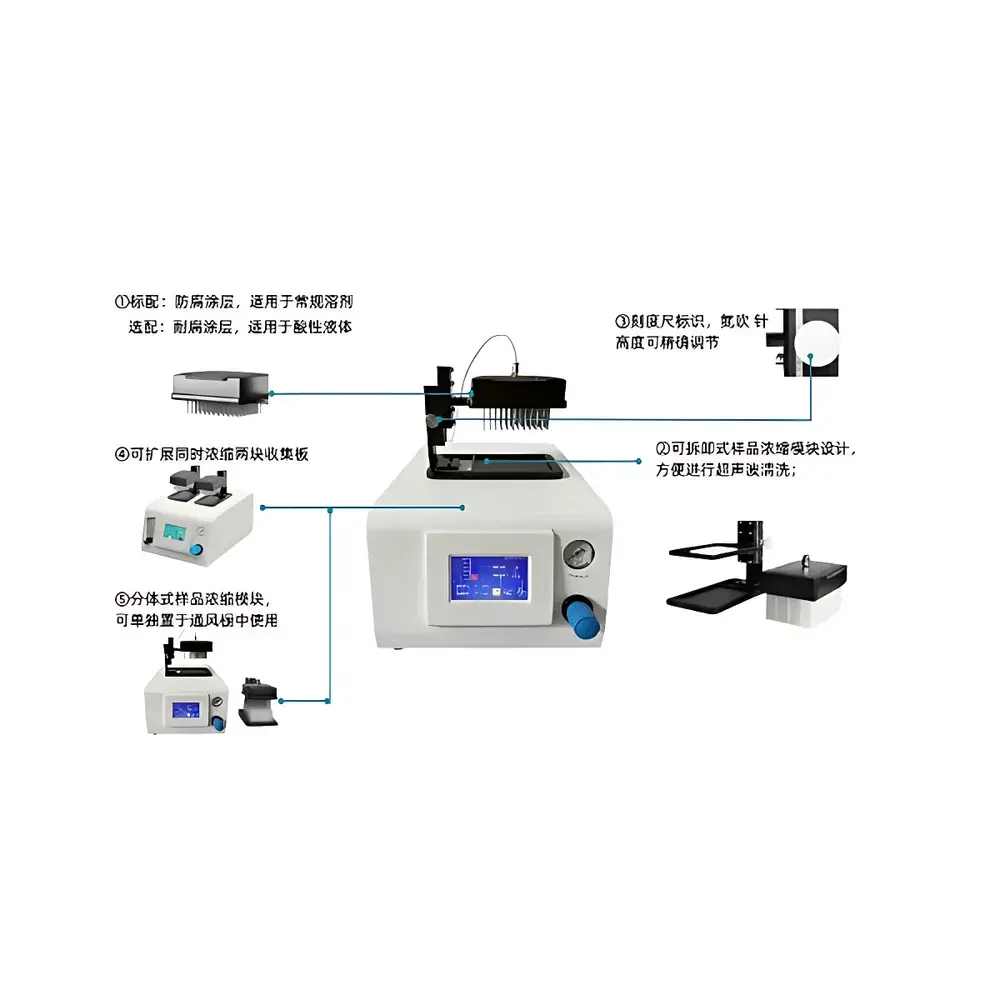
- Modular, detachable sample concentrator head—enabling rapid cleaning of nitrogen needles and full access to gas channels; compatible with autoclaving of non-electronic components.
- Split-module configuration: the heating block and control unit are physically separable, allowing the block to be placed inside fume hoods or cold rooms while retaining full operational integrity.
- Scalable gas distribution architecture—supports optional expansion to 8- or 24-position modules via standardized manifold interfaces, enabling method harmonization across low- and high-throughput workflows.
- 4.3-inch capacitive touchscreen interface with intuitive icon-based navigation, multi-language support (English, Spanish, German), and password-protected parameter locking for GLP-compliant environments.
Sample Compatibility & Compliance
The CM-V96 is designed for seamless integration with widely adopted 96-well formats including deep-well SLE plates (e.g., 2 mL capacity), protein precipitation plates (e.g., 0.5 mL round-bottom), MAS (Multi-Mechanism Adsorption Solid-phase Extraction) microplates, and micro-scale liquid–liquid extraction supports. Its mechanical alignment tolerances comply with ANSI/SBS standards for microplate footprint (127.76 × 85.48 mm), ensuring compatibility with robotic liquid handlers and automated SPE workstations. All wetted gas-path components—including standard corrosion-resistant stainless-steel nozzles and optional acid-resistant PTFE/PFA-lined manifolds—meet USP Class VI biocompatibility requirements. The instrument supports audit-trail-enabled operation when paired with validated third-party LIMS or ELN systems, and its temperature calibration protocol aligns with ISO/IEC 17025 traceability frameworks.
Software & Data Management
While the CM-V96 operates as a standalone benchtop device, its embedded firmware supports RS-232 and USB-B communication protocols for external command triggering and status logging. Time-stamped event records—including start/stop timestamps, temperature profiles, gas-on duration, and error codes—are exportable as CSV files for inclusion in analytical batch records. For regulated environments, the system can be configured to generate electronic signatures compliant with FDA 21 CFR Part 11 when interfaced with validated laboratory informatics platforms. No proprietary software installation is required; configuration and monitoring are fully accessible via the onboard HMI or through simple ASCII command sets.
Applications
- Routine concentration of plasma, urine, and tissue homogenate extracts prior to LC-MS/MS quantification in clinical pharmacokinetic studies.
- Parallel evaporation of 96-well SPE eluates following protein precipitation or solid-phase extraction—reducing turnaround time in regulated bioanalytical labs.
- Pre-concentration of environmental water samples (e.g., pesticides, PAHs) prior to GC-ECD or GC-MS analysis.
- High-throughput preparation of standards and QC samples for assay validation per ICH M10 guidelines.
- Method development for acidic analytes (e.g., organic acids, sulfonamides) using the optional acid-resistant gas module.
FAQ
Is the CM-V96 suitable for use with volatile organic solvents such as acetonitrile or methanol?
Yes—the dry-block design eliminates water contamination risks, and the controlled nitrogen flow rate prevents splashing or foaming during rapid evaporation of low-boiling solvents.
Can the instrument be calibrated internally without external equipment?
It includes a built-in reference sensor for routine verification; however, full NIST-traceable calibration requires external Class A PT100 probes per ISO 17025 procedures.
Does the system support programmable multi-step methods (e.g., ramp-and-hold temperature profiles)?
No—it features single-setpoint temperature control optimized for endpoint concentration rather than kinetic drying profiles; users requiring gradient protocols should consider the CM-V96-PRO variant.
What safety certifications does the CM-V96 carry?
It conforms to IEC 61010-1:2010 for electrical safety in laboratory equipment and carries CE marking under the Low Voltage Directive (2014/35/EU) and EMC Directive (2014/30/EU).
Is remote monitoring possible via Ethernet or Wi-Fi?
Not natively—but optional RS-232-to-Ethernet gateways enable integration into facility-wide monitoring networks using Modbus RTU or custom TCP/IP polling scripts.



