
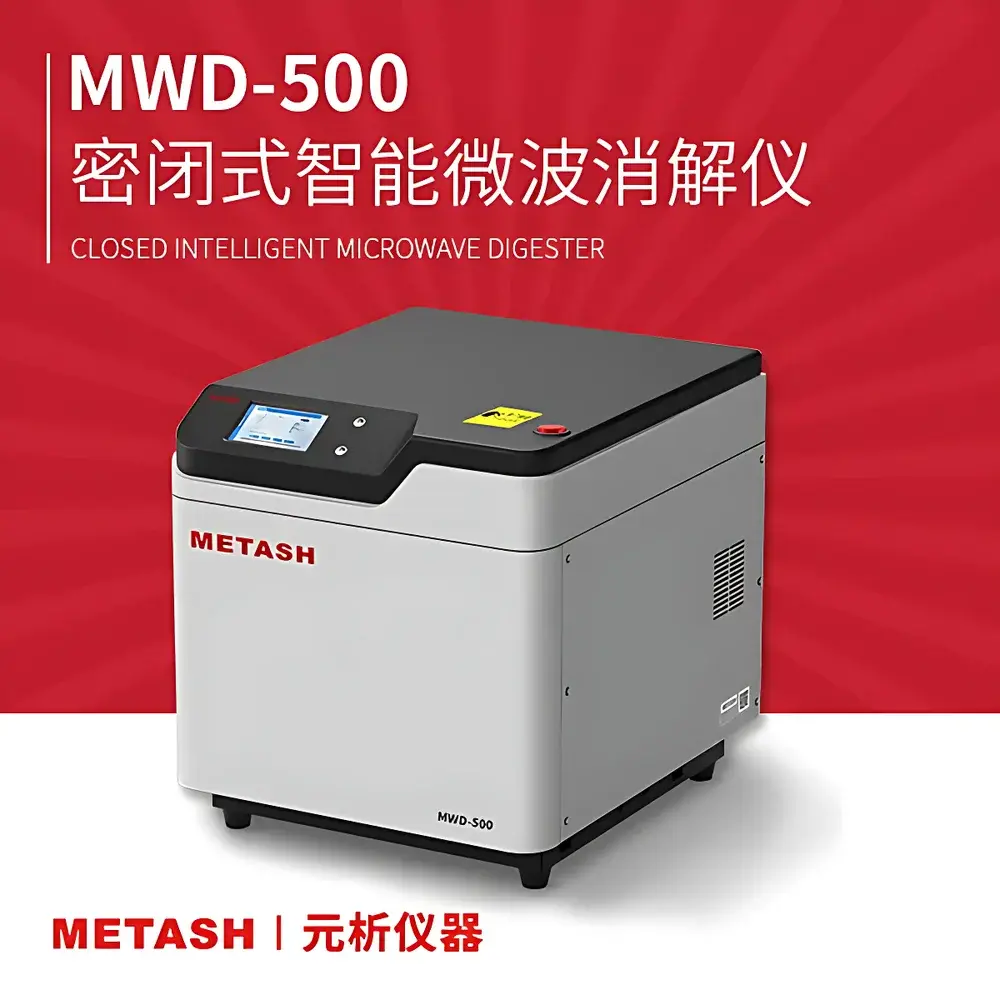
Metash MWD-500 Sealed Intelligent Microwave Digestion System
| Brand | Metash Instruments |
|---|---|
| Origin | Shanghai, China |
| Manufacturer Type | Original Equipment Manufacturer (OEM) |
| Product Category | Domestic |
| Model | MWD-500 |
| Chamber Class | Industrial-Grade |
| Sample Capacity | 6/8/10 positions |
| Microwave Source | Single Magnetron |
| Max Temperature | 250 °C / 300 °C |
| Max Pressure | 6 MPa |
| Temperature Sensing | High-Accuracy Platinum Resistance (Pt100) |
| Pressure Sensing | Non-Contact Multi-Channel Optical Fiber Scanning System |
| Vessel Volume | 100 mL |
| Microwave Power Output | 0–1000 W |
| Control Interface | 7-inch Capacitive Touchscreen |
| Dimensions (W×D×H) | 490 × 560 × 533 mm |
| Vessel Construction | Inner Vessel — TFM (ASTM D4894-compliant fluoroelastomer) |
Overview
The Metash MWD-500 Sealed Intelligent Microwave Digestion System is an industrial-grade, fully automated sample preparation platform engineered for high-throughput, reproducible acid digestion of complex matrices in environmental, geological, pharmaceutical, food, and clinical laboratories. It operates on the principle of controlled microwave energy absorption—where polar molecules (e.g., HNO₃, HCl, HF) rapidly convert electromagnetic energy into thermal energy under sealed conditions—enabling rapid, uniform, and complete decomposition of organic and inorganic samples while minimizing elemental loss or contamination. Unlike pulsed microwave systems, the MWD-500 employs non-pulsed, continuously adjustable magnetron output, ensuring stable power delivery across the full 0–1000 W range. Its compact multimode resonant cavity is dimensionally optimized to generate highly homogeneous electric field distribution, eliminating localized hot/cold spots that compromise digestion consistency and vessel integrity.
Key Features
- Industrial-Grade Resonant Cavity: Precision-engineered stainless steel (AISI 316L) chamber with multi-layer internal PFA coating (per ASTM D1747), delivering exceptional resistance to acid corrosion, mechanical impact, and thermal shock up to 300 °C.
- Dual-Redundant Safety Architecture: Includes interlocked dual-sensor door lock system (EN 61000-6-3 compliant), real-time optical fiber pressure monitoring (IEC 61000-4-3 immunity certified), automatic microwave cutoff upon door opening or overpressure event (>6 MPa), and external emergency stop button meeting IEC 60204-1 requirements.
- Advanced Vessel System: Dual-threaded, self-sealing TFM inner vessels (100 mL capacity, USP Class VI biocompatibility verified) housed in reinforced PEEK/glass-fiber composite outer vessels—mechanically robust, thermally stable, and chemically inert under repeated 6 MPa/300 °C cycles. Features auto-reset dual-pressure relief without consumable burst disks or sealing bowls.
- Intelligent Thermal & Pressure Management: Pt100-based temperature feedback loop with ±0.5 °C accuracy and optical fiber pressure sensors providing real-time, microwave-field-immune readings at up to 10 Hz sampling rate—enabling closed-loop control per ISO/IEC 17025 method validation protocols.
- Rapid Post-Digestion Cooling: Turbulent airflow cooling system reduces cavity temperature from 250 °C to <90 °C within ≤8 minutes, significantly improving lab throughput without compromising vessel longevity.
Sample Compatibility & Compliance
The MWD-500 supports standardized digestion methods including EPA Method 3051A, 3052, and ASTM D5511 for solid waste; ISO 11885 for water analysis; and USP <231> for heavy metal testing in pharmaceuticals. Its vessel configuration accommodates 6-, 8-, or 10-position rotors—enabling flexible batch sizing while maintaining identical thermal kinetics across all positions. All wetted materials comply with FDA 21 CFR §177.1550 (TFM) and ISO 1043-1 (PEEK), and the system architecture supports audit-ready GLP/GMP workflows—including electronic signature-capable method storage, user access levels, and immutable run logs traceable to ISO/IEC 17025 Clause 7.7.
Software & Data Management
The integrated 7-inch capacitive touchscreen runs embedded Linux-based firmware with intuitive graphical workflow navigation. Users define multi-step digestion programs (ramp-hold-cool sequences) with independent setpoints for temperature, pressure, power, and time. Real-time graphs display synchronized temperature/pressure curves with timestamped event markers (e.g., “Pressure Limit Reached”, “Cooling Initiated”). All data—including raw sensor outputs, method parameters, operator ID, and timestamped images of vessel status—are exported in CSV or PDF format. The system supports optional network connectivity for remote monitoring via secure HTTPS API, and logs are structured to satisfy FDA 21 CFR Part 11 requirements for electronic records and signatures when paired with validated identity management infrastructure.
Applications
- Determination of trace metals (As, Cd, Pb, Hg, Cr, Ni) in soils, sediments, and sludge per EPA 6010D and 6020B.
- Preparation of biological tissues (liver, muscle, bone ash) for ICP-MS quantification under CLIA and CAP-accredited protocols.
- Digestion of polymer composites and catalysts prior to XRF or AAS analysis per ISO 18239 and ASTM E1621.
- Food safety testing for toxic elements in infant formula, spices, and seafood per EU Commission Regulation (EU) No 836/2012.
- Pharmaceutical excipient screening per ICH Q5D and USP <232>/<233> elemental impurities guidelines.
FAQ
What safety certifications does the MWD-500 meet?
The system complies with IEC 61010-1 (Safety Requirements for Electrical Equipment), EN 61000-6-3 (EMC Emission Standard), and features CE marking for laboratory instrumentation. Pressure vessel design follows PED 2014/68/EU Annex I essential safety requirements.
Can the MWD-500 be integrated into a LIMS environment?
Yes—via optional RS-232/USB-to-Ethernet gateway, the instrument supports ASTM E1384-compliant data export and can interface with major LIMS platforms using HL7 or custom XML schema.
Is method validation support available?
Metash provides IQ/OQ documentation templates aligned with ISO/IEC 17025 and GMP Annex 15, including temperature uniformity mapping reports, pressure calibration certificates (NIST-traceable), and repeatability studies per ASTM E2655.
What maintenance intervals are recommended?
Optical fiber sensors require annual recalibration; cavity PFA coating inspection every 500 cycles; and magnetron performance verification every 2,000 operating hours—detailed in the included Preventive Maintenance Logbook.
Does the system support custom rotor configurations beyond 6/8/10 positions?
No—rotor compatibility is limited to factory-validated 6-, 8-, and 10-position configurations to ensure consistent field homogeneity and thermal load balancing per IEC 60705.



