
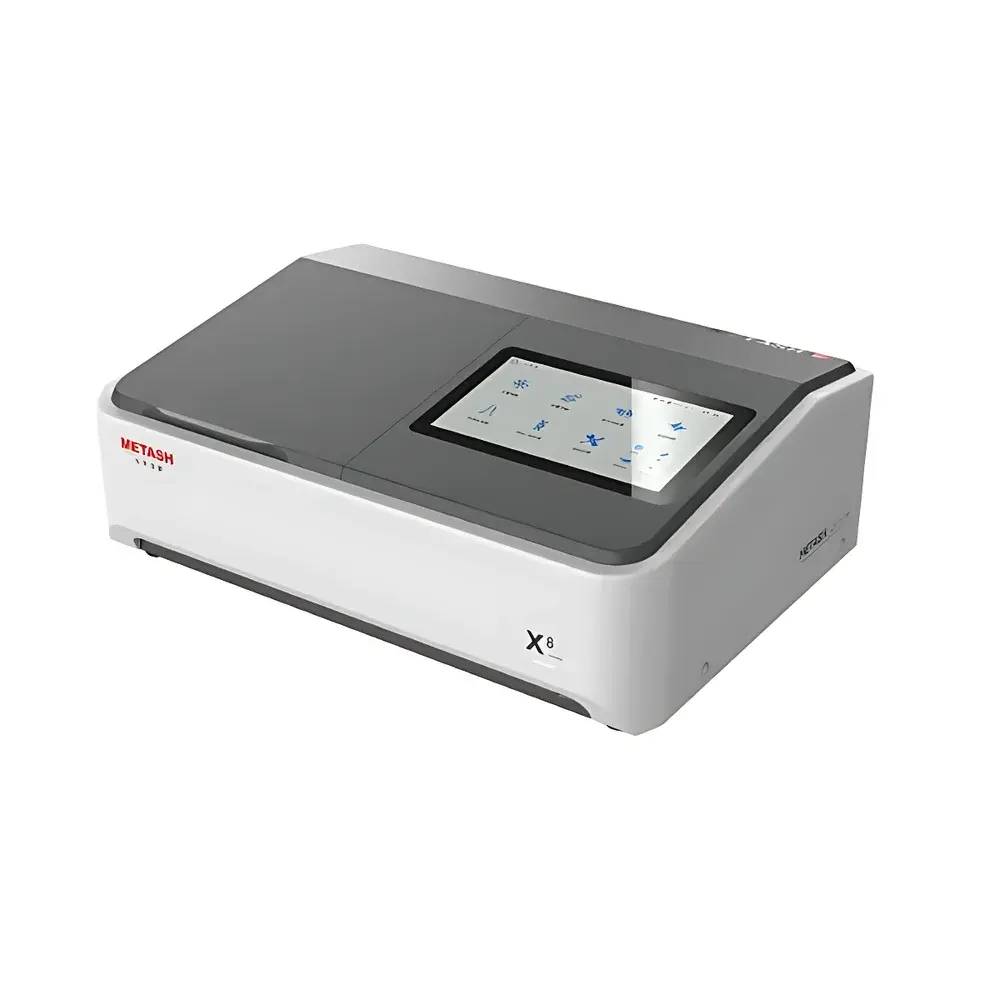
Metash X-8 Dual-Beam UV-Vis Spectrophotometer with 10-inch Capacitive Touchscreen
| Brand | Metash Instruments |
|---|---|
| Origin | Shanghai, China |
| Manufacturer Type | Direct Manufacturer |
| Model | X-8 |
| Wavelength Range | 190–1100 nm |
| Optical System | Dual-beam |
| Detector Type | Silicon Photocell |
| Spectral Bandwidth | 1.8 nm |
| Wavelength Accuracy | ±0.3 nm |
| Wavelength Repeatability | ≤0.15 nm |
| Stray Light | ≤0.03%T |
| Photometric Repeatability | ≤0.1%T |
| Noise Level | ≤0.4%T |
| Display | 10-inch capacitive touchscreen (1024 × 600 resolution, <3 ms response time) |
| Data Interfaces | USB, Bluetooth, Wi-Fi (optional) |
| Lamp Type | Plug-in deuterium and tungsten lamps |
| Base Material | 20 mm machined aluminum optical bench |
| Compliance | GLP/GMP-aligned software architecture, audit-trail-ready user management |
Overview
The Metash X-8 is a dual-beam ultraviolet-visible (UV-Vis) spectrophotometer engineered for high-fidelity absorbance, transmittance, and reflectance measurements across a broad spectral range of 190–1100 nm. Its optical architecture implements a true dual-beam configuration—splitting the light path into reference and sample beams simultaneously—to inherently compensate for source intensity drift, thermal fluctuations in solvent refractive index, and electronic baseline instability. This design ensures superior photometric stability and measurement reproducibility over extended operation cycles. The instrument employs a sealed optical compartment with SiO₂-coated mirrors to minimize environmental degradation of optical surfaces and suppress stray light generation. All critical optical components—including the grating, collimating optics, and beam splitter—are sourced from internationally certified suppliers, contributing to its measured stray light performance of ≤0.03%T at 220 nm and 360 nm—meeting ASTM E387 and ISO 9001–compliant validation thresholds for routine QC laboratories.
Key Features
- Dual-beam optical system with real-time reference compensation for enhanced long-term photometric accuracy and reduced sensitivity to lamp aging or ambient temperature shifts.
- 20 mm thick CNC-machined aluminum optical baseplate, isolating the entire light path from mechanical stress and thermal expansion—improving dimensional stability by >30% compared to conventional steel-frame instruments.
- Plug-in deuterium and tungsten lamps with tool-free replacement: lamp exchange requires only two screws; no post-installation alignment or wavelength recalibration is needed.
- 10-inch multi-touch capacitive display (1024 × 600 resolution) with <3 ms touch latency, adjustable brightness, and industrial-grade firmware for uninterrupted operation in shared lab environments.
- Automated wavelength calibration on power-up, ensuring persistent wavelength accuracy within ±0.3 nm without manual intervention or external calibration standards.
- Optical sealing and SiO₂ anti-corrosion coating on all reflective surfaces to maintain low stray light (<0.03%T) under humid or chemically aggressive laboratory conditions.
Sample Compatibility & Compliance
The X-8 accommodates standard 10 mm pathlength cuvettes as well as specialized accessories including an optional 8-position automatic cell changer, thermostatted autosampler (±0.1 °C control), adjustable micro-volume holder (down to 50 µL), integrating sphere (for diffuse reflectance), and specular reflection module. Its optical design supports both transmission and reflectance modes per ASTM E275, E903, and ISO 13468 standards. Software complies with GLP and GMP documentation requirements: full user role-based access control (administrator, operator, viewer), immutable audit trails for all method changes and data exports, timestamped electronic signatures, and exportable CSV/Excel reports traceable to instrument ID, operator ID, and calibration history. The system satisfies FDA 21 CFR Part 11 readiness when deployed with network authentication and encrypted local storage.
Software & Data Management
The embedded operating system provides unified access to photometric, quantitative, kinetic, spectral scanning, multi-wavelength, and biomolecular (DNA/protein A260/A280) analysis modes—all accessible from a single navigable interface. Data can be saved internally or exported via USB mass storage with customizable filenames and folder structures. Optional Wi-Fi and Bluetooth modules enable secure wireless transfer to LIMS or ELN platforms without physical cabling. Print output supports generic PCL/PostScript drivers for direct A4 reporting on inkjet or laser printers. All raw spectra and processed results are stored with metadata tags—including date/time stamp, lamp hours, slit width, scan speed, and detector gain settings—ensuring full analytical traceability required for ISO/IEC 17025 accreditation.
Applications
The X-8 serves diverse analytical workflows across pharmaceutical QA/QC (e.g., assay validation per USP ), environmental testing (nitrate/nitrite, COD, phosphate per EPA methods), food and beverage quality control (colorimetric assays, antioxidant capacity), academic research (ligand-binding kinetics, enzyme kinetics, nanoparticle characterization), and materials science (thin-film transmittance, semiconductor bandgap estimation). Its 1.8 nm spectral bandwidth and ≤0.15 nm wavelength repeatability support high-resolution identification of overlapping peaks in complex mixtures. The dual-beam architecture proves especially valuable in time-resolved studies where baseline drift would otherwise compromise kinetic modeling fidelity.
FAQ
Does the X-8 require external wavelength calibration standards?
No—the instrument performs automatic wavelength verification and correction at startup using internal reference lines, eliminating routine use of holmium oxide or didymium filters.
Can the X-8 operate without a PC connection?
Yes—it functions fully as a standalone unit with all measurement modes, data storage, and report generation handled locally via the integrated touchscreen interface.
Is the software compliant with 21 CFR Part 11 for regulated environments?
The system supports Part 11 compliance when configured with network authentication, electronic signature enforcement, and encrypted audit-log archiving—subject to site-specific validation protocols.
What is the expected lifetime of the deuterium and tungsten lamps?
Rated lamp life exceeds 2,000 hours for deuterium and 5,000 hours for tungsten sources under typical usage conditions; plug-in design enables field replacement in under 90 seconds.
How does the aluminum optical base improve measurement stability?
The 20 mm machined aluminum bench exhibits lower thermal expansion coefficient than steel and higher damping capacity than cast iron, minimizing wavelength and photometric drift caused by ambient temperature gradients or floor vibrations.





