
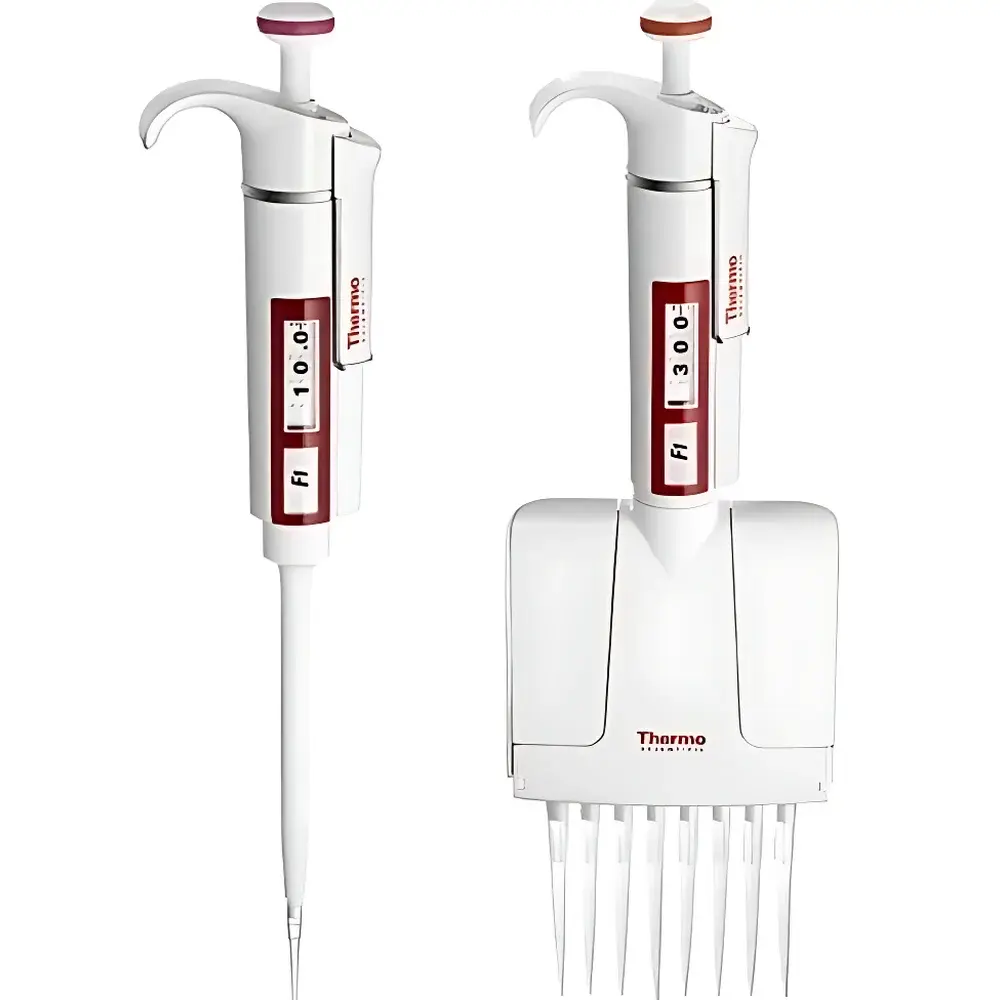
F1 Manual Pipette
| Origin | Beijing |
|---|---|
| Manufacturer Type | Distributor |
| Origin Category | Domestic |
| Model | Various |
| Price | ¥1200 |
| Instrument Type | Single-Channel Pipette |
| Automation Level | Manual |
| Channel Count | Single- and Multi-Channel |
| Volume Range | Various |
| Maximum Capacity | 10 mL |
| Accuracy | ±1% (typical, per ISO 8655) |
Overview
The F1 Manual Pipette is a precision-engineered liquid handling instrument designed for routine and high-sensitivity applications in life science laboratories, clinical diagnostics, pharmaceutical QC, and academic research. Built on the principles of air displacement volumetric delivery, the F1 operates via manual plunger actuation to aspirate and dispense defined volumes of aqueous and low-viscosity liquids with high reproducibility. Its mechanical architecture complies with the fundamental metrological requirements outlined in ISO 8655–1 (Pipettes) and ISO 8655–6 (Test methods), ensuring traceable performance across its full volume range—from 0.2 µL to 10 mL. The device is calibrated at multiple points during manufacturing and supports user-adjustable calibration via internal adjustment screws, facilitating compliance with GLP and GMP documentation workflows.
Key Features
- Antimicrobial Silver-Coated Surface: Critical contact surfaces—including the thumb rest, plunger button, and grip zone—are coated with an ion-releasing silver layer certified to ISO 22196, inhibiting >99.9% of common bacteria (e.g., E. coli, S. aureus), fungi, yeasts, and molds over 24-hour exposure.
- Set-and-Lock Volume Mechanism: A two-stage volume adjustment system allows intuitive volume setting without accidental change: pull the plunger button upward to unlock, rotate the volume dial freely, then press down firmly to engage mechanical locking—preventing drift during benchtop transport or multi-step protocols.
- Advanced Volume Gearing (AVG) System: An isolated gear train decouples volume adjustment from the piston shaft assembly, minimizing torque transmission and maintaining consistent aspiration/dispense force across all volumes—critical for ergonomics and long-term repeatability.
- 120° Adjustable Thumb Rest: Ergonomically contoured and rotatable through three fixed positions (0°, 60°, 120°), the wide thumb rest reduces hand fatigue during high-throughput pipetting and accommodates varied hand sizes and pipetting angles.
- Precision Piston Design with Enhanced Blow-Out: Patented piston geometry ensures complete ejection of residual liquid—even at low volumes—by optimizing seal compression and air cushion dynamics during the second-stop blow-out phase.
- Tool-Free Serviceability: The lower body (tip ejector and tip cone assembly) detaches without tools, enabling rapid cleaning, O-ring replacement, or contamination remediation between users or experiments.
Sample Compatibility & Compliance
The F1 Pipette is validated for use with standard conical polypropylene tips meeting ISO 8655–7 specifications—including Finntip® series (Flex10, Flex200, Flex300, Flex1000, 5 mL, and 10 mL variants). It maintains accuracy with water-like liquids (density ~1 g/mL, viscosity ≤10 cP) at ambient temperature (15–30°C) and relative humidity 40–70%. Performance validation reports include gravimetric testing per ISO 8655–6 Annex B. The instrument meets CE marking requirements under Directive 2014/30/EU (EMC) and 2014/35/EU (LVD), and its materials comply with RoHS 2011/65/EU and REACH SVHC criteria. Documentation packages support audit readiness for ISO/IEC 17025, CLIA, and FDA 21 CFR Part 11–aligned environments when paired with electronic logbooks.
Software & Data Management
As a fully manual instrument, the F1 Pipette does not incorporate onboard electronics or firmware. However, its design integrates seamlessly into digital lab ecosystems: volume settings are clearly displayed via dual-scale rotary dials (primary scale + fine-tuning vernier), and each unit includes a unique serialized ID label compatible with LIMS barcode scanning. Optional calibration certificates (NIST-traceable, issued per ISO/IEC 17025-accredited labs) provide PDF and CSV export for integration into electronic quality records. Maintenance logs—including date of last service, technician ID, and calibration deviation data—can be archived alongside instrument history in compliant ELN platforms.
Applications
- Cell culture passaging and reagent dilution in biosafety cabinets
- Preparation of qPCR master mixes and NGS library normalization
- Standard curve generation for ELISA and immunoassays
- QC sampling in pharmaceutical formulation and stability studies
- Teaching laboratory exercises in analytical chemistry and molecular biology
- Environmental water testing where cross-contamination control is critical
FAQ
Is the F1 Pipette autoclavable?
No—the F1 is not autoclavable. Only the tip cone and ejector components may be sterilized via dry heat (121°C, 1 hour) or 70% ethanol wipe-down. Full-unit autoclaving will damage internal seals and calibration integrity.
What calibration standards are supported?
The F1 conforms to ISO 8655–6 gravimetric test procedures using Class A volumetric flasks and certified reference weights (±0.05 mg resolution). Calibration intervals should follow institutional SOPs—typically every 3–6 months for daily use or after impact events.
Can I use non-Finntip® tips?
While third-party tips may physically fit, only Finntip® tips are validated for optimal sealing, tip ejection force, and volume accuracy across the entire F1 range. Deviations exceeding ±2% may occur with non-certified consumables.
Does the antimicrobial coating require reapplication?
No—the silver coating is sintered onto the polymer substrate during manufacturing and remains effective for the instrument’s operational lifetime (≥5 years under normal lab conditions), as verified by accelerated aging tests per ISO 22196.
How is traceability maintained during multi-user deployment?
Each F1 unit carries a permanent laser-engraved serial number and optional color-coded ID tags (included in packaging). These enable assignment to individual users or workstations within a shared lab environment, supporting accountability in GLP audits.



