
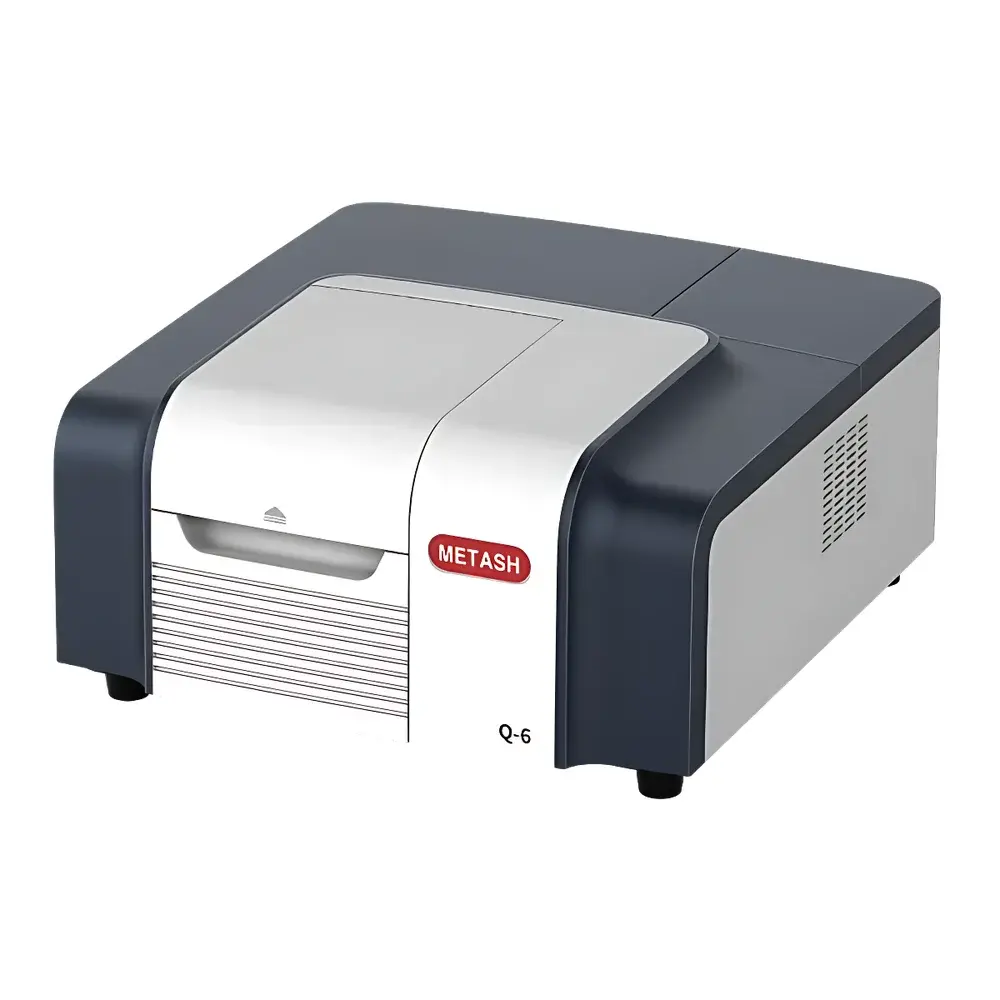
Metash Q-6S Dual-Beam Ultraviolet-Visible Spectrophotometer
| Brand | Metash Instruments |
|---|---|
| Origin | Shanghai, China |
| Manufacturer Type | Direct Manufacturer |
| Model | Q-6S |
| Optical System | Dual-Beam |
| Detector | Photomultiplier Tube (PMT) |
| Wavelength Range | 190–900 nm |
| Wavelength Accuracy | ±0.3 nm |
| Wavelength Repeatability | ≤0.1 nm |
| Spectral Bandwidth | 0.1–5.0 nm (continuously adjustable in 0.1 nm increments) |
| Stray Light | ≤0.005% T |
| Photometric Accuracy | ±0.3% T |
| Photometric Repeatability | ≤0.1% T |
| Baseline Drift | ≤0.0001 Abs/h |
Overview
The Metash Q-6S Dual-Beam Ultraviolet-Visible Spectrophotometer is engineered for high-precision quantitative and qualitative analysis across research laboratories, quality control environments, and regulatory-compliant manufacturing facilities. Utilizing a Czerny-Turner monochromator-based dual-beam optical architecture, the Q-6S continuously compares sample and reference beam intensities in real time—effectively compensating for source fluctuations, detector drift, and environmental variability. This design ensures superior photometric stability and long-term measurement reproducibility. The instrument operates across a broad spectral range of 190–900 nm, covering deep UV through near-infrared, enabling applications from nucleic acid quantification to pigment characterization and pharmaceutical assay development. Its core optical path integrates high-efficiency holographic gratings, precision-aligned quartz optics, and thermally stabilized optical mounts to maintain alignment integrity under extended operation.
Key Features
- Dual-beam Czerny-Turner optical system with real-time beam ratioing for enhanced baseline stability and reduced instrumental drift
- Continuously variable spectral bandwidth from 0.1 to 5.0 nm in 0.1 nm increments—optimized for resolution-versus-sensitivity trade-off in complex matrices
- High-gain, low-noise imported photomultiplier tube (PMT) detector with wide dynamic response range (10–4–3.0 Abs), ideal for low-transmittance or fluorescence-excited measurements
- Integrated mercury lamp for automated wavelength calibration; supports periodic self-check and traceable recalibration without external standards
- Modular lamp housing with plug-in deuterium and tungsten-halogen sources—enabling rapid, tool-free replacement with minimal optical realignment
- Precision-molded ABS enclosure with EMI-shielded internal chassis, supporting stable operation in shared lab environments with electromagnetic interference
- Compliance-ready firmware architecture supporting audit trails, electronic signatures, and user-level access control per FDA 21 CFR Part 11 requirements
Sample Compatibility & Compliance
The Q-6S accommodates standard 10 mm cuvettes (quartz, glass, or plastic), as well as specialized configurations via optional accessories—including integrating spheres (for diffuse reflectance/transmission), temperature-controlled cell holders (±0.1 °C stability), variable-pathlength cells (0.1–100 mm), and solid-sample reflectance stages with adjustable incident angles. All optical components meet ISO 9001-certified manufacturing protocols. The instrument’s photometric accuracy (±0.3% T) and stray light performance (≤0.005% T at 220 nm) satisfy ASTM E275, ISO 6223, and USP specifications for spectrophotometric validation. Routine performance qualification (PQ) can be executed using NIST-traceable holmium oxide and potassium dichromate reference materials.
Software & Data Management
Metash UV-Pro software provides a validated, GLP/GMP-compliant platform for method development, data acquisition, and regulatory reporting. It supports multi-user role assignment (Administrator, Analyst, Reviewer), encrypted local database storage, and full audit trail logging—including parameter changes, calibration events, and result modifications. Data export conforms to ASTM E1382 and LIMS-compatible CSV/Excel formats. Advanced processing modules include derivative spectroscopy, peak deconvolution, multi-component linear regression, kinetic curve fitting (zero-, first-, and second-order models), and DNA/protein concentration calculation using built-in extinction coefficients (e.g., A260/A280 ratio analysis). Software validation documentation (IQ/OQ/PQ templates) is provided for laboratory compliance workflows.
Applications
- Pharmaceutical QC: Assay of active pharmaceutical ingredients (APIs), dissolution testing, excipient compatibility screening
- Biochemistry: Quantification of nucleic acids (dsDNA, ssDNA, RNA) and proteins (Bradford, Lowry, BCA), enzyme kinetics (NADH/NADPH monitoring)
- Environmental analysis: Nitrate/nitrite, phosphate, heavy metal chelates (e.g., Fe-phenanthroline), COD determination
- Materials science: Bandgap estimation of semiconductors, thin-film transmittance/absorbance profiling, nanoparticle surface plasmon resonance
- Food & beverage: Colorimetric analysis (CIE L*a*b*), antioxidant capacity (DPPH assay), adulterant detection
- Academic research: Ligand-binding studies, pH-dependent spectral shifts, photochemical reaction monitoring
FAQ
Does the Q-6S support remote operation and network integration?
Yes—the instrument features Ethernet and USB 2.0 interfaces, enabling seamless integration into LAN-based lab networks and compatibility with third-party LIMS or ELN systems via TCP/IP command protocol.
Is wavelength calibration traceable to national standards?
Yes—internal Hg lamp emission lines (253.7 nm, 365.0 nm, 404.7 nm, 435.8 nm, 546.1 nm) provide NIST-traceable reference points; full calibration reports include uncertainty budgets aligned with ISO/IEC 17025 guidelines.
What maintenance is required for optimal long-term performance?
Routine maintenance includes quarterly lamp intensity verification, biannual grating alignment check using built-in diagnostic routines, and annual PMT gain calibration—documented in the included Preventive Maintenance Logbook.
Can the Q-6S perform kinetic measurements over extended durations?
Yes—baseline drift is specified at ≤0.0001 Abs/h at 500 nm, enabling reliable time-course experiments up to 8 hours without active re-zeroing; optional Peltier-controlled cuvette holders further suppress thermal artifacts.
Are software updates and firmware patches provided post-purchase?
Metash offers free minor version updates and critical security patches for five years following instrument commissioning; major version upgrades are available under an optional Annual Support Agreement.





