
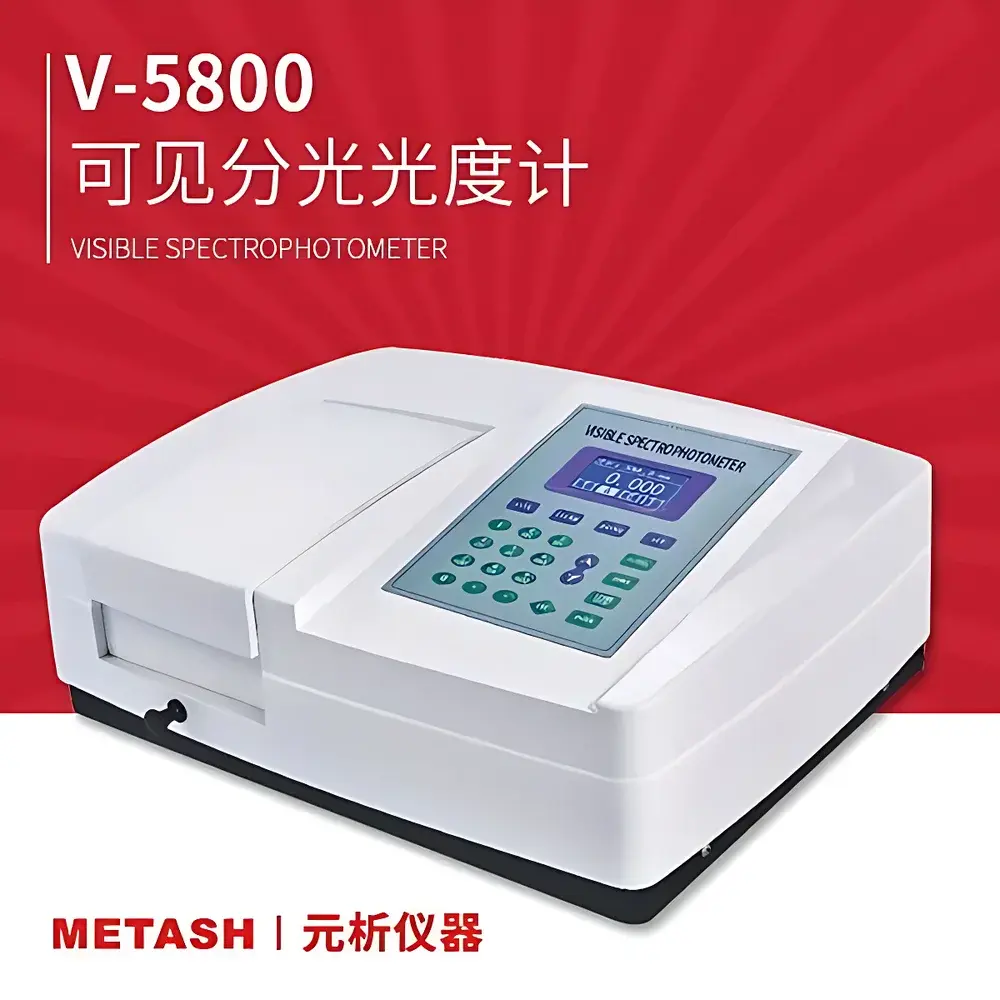
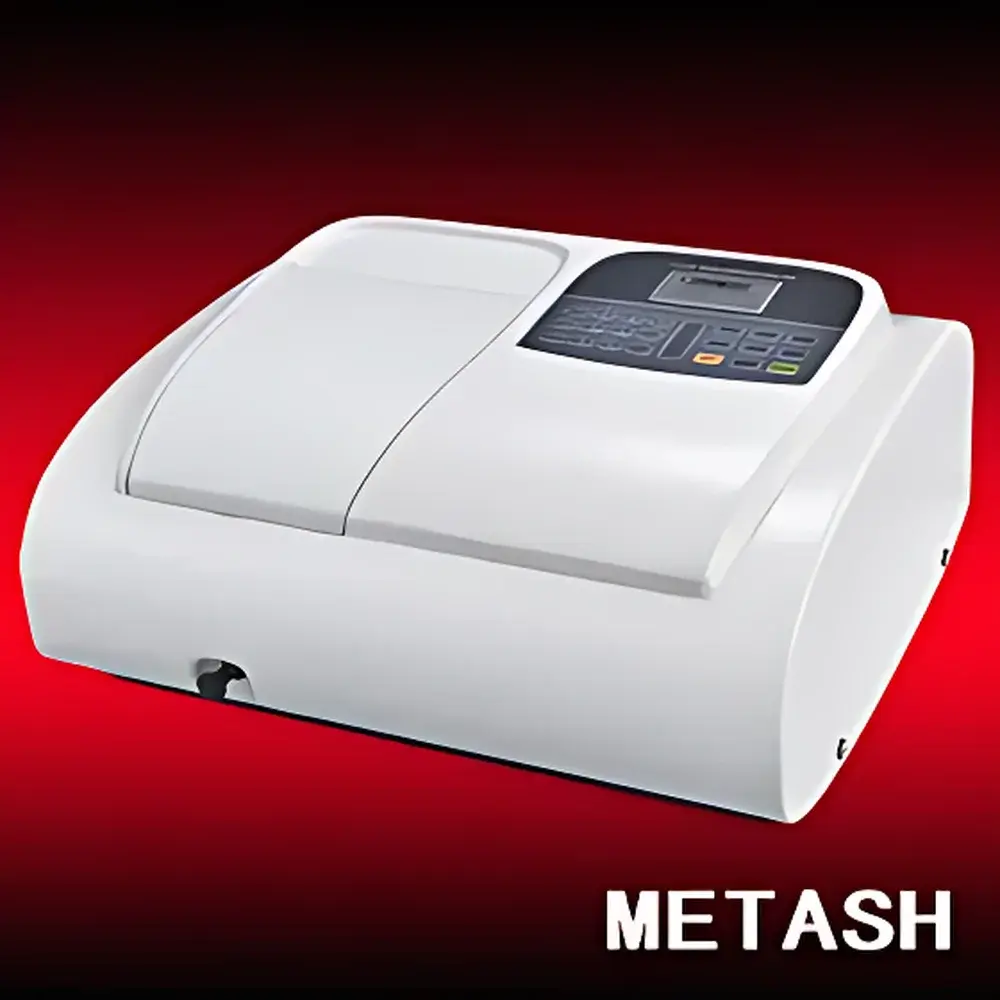
Metash V-5800(PC) Dual-Beam UV-Vis Spectrophotometer
| Brand | Metash Instruments |
|---|---|
| Origin | Shanghai, China |
| Manufacturer | Yes |
| Type | Domestic |
| Model | V-5800 |
| Instrument Architecture | Dual-beam |
| Detector Type | Silicon Photocell |
| Wavelength Range | 320–1100 nm |
| Automation Level | Automatic Wavelength Scanning |
| Spectral Bandwidth | 2 nm |
| Wavelength Accuracy | ±0.5 nm |
| Wavelength Repeatability | ≤0.2 nm |
| Stray Light | ≤0.05% T |
Overview
The Metash V-5800(PC) is a dual-beam ultraviolet-visible (UV-Vis) spectrophotometer engineered for precision absorbance and transmittance measurements across the 320–1100 nm spectral range. It operates on the principle of comparative photometry: simultaneous splitting of the light beam into sample and reference paths enables real-time compensation for source intensity drift, lamp aging, and electronic fluctuations—thereby delivering high photometric stability and measurement reproducibility essential for quantitative analysis in regulated environments. Designed for routine QC/QA laboratories, academic research, and pharmaceutical development labs, the instrument integrates robust optical mechanics with traceable calibration protocols and compliance-ready software architecture.
Key Features
- Dual-beam ratio-monitoring optical system with real-time dynamic compensation for source instability, ensuring consistent baseline integrity over extended measurement sessions.
- Fixed 2 nm spectral bandwidth optimized for resolution–sensitivity balance in routine applications including concentration determination, purity assessment, and kinetic monitoring.
- Self-calibrating wavelength mechanism with automatic initialization, error detection, and deviation correction—eliminating manual alignment and reducing operator dependency.
- Suspended optical assembly mounted on an 8 mm-thick aerospace-grade aluminum optical baseplate, isolating the photometric path from mechanical vibration and thermal-induced chassis deformation.
- 128 × 64 dot-matrix LCD display supporting multi-parameter visualization per screen—enabling concurrent viewing of absorbance, transmittance, wavelength, and scan progress without menu navigation overhead.
- Onboard data management: stores up to 200 measurement datasets and 200 user-defined calibration curves, each retrievable by numeric ID; includes power-failure recovery to preserve unsaved work.
Sample Compatibility & Compliance
The V-5800(PC) accommodates standard 10 mm rectangular cuvettes and supports optional accessories—including automated 8-cell rotating sample changers, micro-volume cuvette holders (down to 50 µL), Peltier-controlled temperature-regulated cells, and diffuse reflectance attachments—for solid, liquid, and semi-solid sample formats. Its optical design conforms to ISO 9001 manufacturing standards and meets core performance criteria outlined in ASTM E275 (Standard Practices for Describing and Measuring Performance of UV-Vis Spectrophotometers) and USP (Spectrophotometry and Light-Scattering). When paired with the optional PC software, the system supports audit-trail-enabled operation compliant with FDA 21 CFR Part 11 requirements, including role-based user authentication, electronic signature capture, and immutable log retention for GLP/GMP audits.
Software & Data Management
The optional Metash SpectraScan PC software provides full instrument control via USB interface and implements a modular workflow architecture: photometric mode (single/multi-wavelength), quantitative analysis (linear/nonlinear calibration curve fitting), kinetics (time-resolved absorbance tracking), spectral scanning (full-range or user-defined windows), and biomolecular analysis (DNA/RNA/protein quantification using preloaded extinction coefficients). All data files are saved in vendor-neutral CSV and XML formats, with embedded metadata (timestamp, operator ID, instrument serial number, calibration status). The software enforces structured user roles (Admin, Analyst, Viewer), maintains tamper-proof activity logs, and generates PDF reports containing raw spectra, processed curves, statistical summaries, and digital signatures—fully aligned with ALCOA+ (Attributable, Legible, Contemporaneous, Original, Accurate, Complete, Consistent, Enduring, Available) data integrity principles.
Applications
- Quantitative analysis of pharmaceutical actives and excipients per USP/EP monographs.
- Enzyme kinetics and ligand-binding studies requiring high temporal stability and low noise floor.
- Water quality testing (e.g., nitrate, phosphate, COD estimation) in environmental labs.
- Quality control of dyes, pigments, and coatings in chemical manufacturing.
- Educational use in undergraduate chemistry and biochemistry laboratories for Beer–Lambert law validation and spectral interpretation training.
- Stability-indicating assays for forced degradation studies under ICH Q1 guidelines.
FAQ
Is the V-5800(PC) suitable for GMP-regulated environments?
Yes—when used with the validated SpectraScan software and configured with appropriate access controls and audit trail settings, it satisfies key elements of Annex 11 and 21 CFR Part 11 for electronic records and signatures.
What is the typical warm-up time required before achieving photometric stability?
Less than 15 minutes after power-on, verified by internal diagnostic routines that monitor detector signal variance and lamp output consistency.
Can the instrument perform spectral scans below 320 nm?
No—the lower limit is fixed at 320 nm due to the spectral cutoff of the tungsten-halogen lamp and optical component transmission characteristics; UV-range extension requires deuterium-lamp-equipped models.
How is wavelength accuracy maintained over long-term operation?
Through factory-installed holmium oxide and didymium glass reference filters, supported by automated self-check routines triggered at startup and configurable periodic intervals.
Does the system support third-party LIMS integration?
Yes—via ASCII-based command protocol over USB or RS-232; raw data export formats (CSV/XML) enable direct ingestion into common laboratory information management systems without proprietary middleware.





