
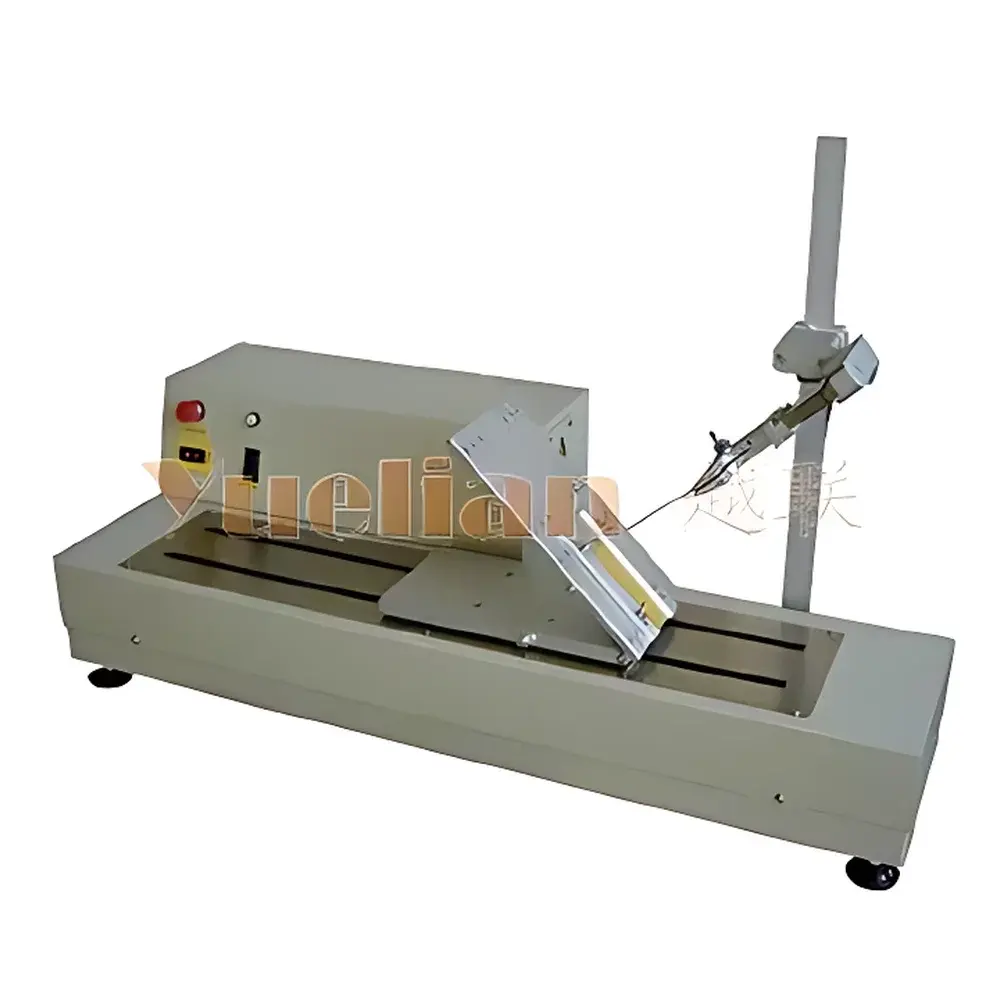
AR-1000 Adhesion Tester & Release Force Tester
| Origin | Guangdong, China |
|---|---|
| Manufacturer Type | Distributor |
| Origin Category | Domestic |
| Model | AR-1000 |
| Price | ¥420 |
| Instrument Type | Electronic Universal Testing Machine |
| Load Capacity Options | 5N, 10N, 20N, 50N, 100N, 200N, 500N |
| Force Resolution | 1/250,000 |
| Force Accuracy | ≤ ±0.5% |
| Stroke Resolution | 0.005 mm |
| Data Acquisition Rate | ~200 Hz |
| Control Mode | Full PC-based operation |
| Maximum Travel | 600 mm |
| Test Width | 100 mm |
| Speed Range | 0.1–500 mm/min (adjustable) |
| Force Units | kgf, N, lbf, g, ton, MPa |
| Stop Modes | Overload shutdown, emergency stop, automatic stop on specimen failure, upper/lower limit-triggered stop, auto-return function |
| Dimensions (W×D×H) | 950 × 300 × 300 mm |
| Drive System | AC servo motor with precision ball screw and linear guide rails |
| Power Consumption | 90 W |
| Weight | ~35 kg |
| Electrical Supply | 220 V, 50/60 Hz, 5 A |
| Standard Accessories | One set of fixtures, test software, USB interface cable |
Overview
The AR-1000 Adhesion Tester & Release Force Tester is an electronic universal testing machine engineered for high-reproducibility quantitative measurement of interfacial adhesion strength and release characteristics in pressure-sensitive adhesives (PSAs), tapes, labels, laminates, and coated films. It operates on the fundamental principle of controlled tensile separation—applying precisely regulated uniaxial force to peel a bonded specimen at standardized angles (90° or 180°) per ASTM D3330, ASTM D903, ISO 8510-2, and PSTC-101. Unlike static load testers, the AR-1000 employs closed-loop servo control to maintain constant crosshead velocity during detachment, ensuring compliance with dynamic peel test protocols required for QC laboratories and R&D validation under GLP and ISO/IEC 17025 environments.
Key Features
- Modular angle-adjustable specimen mounting stage supporting both 90° and 180° peel configurations, with independent height and angular alignment of the load cell to minimize parasitic bending moments.
- AC servo-driven actuation system coupled with preloaded ball screws and high-rigidity linear guideways, delivering stable motion control across the full speed range (0.1–500 mm/min) with minimal backlash and thermal drift.
- High-fidelity force transduction with 1/250,000 internal resolution and ≤ ±0.5% full-scale accuracy, traceable to national metrological standards; supports seven selectable force units (N, kgf, lbf, g, ton, MPa) without recalibration.
- Real-time data acquisition at ~200 Hz, enabling accurate capture of transient peak forces, plateau regions, and post-failure relaxation behavior critical for analyzing cohesive vs. adhesive failure modes.
- Integrated safety architecture including overload cutoff, programmable upper/lower force limits, emergency stop, and automatic halt upon specimen rupture—fully compliant with EN ISO 13850 and IEC 61508 functional safety requirements.
Sample Compatibility & Compliance
The AR-1000 accommodates specimens up to 100 mm wide and 600 mm travel length, making it suitable for standard tape strips (e.g., 25 mm × 150 mm), flexible packaging laminates, medical transdermal patches, and die-cut electronics bonding films. Its mechanical design conforms to ASTM E4 and ISO 7500-1 for verification of force-measuring systems. Test methods executed on this platform align with regulatory expectations for documentation integrity: all test parameters, raw force-displacement data, and operator metadata are timestamped and stored in encrypted MS-ACCESS databases, supporting audit readiness for FDA 21 CFR Part 11-compliant environments when paired with validated software configuration.
Software & Data Management
The dedicated PC-based control and analysis suite provides full instrument orchestration—including real-time graphing of force vs. displacement curves, automated calculation of average peel force, maximum peel load, and standard deviation across multiple cycles. It supports multi-sensor synchronization (e.g., optional environmental chamber feedback), customizable report templates (PDF/Excel export), and statistical process control (SPC) charting. The software architecture implements role-based user access control, electronic signatures, and immutable audit trails for all test modifications—essential for GMP-aligned quality systems. Raw binary data files are retained alongside processed results, enabling third-party reanalysis using MATLAB or Python-based toolchains.
Applications
- Quantitative evaluation of silicone release liner peel resistance against acrylic PSAs in label manufacturing.
- Comparative assessment of hot-melt adhesive bond durability under accelerated aging (pre/post-thermal cycling).
- Quality gate testing of automotive interior trim bonding tapes per OEM specifications (e.g., Ford WSS-M99P1111-A, GMW14872).
- Research into peel energy dissipation mechanisms in bioadhesive hydrogels using variable-rate ramp tests.
- Validation of clean-release performance in pharmaceutical blister foil laminates per USP and Ph. Eur. 5.1.3 guidelines.
FAQ
What peel angles does the AR-1000 support, and how is angular alignment verified?
The system supports both 90° and 180° peel configurations via a calibrated, lockable specimen stage. Angular fidelity is maintained through machined reference surfaces and verified annually using optical inclinometry per ISO 9276-3.
Is the software compatible with Windows 10/11 and does it support network deployment?
Yes—the application runs natively on 64-bit Windows 10/11 and supports centralized server-based license management for multi-station labs.
Can the AR-1000 be integrated into an existing LIMS or MES environment?
It exports structured CSV and XML test result files with embedded metadata (operator ID, timestamp, calibration ID), enabling seamless ingestion via REST API or OPC UA middleware.
What maintenance intervals are recommended for long-term metrological stability?
Annual force calibration with NIST-traceable deadweight standards and biannual mechanical inspection of ball screw preload and guide rail lubrication are advised per ISO 17025 Clause 6.4.2.
Does the system meet CE marking requirements for sale in the European Economic Area?
Yes—it carries CE marking under the Machinery Directive 2006/42/EC and EMC Directive 2014/30/EU, with technical documentation available upon request.



