
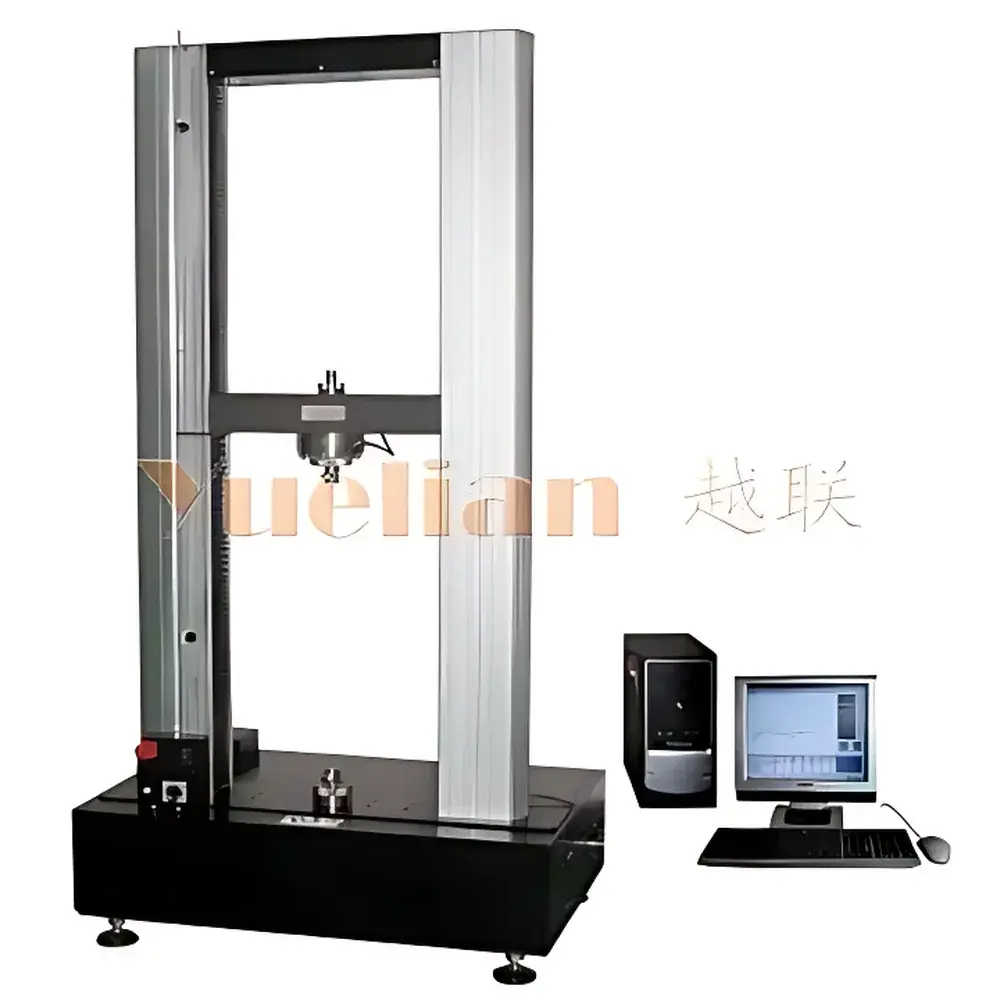
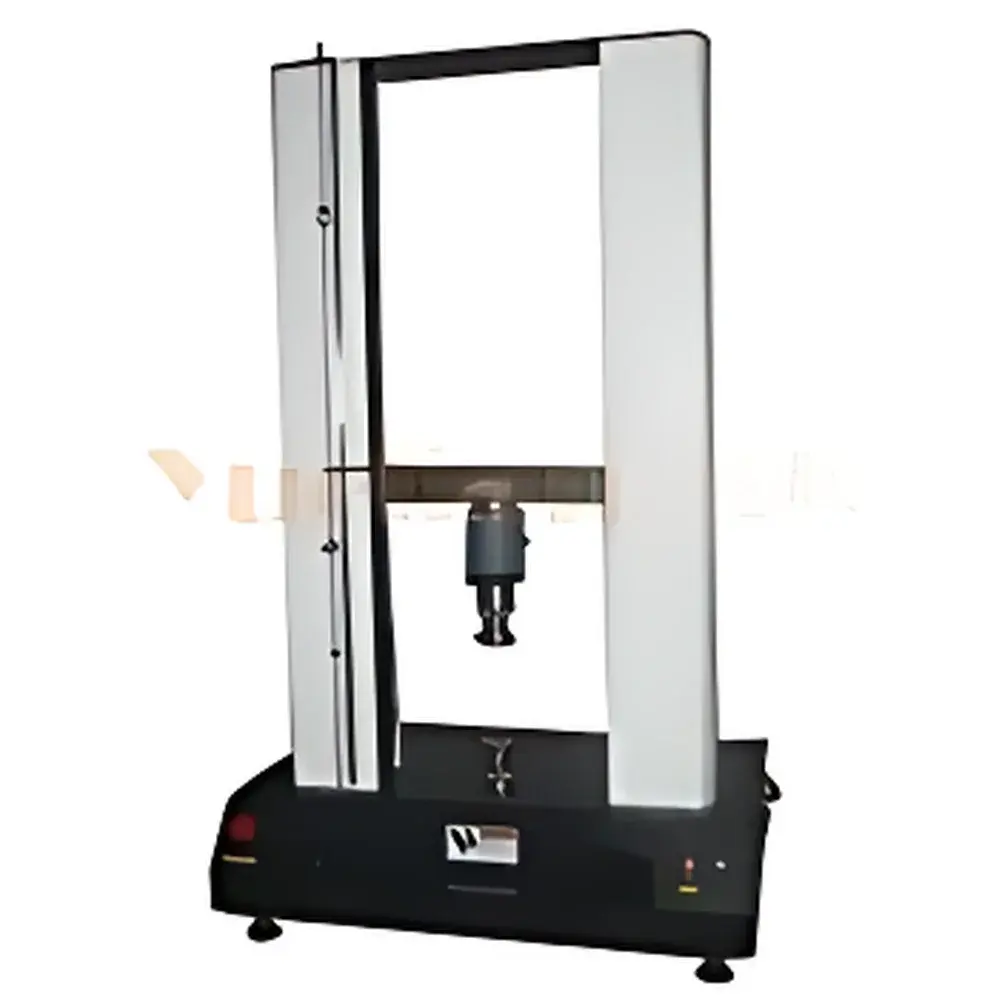
Yuelian YL-1125 Solar Panel Tensile Testing Machine
| Brand | Yuelian |
|---|---|
| Origin | Guangdong, China |
| Model | YL-1125 |
| Load Capacity Options | 10 N to 50 kN (dual-range configuration available) |
| Force Resolution | 1/250,000 full scale |
| Force Accuracy | ≤ ±0.5% of reading |
| Crosshead Travel | 1000 mm |
| Test Width | 420 mm |
| Speed Range | 0.5–500 mm/min (PC-controlled) |
| Displacement Resolution | 0.005 mm |
| Control Interface | PC-based software with USB interface |
| Drive System | Servo motor + precision ball screw + timing pulley transmission |
| Power Supply | 220 V, 50/60 Hz, 10 A |
| Power Consumption | 750 W |
| Dimensions (W×D×H) | 92 × 62 × 199 cm |
| Weight | ~422 kg |
| Standard Accessories | One set of universal grips, proprietary test software, USB data cable |
Overview
The Yuelian YL-1125 Solar Panel Tensile Testing Machine is a high-precision, microprocessor-controlled electromechanical universal testing system engineered for static mechanical characterization of rigid and semi-rigid materials—particularly photovoltaic (PV) modules, encapsulants, backsheet laminates, frame adhesives, and mounting hardware. Operating on the principle of controlled uniaxial force application via servo-driven crosshead displacement, the system conforms to fundamental ASTM E4, ISO 7500-1, and GB/T 228.1 standards for force measurement system calibration and verification. Its modular load frame architecture supports both tensile and compressive loading modes, enabling standardized evaluation of mechanical integrity under simulated service conditions—including thermal cycling-induced stress, mechanical load testing per IEC 61215-2 (MQT 16), and peel/adhesion assessment per ASTM D903 or EN 14410. Designed for integration into QC laboratories, R&D facilities, and third-party certification labs, the YL-1125 delivers repeatable, traceable mechanical data essential for PV module qualification, supplier auditing, and long-term reliability modeling.
Key Features
- High-resolution force measurement with ≤ ±0.5% accuracy and 1/250,000 internal resolution—validated per ISO 7500-1 Class 1 requirements.
- Adjustable crosshead speed from 0.5 to 500 mm/min, programmable in real time via PC interface to meet dynamic loading protocols (e.g., creep, stress relaxation, cyclic ramping).
- Dual-capacity load cell configuration option allows seamless switching between high-sensitivity (e.g., 10–500 N) and high-force (e.g., 5–50 kN) ranges without manual recalibration.
- Precision ball screw transmission coupled with synchronous belt drive ensures minimal backlash, consistent velocity fidelity, and <0.005 mm displacement resolution over 1000 mm travel.
- Integrated safety architecture includes hardware-triggered emergency stop, overload cutoff, specimen fracture detection, programmable upper/lower limit stops, and automatic return-to-start positioning.
- Universal grip compatibility—supports wedge-action, pneumatic, hydraulic, and custom fixtures for solar panel edge clamping, tab pull tests, junction box adhesion, and backsheet delamination studies.
Sample Compatibility & Compliance
The YL-1125 accommodates flat, sheet-like specimens up to 420 mm wide and 1000 mm in active test length—ideal for full-size PV module subcomponents (e.g., 156 mm × 156 mm to 210 mm × 210 mm cell interconnect ribbons, EVA/POE laminates, tempered glass substrates, and aluminum frames). It supports standardized test geometries defined in IEC 61215-2 (Mechanical Load Test), UL 1703 (Section 24), and JIS C 8990. All force and displacement outputs are compliant with GLP and GMP documentation requirements when used with audit-trail-enabled software configurations. Optional calibration certificates traceable to NIM (China National Institute of Metrology) or internationally accredited bodies (e.g., UKAS, DAkkS) are available upon request.
Software & Data Management
The proprietary Windows-based control and analysis suite operates via USB-connected interface board and supports Microsoft Access relational database backend for structured storage of test metadata, raw channel data (force, displacement, time), and derived parameters—including ultimate tensile strength (UTS), yield point, elongation at break, Young’s modulus, peel resistance (N/mm), and tear propagation energy. Real-time graphical display enables live stress–strain curve overlay, multi-curve comparison, and derivative calculation (e.g., tangent modulus, secant modulus). Export formats include CSV, XLSX, PDF reports, and XML for LIMS integration. Software architecture complies with FDA 21 CFR Part 11 requirements when configured with electronic signatures, user role permissions, and immutable audit logs.
Applications
- Tensile strength and elongation testing of PV encapsulant films (EVA, POE, PVB) per ASTM D882.
- Peel adhesion testing of front/backsheet interfaces and junction box bonding per ASTM D903 and IEC 61215-2 MQT 19.
- Compression testing of module frames and mounting brackets under static load per IEC 61215-2 MQT 16.
- Bending stiffness and flexural modulus evaluation of glass-glass or glass-backsheet laminates using three-point bending fixtures.
- Shear strength assessment of solder joint interconnects and ribbon-to-cell bonds using custom shear jigs.
- Qualification of new encapsulation chemistries or anti-PID coatings through comparative mechanical aging studies (e.g., post-damp heat exposure per IEC 61215-2 TH100).
FAQ
Does the YL-1125 comply with IEC 61215-2 mechanical load testing requirements?
Yes—the system’s force accuracy, displacement resolution, speed control stability, and fixture repeatability meet the metrological prerequisites for MQT 16 (static mechanical load) and MQT 19 (adhesion) when configured with certified load cells and calibrated displacement transducers.
Can the software generate reports compliant with ISO/IEC 17025 accreditation?
Yes—when deployed with full audit trail, electronic signature, and calibration certificate linkage, the software satisfies data integrity and traceability clauses required by ISO/IEC 17025:2017 Clause 7.7.
Is thermal chamber integration supported?
The YL-1125 frame design allows optional integration with environmental chambers (−40 °C to +150 °C) via external mounting rails and feedthrough-compatible cabling; chamber synchronization requires third-party API or analog signal interfacing.
What maintenance intervals are recommended for long-term accuracy?
Annual force system recalibration and biannual mechanical inspection (ball screw lubrication, belt tension verification, guide rail cleaning) are recommended per manufacturer guidelines to maintain ≤ ±0.5% force accuracy and sub-micron displacement linearity.
Are ASTM- or ISO-standard test methods preloaded in the software?
The software includes method templates for ASTM D638, D882, D903, D1876, and ISO 527-2, with configurable parameters (gauge length, crosshead speed, preload thresholds) aligned to latest editions.



