
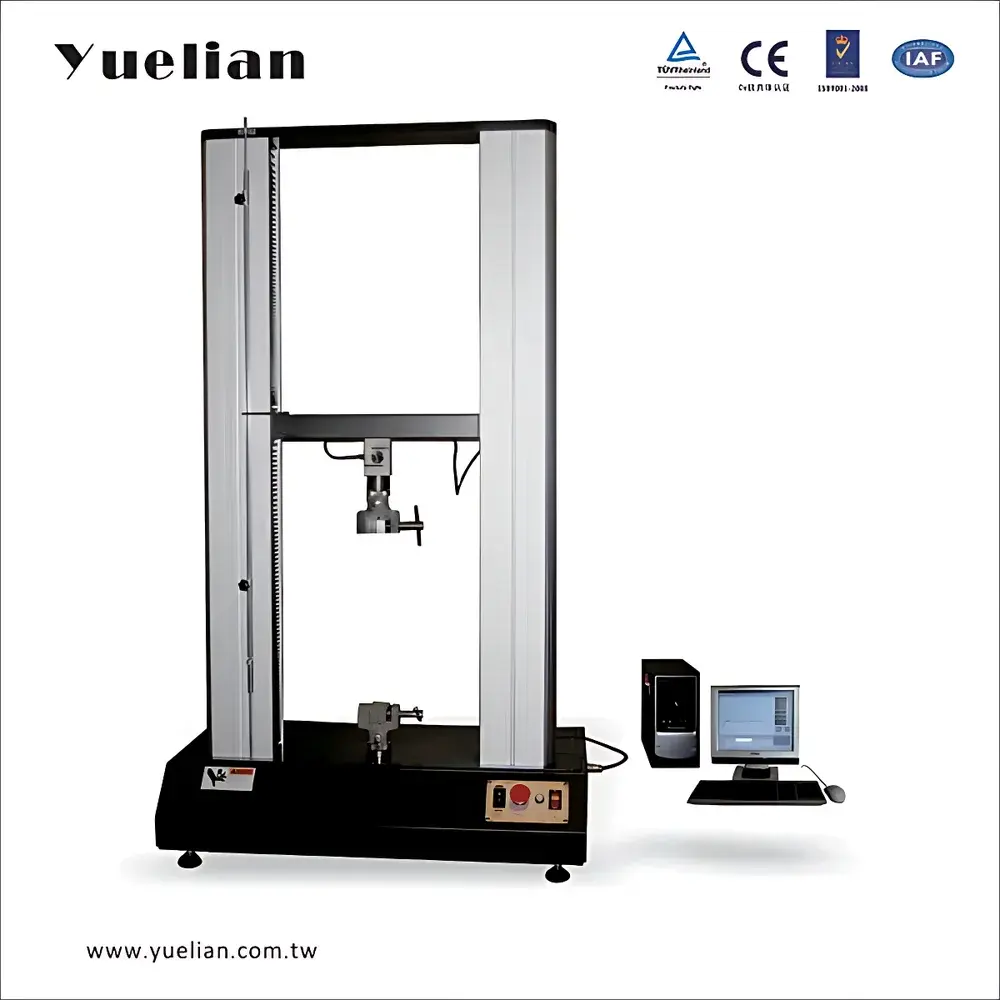
YL-1123 Universal Compression and Tensile Testing Machine (Yuelian)
| Brand | Yuelian |
|---|---|
| Origin | Guangdong, China |
| Model | YL-1123 |
| Capacity Options | 10 N to 20 kN (dual-range configurable) |
| Load Resolution | 1/250,000 full scale |
| Load Accuracy | ≤ ±0.5% FS |
| Displacement Resolution | 0.005 mm |
| Test Speed Range | 0.01–1000 mm/min (PC-programmable) |
| Maximum Travel | 700 mm |
| Test Width | 350 mm |
| Drive System | Servo motor + precision ball screw + timing belt |
| Power Supply | 220 V, 50/60 Hz, 10 A |
| Power Consumption | 400 W |
| Dimensions (W×D×H) | 72 × 52 × 130 cm |
| Weight | ~115 kg |
| Compliant Standards | ISO 7500-1, ASTM E4, EN 10002-1, JJG 475-88, GB/T 228, DIN 5122, JIS B7721/B7733, BS 1610 |
Overview
The YL-1123 Universal Compression and Tensile Testing Machine is an electromechanical materials testing system engineered for precision mechanical property evaluation of polymeric, metallic, composite, and fibrous materials under uniaxial loading conditions. Based on the principle of controlled displacement actuation via servo-driven ball screw translation, the machine applies calibrated compressive, tensile, flexural, shear, peel, and tear loads while synchronously recording force-displacement data in real time. Its modular architecture supports standardized test methods across ISO, ASTM, EN, JIS, and GB frameworks—making it suitable for routine quality control laboratories, incoming material inspection workflows, R&D departments conducting polymer characterization, and academic institutions performing fundamental mechanics of materials studies. The system operates within a defined mechanical envelope (700 mm stroke, 350 mm test width) and accommodates load capacities from 10 N to 20 kN, with optional dual-range transducer configurations enabling high-resolution measurement at low forces and robust overload tolerance at high loads.
Key Features
- High-fidelity load measurement with ≤ ±0.5% full-scale accuracy and 1/250,000 internal resolution, traceable to ISO 7500-1 Class 1 calibration requirements.
- Programmable crosshead speed from 0.01 to 1000 mm/min, adjustable via PC interface with ramp-hold-step profiles compliant with ASTM D638, ISO 527, and ISO 604 protocols.
- Servo-motor-driven motion control ensures repeatable positioning, minimal backlash, and stable velocity regulation—even during dynamic transitions between loading phases.
- Integrated safety logic includes over-load shutdown, emergency stop circuitry, specimen failure detection, and programmable upper/lower travel limits with automatic return-to-start functionality.
- Modular fixture interface compatible with standard wedge-action grips, compression platens, bend supports, peel fixtures, and custom-designed tooling per application-specific geometry.
- Robust mechanical construction: cast-iron base, reinforced steel frame, and precision-ground ball screws ensure long-term dimensional stability and minimal deflection under rated load.
Sample Compatibility & Compliance
The YL-1123 accommodates specimens ranging from thin polymer films (e.g., PE, PP, PET), elastomeric compounds (rubber, TPU), rigid thermoplastics (ABS, PC, PVC), fiber-reinforced composites, metallic foils, paperboard, and textile laminates. It supports standardized specimen geometries per ISO 527–2 (tensile bars), ISO 604 (compression prisms), ISO 178 (flexural beams), ASTM D882 (thin films), and ASTM D1876 (T-peel). All hardware and firmware comply with electromagnetic compatibility (EMC) directives and electrical safety standards applicable to laboratory-grade instrumentation. Calibration documentation aligns with ISO/IEC 17025 traceability principles when used with certified reference load cells and displacement calibrators.
Software & Data Management
The embedded Windows-based control software provides a graphical user interface for test method configuration, real-time curve visualization, and post-test analysis. It supports multi-sensor input channels—including auxiliary extensometer or environmental chamber signals—and enables calculation of key mechanical parameters: ultimate tensile strength (UTS), yield stress (0.2% offset), Young’s modulus, elongation at break, compressive yield strength, flexural modulus, and peel adhesion energy. Data export formats include CSV, PDF reports, and native MS Access database storage with audit-trail-capable event logging. While not natively 21 CFR Part 11 compliant, the software architecture permits integration with third-party electronic lab notebook (ELN) systems supporting ALCOA+ data integrity principles for GLP/GMP environments.
Applications
- Compression testing of plastic injection-molded parts per ISO 604 to determine compressive strength and modulus.
- Tensile characterization of thermoplastic sheets and extruded profiles in accordance with ASTM D638 and ISO 527.
- Flexural stiffness assessment of polymer composites using three-point bending (ISO 178).
- Peel strength quantification of adhesive bonds on flexible substrates (e.g., packaging laminates) per ASTM D903.
- Shear resistance evaluation of structural adhesives and laminated assemblies.
- Quality assurance screening of raw polymer pellets, recycled granules, and compounded resins prior to processing.
- Educational use in undergraduate and graduate materials science laboratories for hands-on mechanics experiments.
FAQ
What standards does the YL-1123 support for plastic compression testing?
It fully implements ISO 604, ASTM D695, and GB/T 1041 for rigid plastics, and ISO 844 for cellular plastics.
Can the system be integrated into a networked laboratory information management system (LIMS)?
Yes—via CSV/Excel export and ODBC-compliant MS Access backend, enabling automated data ingestion into validated LIMS platforms.
Is an external extensometer supported?
Yes; the controller features analog input channels compatible with clip-on or non-contact video extensometers for strain measurement.
Does the machine require periodic recalibration?
Per ISO 7500-1, annual verification against certified reference standards is recommended; load cell and encoder calibration intervals depend on usage frequency and criticality of measurement.
What maintenance is required for long-term reliability?
Routine lubrication of ball screws, inspection of grip jaw surfaces, and verification of limit switch functionality every 500 operational hours are advised.



