
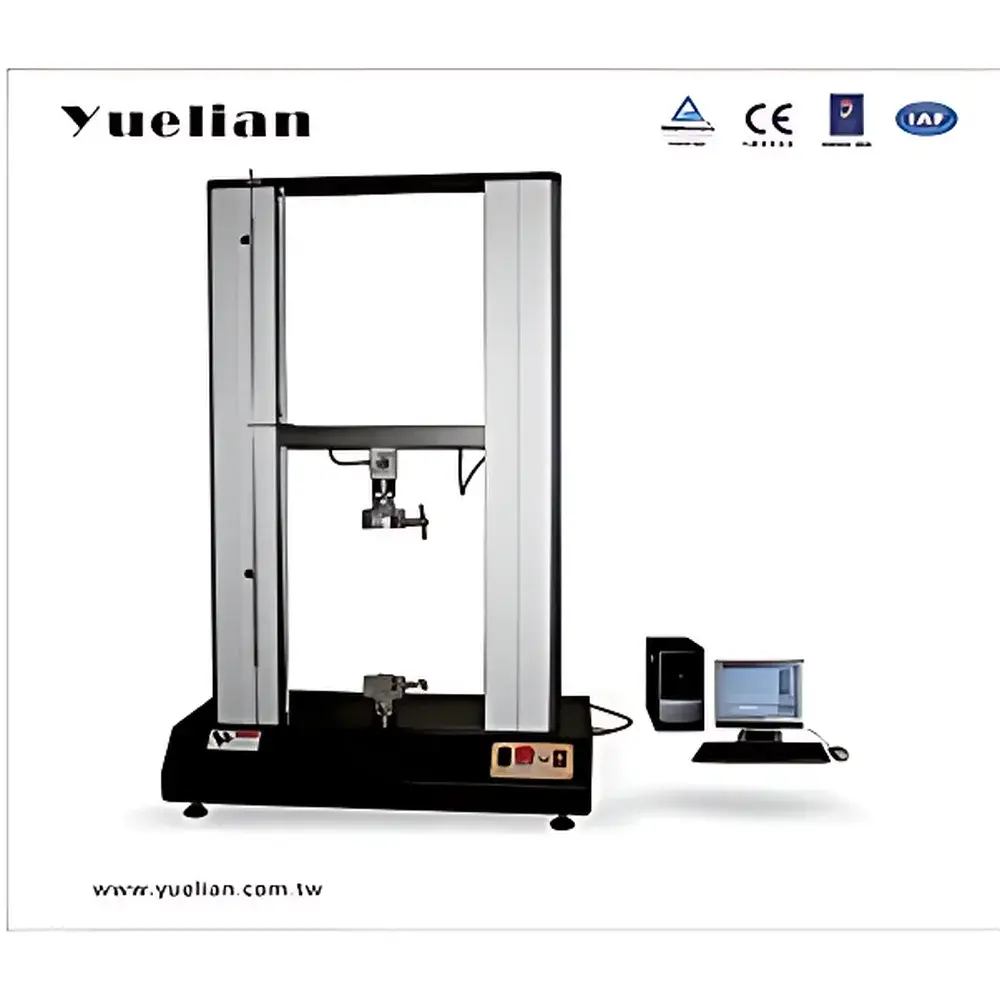
Yuelian YL-1123 Servo-Controlled Universal Testing Machine (20 kN Capacity)
| Brand | Yuelian |
|---|---|
| Origin | Guangdong, China |
| Manufacturer Type | Authorized Distributor |
| Country of Origin | China |
| Model | YL-1123 |
| Instrument Type | Electromechanical Universal Testing Machine |
| Load Capacity Options | 10 N – 20 kN (dual-range configuration available) |
| Force Resolution | 1/500,000 full scale |
| Force Accuracy | ±0.3% of reading |
| Crosshead Travel | 700 mm |
| Test Width | 420 mm |
| Speed Range | 0.01 – 1000 mm/min (programmable via PC) |
| Position Resolution | 1/500,000 full stroke |
| Control Interface | PC-based closed-loop servo control |
| Drive System | AC servo motor + precision ball screw + timing belt transmission |
| Power Supply | 220 V, 50/60 Hz, 10 A |
| Rated Power | 400 W |
| Dimensions (W×D×H) | 720 × 520 × 1300 mm |
| Weight | ~115 kg |
| Compliance Standards | ISO 7500-1, ASTM E4, EN 10002-1, GB/T 228.1, GB/T 2792, ASTM D3330, JJG 475 |
Overview
The Yuelian YL-1123 Servo-Controlled Universal Testing Machine is a high-precision electromechanical system engineered for static mechanical characterization of solid materials across research laboratories, quality assurance departments, and industrial R&D facilities. Operating on the principle of closed-loop servo-controlled displacement and load regulation, the YL-1123 applies controlled uniaxial tensile, compressive, flexural, shear, peel, tear, and adhesion forces to specimens while continuously acquiring force-displacement data at sub-micron positional resolution and sub-0.3% force fidelity. Its modular architecture supports standardized test methods defined in ISO 7500-1 (static calibration), ASTM E4 (verification of force-measuring systems), and GB/T 228.1 (metallic materials tensile testing), ensuring metrological traceability and inter-laboratory comparability. Designed for compliance with GLP and pre-GMP environments, the system meets foundational requirements for audit-ready mechanical testing in regulated sectors including medical device packaging, automotive component validation, and polymer formulation development.
Key Features
- AC servo motor-driven actuation with precision ground ball screw and synchronous timing belt transmission—ensuring smooth motion, zero backlash, and long-term repeatability over >500,000 cycles.
- Programmable speed range from 0.01 to 1000 mm/min, enabling quasi-static creep tests and high-rate dynamic loading within a single platform.
- Force transducer resolution of 1 part in 500,000 full scale, supporting accurate measurement across dual-capacity configurations (e.g., 1 kN / 20 kN).
- Integrated PC-based controller with real-time PID tuning, automatic zeroing, and hardware-triggered emergency stop logic compliant with EN ISO 13850.
- 700 mm vertical travel and 420 mm throat depth accommodate extended specimens—including composite laminates, rubber hoses, and multi-layer flexible packaging.
- Standard USB interface with Windows-compatible driver suite; no proprietary OS or runtime dependencies required.
Sample Compatibility & Compliance
The YL-1123 accommodates a broad spectrum of specimen geometries and material classes—including metallic wires, thermoplastic films, elastomeric seals, textile yarns, paperboard substrates, adhesive tapes, and fiber-reinforced composites. Its configurable grip systems (tensile wedges, compression platens, bend fixtures, peel jigs, and shear adapters) align with dimensional tolerances specified in ASTM D3330 (peel adhesion), GB/T 2792 (180° peel strength), and ISO 8510-2 (adhesive bond failure analysis). All mechanical calibrations adhere to ISO 7500-1 Class 1 accuracy requirements, while software-generated reports include timestamped metadata, operator ID, environmental conditions (optional sensor input), and digital signatures—supporting 21 CFR Part 11 readiness when deployed with validated MS Access database logging.
Software & Data Management
The embedded test control software operates natively on Windows 10/11 and provides full IEC 61508-aligned functional safety during execution. It enables automated test sequencing, real-time stress-strain curve overlay, batch processing of up to 999 specimens per session, and export of raw ASCII or CSV files compatible with MATLAB, Python (NumPy/Pandas), and Minitab. Calculated outputs include ultimate tensile strength (UTS), yield point (0.2% offset), Young’s modulus, elongation at break, peel average force, and energy-to-break (area under curve). Audit trails record all parameter modifications, calibration events, and user logins—retained for ≥10 years per internal retention policy. Database schema follows ANSI SQL standards, allowing direct ODBC connectivity to enterprise LIMS or QMS platforms.
Applications
- Quality control of pressure-sensitive adhesives per GB/T 2792 and ASTM D3330.
- Mechanical screening of biodegradable films used in food packaging per GB/T 1040.3.
- Validation of tensile properties in aerospace-grade aluminum alloys per GB/T 228.1 and ASTM E8.
- Peel and tack evaluation of medical transdermal patch backings under ISO 2555.
- Compression testing of foam cushioning materials per GB/T 6344.
- R&D of elastomeric gaskets for EV battery enclosures under thermal cycling preconditioning.
FAQ
Does the YL-1123 support ASTM E4-compliant verification procedures?
Yes—the system includes built-in calibration routines aligned with ASTM E4 Annex A1, enabling third-party verification using certified deadweight standards or reference load cells traceable to NIM or NIST.
Can the software generate PDF reports with digital signatures for ISO 9001 audits?
Yes—reports include configurable headers, embedded test parameters, graphical curves with axis annotations, statistical summaries, and electronic signature fields compliant with ISO/IEC 17025 documentation requirements.
Is remote operation possible via LAN or industrial Ethernet?
The standard configuration uses USB 2.0; optional Ethernet-to-USB bridge modules enable networked deployment in centralized lab infrastructure, though deterministic real-time control remains local to the host PC.
What maintenance intervals are recommended for the ball screw and servo drive?
Ball screw lubrication is required every 2,000 operational hours; servo motor encoder calibration is advised annually or after any mechanical impact event—both documented in the included maintenance log template.
Are custom fixture designs supported for non-standard specimens?
Yes—Yuelian provides mechanical drawings and mounting interface specifications (ISO 26203-compliant T-slot dimensions) to facilitate OEM fixture development by qualified machine shops.
Related Products



