
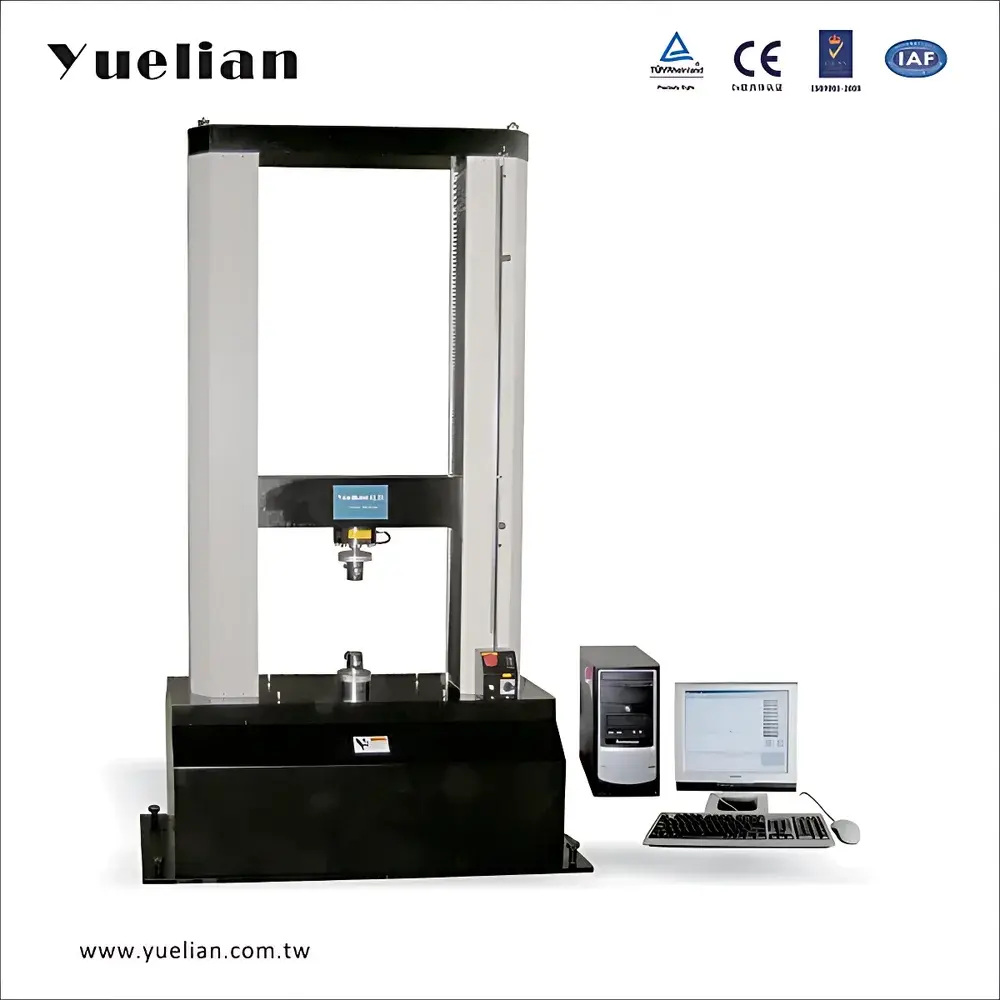
YL-1151 Yuelian Universal Compression Testing Machine for Steel Balls and Zirconia Beads
| Brand | Yuelian |
|---|---|
| Origin | Guangdong, China |
| Model | YL-1151 |
| Load Capacity Options | 1 kN, 2 kN, 5 kN, 10 kN, 20 kN, 50 kN, 100 kN (dual-range configuration available) |
| Force Resolution | 1/250,000 full scale |
| Force Accuracy | ≤ ±0.5% of reading |
| Displacement Resolution | 0.005 mm |
| Test Speed Range | 0.5–500 mm/min (software-controlled) |
| Maximum Stroke | 1000 mm |
| Test Width | 550 mm |
| Drive System | Servo motor with precision ball screw and synchronous belt transmission |
| Power Supply | 220 V, 50/60 Hz, 10 A |
| Rated Power | 1800 W |
| Dimensions (W×D×H) | 92 × 75 × 199 cm |
| Weight | ~800 kg |
| Compliant Standards | ISO 7500-1, ASTM E4, EN 10002-1, EN 10002-2, DIN 51221, JIS B7721/B7733, GB/T 228, JJG 475-88 |
Overview
The YL-1151 Yuelian Universal Compression Testing Machine is an electromechanical force-testing system engineered for high-reproducibility uniaxial compression evaluation of rigid spherical specimens—including steel balls, zirconia (ZrO₂) beads, ceramic microspheres, and other high-density granular materials used in grinding, pharmaceutical excipient processing, catalyst support applications, and precision bearing industries. Unlike general-purpose tensile-compression testers, the YL-1151 integrates a rigid C-frame architecture, high-stiffness load train, and calibrated displacement feedback to ensure traceable mechanical response under quasi-static loading conditions (per ISO 7500-1 Class 1). Its design prioritizes axial alignment stability and minimal lateral deflection—critical when measuring brittle fracture thresholds of sub-millimeter to 25 mm diameter spheres where localized Hertzian contact stress governs failure initiation. The system operates on fundamental principles of compressive stress–strain analysis, delivering quantifiable metrics such as crushing load, onset of plastic deformation, and catastrophic fracture force—parameters directly linked to ISO 10993 biocompatibility screening for medical-grade zirconia and ASTM F2129 corrosion-fatigue resistance validation.
Key Features
- Rigid C-frame construction with reinforced crosshead and base plate, minimizing frame compliance during high-load compression (up to 100 kN)
- Precision-ground ball screw actuation paired with servo motor control enables repeatable displacement rates from 0.5 to 500 mm/min, programmable via PC interface
- Force transducer calibrated to ISO 7500-1 Class 1 accuracy (≤ ±0.5% FS), with resolution down to 1/250,000 of selected capacity
- Displacement measurement via linear encoder with 0.005 mm resolution, synchronized with force acquisition at ≥1 kHz sampling rate
- Dual-range load cell option supports both low-force bead crush testing (e.g., 1–5 kN for 1–3 mm ZrO₂ beads) and high-force structural validation (e.g., 50–100 kN for Ø25 mm steel bearing balls)
- Integrated safety interlocks: overload cutoff, emergency stop, specimen rupture auto-halt, and software-defined upper/lower travel limits
- Modular fixture mounting system compatible with standardized compression platens, spherical indenters, and custom-designed cradles for centric loading of round specimens
Sample Compatibility & Compliance
The YL-1151 accommodates spherical test specimens ranging from 0.5 mm to 25 mm in diameter, including AISI 52100 steel balls, yttria-stabilized zirconia (YSZ) beads, silicon nitride (Si₃N₄) spheres, and alumina (Al₂O₃) microspheres. Specimen positioning utilizes adjustable V-groove supports or concentric ring fixtures to enforce axial load alignment—essential for eliminating eccentric bending moments that distort crush strength interpretation. All hardware and calibration protocols conform to international metrological standards: force verification per ASTM E4 and ISO 7500-1; displacement linearity per EN 10002-2; and overall system validation aligned with GB/T 228.1 for metallic materials and ISO 14577 for instrumented indentation (where applicable to composite bead systems). Data integrity meets GLP audit requirements through timestamped raw data logging and user-accessible calibration certificate archives.
Software & Data Management
The proprietary Windows-based test control and analysis suite provides real-time force–displacement curve visualization, multi-curve overlay, and automated parameter extraction—including peak crush load, yield inflection point (via tangent modulus method), post-yield energy absorption, and elastic recovery ratio. Raw data exports to CSV, XML, or native .mdf format; database backend leverages Microsoft Access for structured storage of test records, operator IDs, environmental metadata (temperature/humidity tags), and calibration history. Audit trail functionality complies with FDA 21 CFR Part 11 requirements: electronic signatures, immutable event logs, and role-based access control (administrator/operator modes). Software supports ASTM D695, ISO 7500-1 Annex C, and GB/T 7759.1 reporting templates—enabling direct export to LIMS or ERP platforms via ODBC connectivity.
Applications
- Crush strength qualification of zirconia grinding media for pharmaceutical wet milling processes (USP particulate integrity screening)
- Mechanical reliability assessment of steel balls in aerospace-grade angular contact bearings (per SAE AS7471)
- Batch consistency verification for ceramic microspheres used in controlled-release drug carriers
- Interfacial bond strength evaluation of coated beads under compressive preload (e.g., polymer-coated iron oxide spheres)
- Material development support for high-hardness composites: correlation of Vickers hardness, fracture toughness (KIC), and macro-scale crush resistance
- QC/QA in powder metallurgy: green-state compact strength analysis prior to sintering
FAQ
What is the minimum recommended sphere diameter for reliable crush testing on the YL-1151?
For statistically valid results, specimens should be ≥1 mm in diameter; sub-millimeter beads require optional high-resolution load cells (50 N or 100 N capacity) and micro-positioning fixtures.
Can the system perform cyclic compression tests on beads?
Yes—the software supports programmed load-controlled or displacement-controlled fatigue sequences up to 10⁶ cycles, with dwell time, ramp rate, and amplitude modulation fully configurable.
Is third-party calibration certification included with delivery?
Each unit ships with a factory-issued ISO/IEC 17025-accredited calibration certificate covering force and displacement axes, valid for 12 months under standard operating conditions.
Does the system support ASTM F2129-compliant electrochemical-mechanical coupling tests?
While the YL-1151 itself is a purely mechanical tester, its analog output ports and TTL trigger interface enable synchronization with potentiostats for combined corrosion–compression studies—custom integration support available upon request.
Are replacement load cells and platen sets available as spare parts?
Yes—Yuelian maintains global inventory of certified load cells (1 kN to 100 kN), hardened steel compression platens (flat, concave, and hemispherical), and application-specific fixtures, all supplied with recalibration documentation.



