
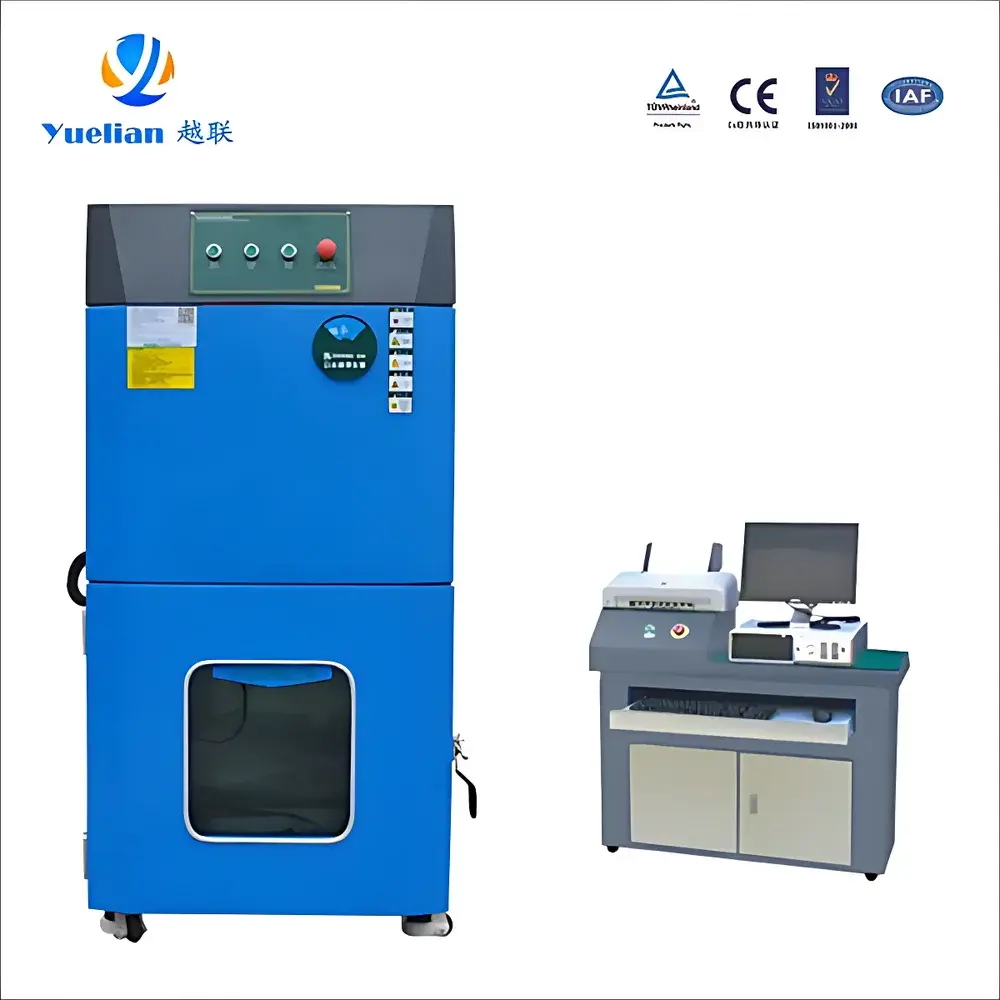
English Product Name
| Brand | Yuelian |
|---|---|
| Origin | Guangdong, China |
| Manufacturer Type | Authorized Distributor |
| Country of Manufacture | China |
| Model | YL-JZ-2T |
| Maximum Applied Force | 20 kN (2 metric tons) |
| Max Sample Dimensions | W30 × D30 cm |
| Overall Dimensions | W88 × H168 × D73 cm |
| Crush Stroke Range | 0–300 mm (adjustable) |
| Crush Speed | 1–500 mm/min (customizable) |
| Nail Penetration Speed | 1–50 mm/s (customizable) |
| Force Accuracy | ±0.5% of reading |
| Force Resolution | 1/500,000 full scale |
| Displacement Accuracy | ±0.5% of reading |
| Displacement Resolution | 0.01 mm |
| Force Units | N, kN, kgf, lbf |
| Control Interface | RS232 / RS485 |
| Voltage Measurement Range | 0–36 V (±0.5% FS) |
| Temperature Measurement Range | 0–300 °C (±1 °C) |
| Data Acquisition Rate | ≥30 Hz per channel |
| Video Monitoring | Optional HD in-chamber camera system |
| Safety Features | Overload, overtemperature, overvoltage, leakage, and emergency acoustic-optic alarm |
Overview
The Yuelian YL-JZ-2T Integrated Battery Crush and Nail Penetration Test System is an engineering-grade safety evaluation platform designed for rigorous mechanical abuse testing of lithium-ion and other rechargeable battery cells under controlled laboratory conditions. It implements two standardized destructive test modalities—quasi-static crush and dynamic nail penetration—per major international safety standards including UN 38.3, IEC 62133-2, GB/T 31485, UL 1642, and IEEE 1625. The system employs a high-rigidity monolithic frame coupled with a precision servo-motor-driven actuator to deliver repeatable, traceable force application. Crush testing follows a constant-force protocol (up to 20 kN), while nail penetration utilizes programmable velocity control (1–50 mm/s) with real-time monitoring of voltage, surface temperature, displacement, and time. All operations are executed under a sealed, ventilated, and pressure-relieved chamber equipped with dual-layer explosion-resistant observation windows and integrated LED illumination—ensuring operator safety and experimental integrity during thermal runaway events.
Key Features
- Monolithic structural design with reinforced cold-rolled steel outer enclosure (gray + blue epoxy finish) and 304 stainless-steel inner chamber for corrosion resistance and thermal stability.
- Explosion-proof double-layer tempered glass observation window (350 × 400 mm) with integrated LED lighting for unobstructed visual monitoring during hazardous events.
- Automated pressure relief port and forced exhaust system to rapidly evacuate smoke, gas, or volatile decomposition products during thermal runaway.
- Multi-parameter synchronous acquisition: simultaneous recording of force (N/kN), displacement (mm), cell voltage (0–36 V), surface temperature (0–300 °C), and time—with minimum sampling frequency of 30 Hz per channel.
- Modular fixture system: height-adjustable (0–200 mm) dedicated crush plates, needle-holding penetrator assembly, V-groove support fixtures, and universal clamping bases compatible with cylindrical (e.g., 18650, 21700), prismatic, pouch, and coin-cell formats.
- Imported tungsten carbide needles (Φ3, Φ5, Φ8 mm; 45°–60° conical tip; Ra ≤ 0.4 µm surface roughness) certified for high-temperature stability and mechanical durability across repeated tests.
Sample Compatibility & Compliance
The YL-JZ-2T accommodates single-cell specimens up to 30 cm in width and depth, supporting standardized orientation protocols per IEC 62133-2 Annex A. Cylindrical cells are positioned with their longitudinal axis parallel to the crush plates; prismatic and pouch cells undergo compression on the largest face; coin cells are aligned flat between parallel platens. Nail penetration is performed perpendicular to the electrode plane, targeting geometric center regions at 25 ± 5 mm/s. The system meets functional requirements for GLP-compliant battery safety laboratories and supports audit-ready documentation—including timestamped raw data logs, parameter configuration records, and event-triggered video capture (optional). It aligns with mechanical abuse test prerequisites outlined in ISO 12405-4, SAE J2464, and China’s MIIT Order No. 39 for electric vehicle battery certification.
Software & Data Management
The proprietary Windows-based control software provides closed-loop PID regulation of actuator motion, configurable test sequences (crush-only, penetration-only, or sequential dual-mode), and real-time overlay of five synchronized curves: force vs. time, displacement vs. time, voltage vs. time, temperature vs. time, and derived power/energy metrics. All datasets are stored in .csv and .xlsx formats with embedded metadata (operator ID, sample ID, environmental conditions, calibration timestamps). The software supports RS232/RS485 communication for integration into centralized lab information management systems (LIMS) and includes configurable pass/fail logic based on user-defined thresholds (e.g., voltage drop >50% within 60 s post-penetration). Audit trails comply with FDA 21 CFR Part 11 requirements when operated with electronic signature modules and role-based access control.
Applications
This system serves R&D labs, quality assurance departments, third-party certification bodies, and battery recycling facilities requiring reproducible mechanical abuse data for failure mode analysis, safety margin quantification, and regulatory dossier preparation. Typical use cases include: validation of separator integrity under compressive stress; evaluation of jelly-roll deformation tolerance in cylindrical cells; comparative assessment of thermal runaway onset latency across cathode chemistries (LFP, NMC, LCO); verification of cell-level robustness prior to module/pack integration; and root-cause investigation of field failures linked to mechanical impact or crush-induced internal short circuits.
FAQ
What standards does the YL-JZ-2T support for crush and nail penetration testing?
It fully supports UN 38.3 Section 38.3.4 (crush), IEC 62133-2:2017 Clause 7.2.2 (mechanical abuse), GB/T 31485-2015 Section 4.5 (crush) and Section 6.1.3 (nail penetration), and UL 1642 Section 9 (abuse tests).
Can the system record voltage and temperature simultaneously during crush or penetration?
Yes—dual-channel analog inputs enable concurrent acquisition of voltage (0–36 V, ±0.5% FS) and surface thermocouple signals (0–300 °C, ±1 °C) at ≥30 Hz, synchronized with force and displacement data.
Is remote operation or network integration possible?
Standard RS232/RS485 interfaces allow integration with SCADA or LIMS platforms; optional Ethernet/WiFi modules enable remote monitoring and script-based batch testing via TCP/IP.
What safety interlocks prevent unintended actuation or exposure during testing?
Hardware-enforced safety chain includes door-position sensors, pressure-relief valve status monitoring, emergency stop circuitry, overload cutoff, and real-time thermal runaway detection triggering automatic actuator halt and exhaust activation.
Does the system include calibration documentation traceable to national metrology institutes?
Each unit ships with factory calibration certificates for load cell (ISO/IEC 17025-accredited), displacement encoder, and temperature/voltage input modules, with recommended annual recalibration intervals aligned with ISO 9001 laboratory practice guidelines.
Related Products



