
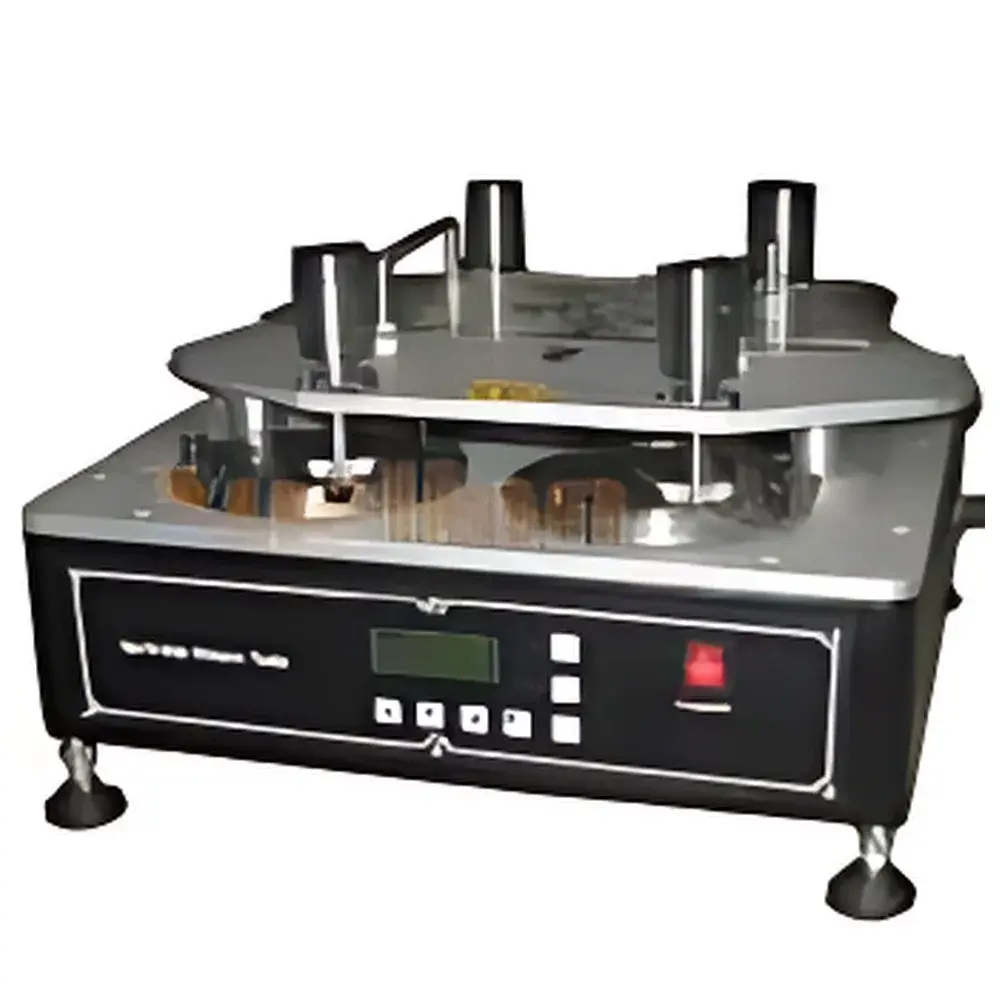
Yuelian YL-3315M Martindale Abrasion and Pilling Tester
| Brand | Yuelian |
|---|---|
| Model | YL-3315M |
| Application | Textile, Synthetic Leather, Membrane Materials Abrasion & Pilling Resistance Testing |
| Standards Compliance | GB/T 21196-2007, GB/T 13775, FZ/T 20020, ASTM D3886, ASTM D4966, ASTM D4970, ISO 12947-1~4, ISO 12945-2, JIS L1096, IWS TM196/TM112, M&S Test Methods, GB/T 4802.1-1997 |
| Specimen Motion Path | Lissajous Curve (60.5 ± 0.5 mm horizontal × 24 ± 0.5 mm vertical) |
| Load Options | 200 g (clamping weight), 395 g (apparel), 594 g (furniture), 260 g (stainless steel disc) |
| Friction Head Types | A-type (28.8 −0.084 mm, 1.96 N / 9 kPa), B-type (90 −0.10 mm, 1.52 N / 12 kPa) |
| Rotational Speed | 50 ± 2 rpm |
| Counting Range | 0–999999 cycles |
| Configurable Stations | 4 or 8 |
| Power Supply | AC 220 V, 50 Hz, 500 W |
| Dimensions (W×D×H) | 885 × 600 × 410 mm |
| Weight | 150 kg |
Overview
The Yuelian YL-3315M Martindale Abrasion and Pilling Tester is an electromechanical tribological instrument engineered for standardized evaluation of surface durability in flexible sheet materials. It operates on the principle of controlled two-dimensional oscillatory motion—specifically a Lissajous trajectory—where circular test specimens undergo reciprocating friction against standardized abradant surfaces under precisely defined normal loads. This methodology replicates real-world mechanical stress conditions encountered during garment wear, upholstery use, or industrial membrane handling. The instrument quantifies material resistance to surface degradation via two primary metrics: abrasion resistance (cycles to specimen failure, e.g., yarn breakage or hole formation) and pilling propensity (visual assessment of fiber entanglement after prescribed cycles). Its design adheres to fundamental tribological test theory, where contact pressure, relative velocity, path geometry, and abrasive topology are held constant to ensure inter-laboratory reproducibility.
Key Features
- Four independent testing stations (configurable to eight upon request), enabling parallel execution of replicate or multi-condition trials without cross-interference.
- Integrated capacitive touchscreen interface with dual-language support (English/Chinese), offering intuitive parameter entry, real-time cycle monitoring, and status feedback without external software dependency.
- Tool-free specimen loading mechanism: patented hinged clamping system eliminates need to remove top covers, reducing setup time and minimizing operator-induced alignment errors.
- Dual counting modes—incremental and decremental—with mid-test resume capability and cumulative session logging, supporting both pass/fail threshold testing and progressive degradation analysis.
- Modular load configuration: interchangeable weighted carriers (200 g clamp, 395 g apparel mass, 594 g furniture mass, 260 g stainless steel disc) compliant with ASTM, ISO, and GB standard requirements for different material classes.
- Interchangeable friction heads: A-type (28.8 −0.084 mm diameter, 1.96 N / 9 kPa) and B-type (90 −0.10 mm, 1.52 N / 12 kPa) meet distinct pressure-density specifications across textile, leather, and technical membrane standards.
Sample Compatibility & Compliance
The YL-3315M accommodates flat, flexible specimens up to 140 mm in diameter—including woven/knitted fabrics, nonwovens, coated textiles, synthetic leathers, elastomeric membranes, and laminated composites. Its mechanical architecture satisfies dimensional and dynamic tolerances mandated by major international test protocols. It is validated for full conformance with GB/T 21196-2007 (Martindale method for pilling resistance), GB/T 13775 (abrasion resistance of silk fabrics), ASTM D4966 (standard Martindale abrasion test), ASTM D4970 (pilling resistance of woven fabrics), ISO 12947-1 through -4 (determining abrasion resistance using Martindale apparatus), ISO 12945-2 (pilling assessment), JIS L1096, IWS TM112/TM196, and Marks & Spencer internal specifications. Instrument calibration traceability supports GLP-compliant documentation workflows, and mechanical repeatability meets ASTM E2586 requirements for within-laboratory precision.
Software & Data Management
The embedded controller logs all test parameters—including start/stop timestamps, applied load, selected friction head, cycle count, and operator ID—to internal non-volatile memory. Export is supported via USB interface in CSV format for integration into LIMS or statistical process control platforms. Audit trail functionality records parameter changes, user logins, and system events, satisfying basic FDA 21 CFR Part 11 readiness criteria for electronic record integrity. While no proprietary PC software is required for operation, optional Excel-based reporting templates are available for automated generation of test certificates aligned with ISO/IEC 17025 clause 7.8 documentation requirements.
Applications
- Quality assurance of apparel textiles for retail brands requiring compliance with ASTM D4966 and ISO 12947-2.
- R&D evaluation of novel fiber blends, nano-coated fabrics, and biodegradable membranes under accelerated wear simulation.
- Validation of surface treatments (e.g., silicone finishes, plasma coatings) for improved pilling resistance per ISO 12945-2.
- Comparative benchmarking of synthetic leather alternatives in automotive and furniture supply chains governed by ISO 12947-4 and M&S TM196.
- Third-party certification testing accredited to CNAS (China) and UKAS (UK) scopes referencing GB/T 13775 and ASTM D3886.
FAQ
What standards does the YL-3315M fully support for abrasion and pilling testing?
It implements all mechanical and procedural requirements of GB/T 21196-2007, ASTM D4966, ISO 12947-1~4, ISO 12945-2, JIS L1096, and IWS TM112/TM196 without hardware modification.
Can the instrument perform both abrasion and pilling tests simultaneously?
Yes—each station operates independently; users may assign different loads, friction heads, and cycle targets per station, enabling concurrent abrasion (e.g., 594 g + B-head) and pilling (e.g., 395 g + A-head) protocols.
Is calibration certification included with shipment?
A factory calibration report verifying Lissajous motion amplitude, rotational speed, and load accuracy is provided; NIST-traceable third-party calibration services are available as an add-on option.
What maintenance intervals are recommended for long-term repeatability?
Daily visual inspection of abradant cloth tension and friction head wear; quarterly verification of motor encoder linearity and load cell drift using certified reference masses; annual full mechanical recalibration per ISO 16474-2 guidelines.
Does the instrument meet electromagnetic compatibility (EMC) requirements for EU laboratories?
Yes—it complies with EN 61326-1:2013 for laboratory equipment emissions and immunity, and carries CE marking under the Low Voltage Directive 2014/35/EU.
Related Products



