
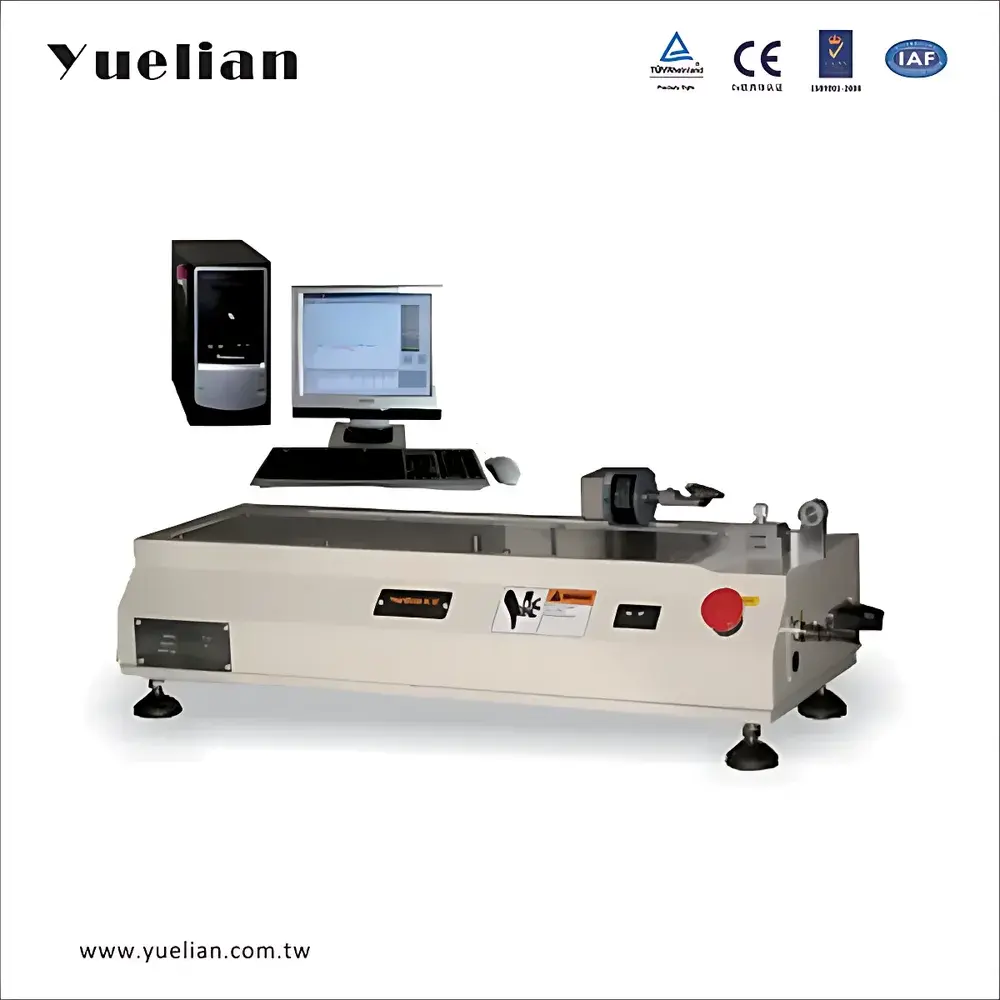
YL-1103S Yuelian Universal Testing Machine for Release Liner Peel Force Measurement
| Brand | Yuelian |
|---|---|
| Model | YL-1103S |
| Type | Electromechanical Universal Testing Machine |
| Load Capacity Options | 10 N, 20 N, 50 N, 100 N, 200 N (dual-range configuration available) |
| Force Resolution | 1/500,000 full scale |
| Force Accuracy | ±0.3% of reading |
| Crosshead Travel | 500 mm |
| Test Width | 140 mm |
| Speed Range | 5–500 mm/min (programmable via PC) |
| Displacement Resolution | 1/500,000 full stroke |
| Control Interface | PC-based with USB connection |
| Drive System | Stepper motor + precision ball screw + synchronous timing belt |
| Power Supply | 220 V AC, 50/60 Hz, 5 A |
| Dimensions (W×D×H) | 1063 × 300 × 200 mm |
| Weight | ~45 kg |
| Standard Accessories | One set of peel/clamp fixtures, proprietary test software, USB interface cable |
Overview
The YL-1103S Yuelian Universal Testing Machine is an electromechanical force measurement system engineered specifically for quantitative peel force evaluation of release liners, carrier tapes, pressure-sensitive adhesives (PSAs), and related functional laminates. It operates on the principle of controlled tensile separation—applying a defined rate of crosshead displacement to separate two bonded substrates while continuously recording the instantaneous normal and tangential force components. The system complies with core mechanical testing standards including ASTM D903 (Peel Resistance of Adhesive Bonds), ISO 8510-2 (Adhesives – Peel Test), and TAPPI T497 (Peel Strength of Pressure-Sensitive Tapes), ensuring traceable, repeatable data generation under GLP-aligned laboratory conditions. Its microprocessor-controlled architecture integrates high-resolution load cell feedback, closed-loop speed regulation, and real-time displacement tracking to deliver metrologically sound results across low-force regimes typical of thin-film and flexible substrate characterization.
Key Features
- Electromechanical actuation with stepper motor, precision ground ball screw, and synchronous timing belt drive—ensuring smooth motion control, minimal backlash, and long-term positional repeatability.
- Dual-range load cell support (10 N to 200 N) enables high-resolution measurement in both low-force peel applications (e.g., silicone-coated release liners) and higher-load interfacial strength assessments.
- Programmable test speed from 5 to 500 mm/min with <0.1% speed stability—critical for evaluating rate-dependent adhesion behavior per ISO 4587 and ASTM D3167.
- Automatic return-to-start and failure-triggered stop functions—including overload cutoff, specimen rupture detection, and user-defined upper/lower displacement limits—enhancing operational safety and test consistency.
- PC-based control interface with USB 2.0 connectivity, supporting Windows OS environments and enabling full audit trail logging compliant with FDA 21 CFR Part 11 requirements when configured with electronic signature modules.
- Integrated data acquisition engine capable of sampling at ≥1 kHz, capturing transient peak forces, average peel load, and energy-to-peel metrics with synchronized displacement timestamps.
Sample Compatibility & Compliance
The YL-1103S accommodates standard peel geometries including 90° and 180° configurations per ASTM D3330 and ISO 29862. Its 140 mm test width and adjustable fixture height support common carrier tape widths (e.g., 8 mm, 12 mm, 16 mm) and release liner rolls up to 200 mm in diameter. Fixtures are modular and interchangeable—compatible with pneumatic, mechanical, or spring-loaded clamping systems for consistent grip without slippage or premature substrate damage. All firmware and software operations adhere to IEC 61000-6-3 (EMC emissions) and IEC 61010-1 (safety for electrical equipment). Calibration certificates are provided traceable to NIM (China National Institute of Metrology) or equivalent national metrology institutes upon request.
Software & Data Management
The proprietary test software provides a graphical user interface for method definition, real-time curve monitoring, and post-test analysis. It supports multi-curve overlay, statistical reporting (mean, SD, CV%), and export to CSV, PDF, or MS Access databases. Raw data files include embedded metadata: operator ID, timestamp, environmental conditions (if external sensors connected), calibration status, and instrument serial number—enabling full data lineage for internal QA audits or regulatory submissions. Software architecture permits role-based access control and optional digital signature workflows aligned with GMP/GLP documentation practices.
Applications
- Quantitative peel force profiling of silicone- and fluoropolymer-coated release liners used in medical device packaging and electronics assembly.
- Evaluation of adhesive anchorage strength in wafer-level chip-scale packaging (WLCSP) carrier tapes per JEDEC J-STD-020.
- Quality control of PSA-backed labels, graphic films, and masking tapes during manufacturing process validation.
- Comparative assessment of aging effects (thermal, UV, humidity) on interfacial bond integrity using accelerated stability protocols.
- R&D support for formulation optimization of low-tack or repositionable adhesives requiring precise force hysteresis mapping.
FAQ
What peel angles does the YL-1103S support?
The system is mechanically compatible with both 90° and 180° peel configurations using standardized fixture kits; angle selection is determined by fixture geometry, not software settings.
Is third-party calibration certification included?
A factory calibration report traceable to NIM is supplied standard; ISO/IEC 17025-accredited calibration services are available as an optional add-on.
Can the system perform tensile tests on unsupported films?
Yes—when equipped with film-specific grips and extensometer input (optional), it meets ASTM D882 requirements for thin plastic film tensile properties.
Does the software support automated pass/fail decision logic?
Yes—user-definable acceptance criteria (e.g., “average peel force ≥ 0.8 N ± 0.15 N”) can trigger visual alerts and auto-flag outliers during batch testing.
Is remote operation possible over LAN or VPN?
Local network operation is supported via shared folder access to test data archives; secure remote desktop control requires customer-provided IT infrastructure and policy compliance verification.



