
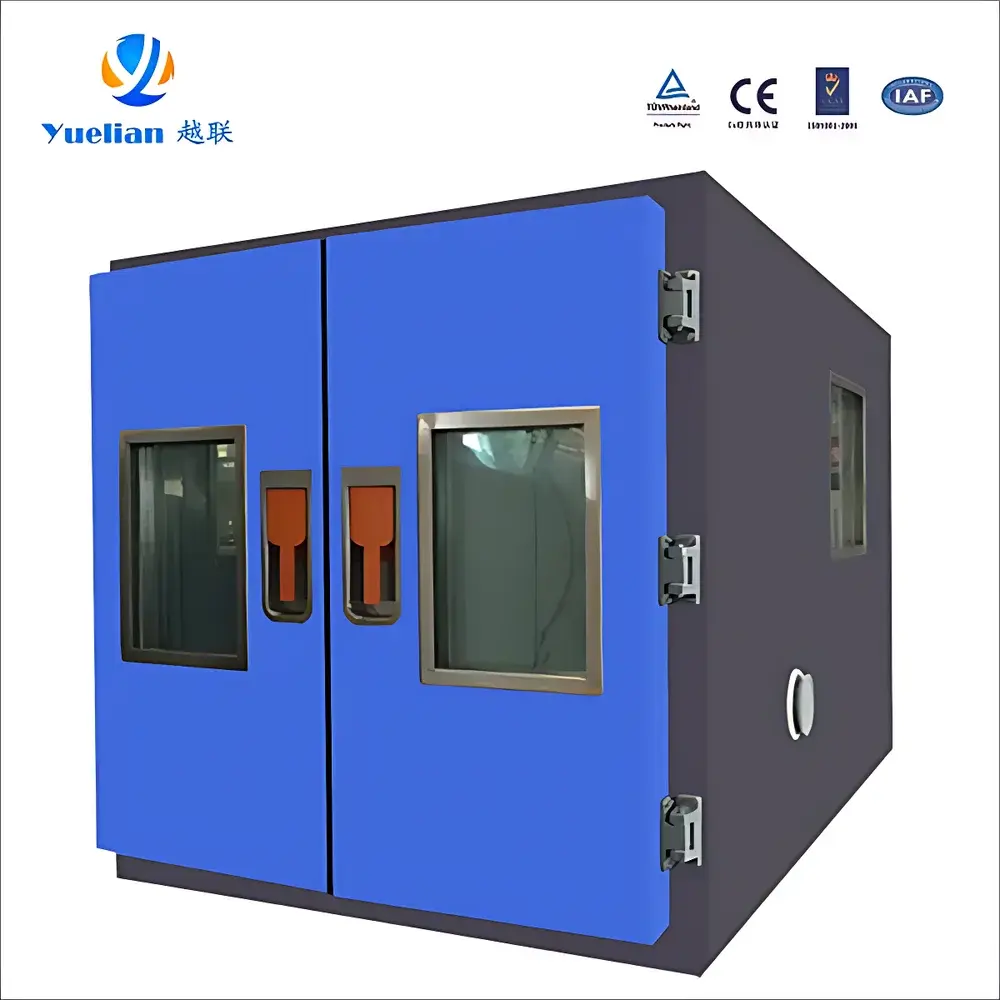
Yuelian YL-A-16000E Walk-In Combined Environmental Test Chamber (Temperature, Humidity & Vibration)
| Brand | Yuelian |
|---|---|
| Origin | Guangdong, China |
| Model | YL-A-16000E |
| Internal Volume | 16,000 L |
| Working Chamber Dimensions | 200 × 200 × 400 cm |
| Temperature Range | −50 °C to +100 °C |
| Temperature Uniformity | ≤2 °C |
| Temperature Fluctuation | ±0.5 °C |
| Temperature Resolution | 0.01 °C |
| Humidity Range | 20–98% RH |
| Humidity Resolution | 0.1% RH |
| Humidity Uniformity | ±3% RH (>75% RH), ±5% RH (≤75% RH) |
| Humidity Fluctuation | ±2% RH |
| Cooling Rate | 1 °C/min (from +85 °C to −40 °C) |
| Heating Rate | 1 °C/min (from −40 °C to +85 °C) |
| Vibration Channels | 2/4/8 configurable |
| Refrigeration Compressor | GEA Bitzer (Germany) |
| Control Interface | Touchscreen LCD |
| Communication | RS-232 / RS-485 |
| Power Supply | AC 380 V, 50 Hz |
Overview
The Yuelian YL-A-16000E Walk-In Combined Environmental Test Chamber is an integrated reliability validation platform engineered for simultaneous temperature, humidity, and mechanical vibration stress application—specifically designed to replicate real-world operational and transit conditions for high-voltage battery systems. It operates on the principle of multi-stress synergistic acceleration, enabling concurrent thermal cycling (per ISO 16750-4 and GB/T 2423.4), controlled hygrothermal exposure (per IEC 60068-2-30), and broadband random or sine vibration input (per ISO 16750-3, SAE J2380, and UN ECE R100 Annex 8). Its 16,000 L internal volume accommodates full-size EV traction battery packs (up to 2,000 kg mass load), supporting full-system functional verification under combined environmental loads. The chamber’s structural integrity, refrigeration stability, and vibration coupling fidelity are validated per IEC 61000-4-27 and ASTM D4728 for transport simulation.
Key Features
- Robust monolithic chamber architecture with 2.5 mm thick cold-rolled steel outer skin (gray epoxy-powder coated) and 2.0 mm SUS#304 stainless steel inner liner—optimized for corrosion resistance and cleanroom-compatible maintenance.
- Multi-stage cascade refrigeration system utilizing GEA Bitzer semi-hermetic compressors (Germany), achieving stable −50 °C to +100 °C operation with ≤1 °C/min average ramp rates across full load range (100–2,000 kg).
- Integrated vibration excitation subsystem featuring electrodynamic shaker(s) with configurable channel count (2/4/8), programmable profiles (sine sweep, random PSD, transient shock), and force capacity matched to chamber payload envelope.
- 4-layer heated anti-fog laminated observation window with tempered glass—ensuring optical clarity during sub-zero/high-humidity operation without condensation interference.
- Intelligent touchscreen HMI with embedded PID+FF (feedforward) control algorithms, real-time deviation compensation, and dual-loop humidity regulation via steam generator + solid-state desiccant drying.
- Comprehensive safety architecture including Class II explosion-proof wiring, dual-stage overtemperature cutoff, smoke detection with activated carbon filtration, and emergency purge ventilation.
Sample Compatibility & Compliance
The YL-A-16000E is validated for testing lithium-ion and solid-state battery modules, packs, and BMS-integrated systems conforming to GB/T 31467.3, GB/T 31485, UN 38.3, and ISO 12405-2. Its thermal-hygric performance meets IEC 60068-3-5 (temperature/humidity tolerances) and ASTM E145 (chamber classification Class A). Vibration subsystem alignment follows ISO 10816-1 (vibration severity assessment) and supports traceable calibration per ISO 17025-accredited procedures. All control software logs comply with FDA 21 CFR Part 11 requirements—including electronic signatures, audit trails, and immutable data archiving—supporting GLP/GMP validation protocols.
Software & Data Management
Embedded test controller firmware supports synchronized acquisition across temperature, humidity, vibration acceleration (triaxial), and optional auxiliary channels (voltage, current, surface thermocouples). Data is timestamped at 100 Hz minimum and exported in CSV/ATF formats compatible with MATLAB, LabVIEW, and JMP. Remote monitoring and alarm escalation (SMS/email) are enabled via Ethernet interface. Optional add-ons include automated test sequence scripting (IEC 61131-3 compliant), real-time FFT spectral analysis, and integration with enterprise MES/QMS platforms via OPC UA.
Applications
- Accelerated life cycle validation of EV battery packs under combined thermal shock, humidity ingress, and road-simulated vibration.
- Pre-certification testing for GB/T 31485 fire propagation resistance and UN 38.3 T.5/T.6 thermal abuse compliance.
- Design verification of battery enclosure sealing, thermal interface material (TIM) integrity, and connector retention under cyclic hygrothermal swelling.
- Failure mode analysis (FMEA) of cell-level venting behavior, electrolyte leakage pathways, and BMS sensor drift under multi-axis dynamic loading.
- Supplier qualification audits requiring reproducible, auditable environmental stress screening per AIAG CQI-13 and VDA 23.
FAQ
What standards does this chamber support for battery testing?
It supports GB/T 2423.4 (damp heat cyclic), GB/T 31467.3 (EV battery safety), ISO 16750-4 (climate stress), and UN ECE R100 Annex 8 (vibration endurance). Full traceability documentation is provided per ISO/IEC 17025.
Can the vibration system be calibrated independently from the environmental chamber?
Yes—each shaker channel includes factory-calibrated accelerometers and force transducers; on-site recalibration is supported using NIST-traceable reference sensors and modal analysis software.
Is remote access and data export compatible with LIMS integration?
Yes—RS-485/Ethernet interfaces enable direct LIMS connectivity via standard protocols (HL7, ASTM E1384); raw data files include metadata headers for automated ingestion.
What is the maximum allowable sample height when using the 200 × 200 × 400 cm working chamber?
The vertical clearance between vibration table surface and ceiling is 380 cm; final usable height depends on selected shaker stroke and fixture stack-up—engineering review required for custom fixtures.
Does the system meet EMC immunity requirements for operation in automotive EMC labs?
The chamber itself complies with EN 61000-6-2 (industrial immunity); however, co-location with radiated immunity test systems requires site-specific shielding assessment and harmonic filtering—consult Yuelian Application Engineering for integration guidance.



