
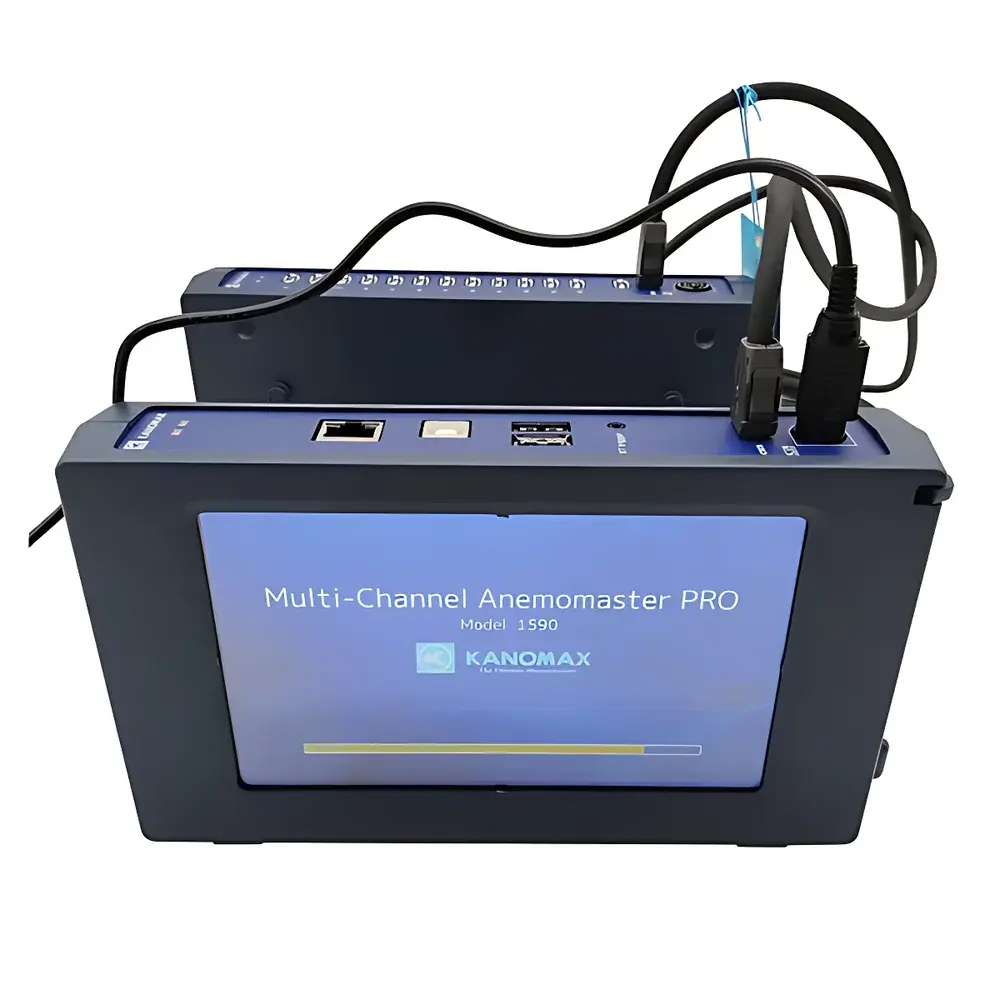
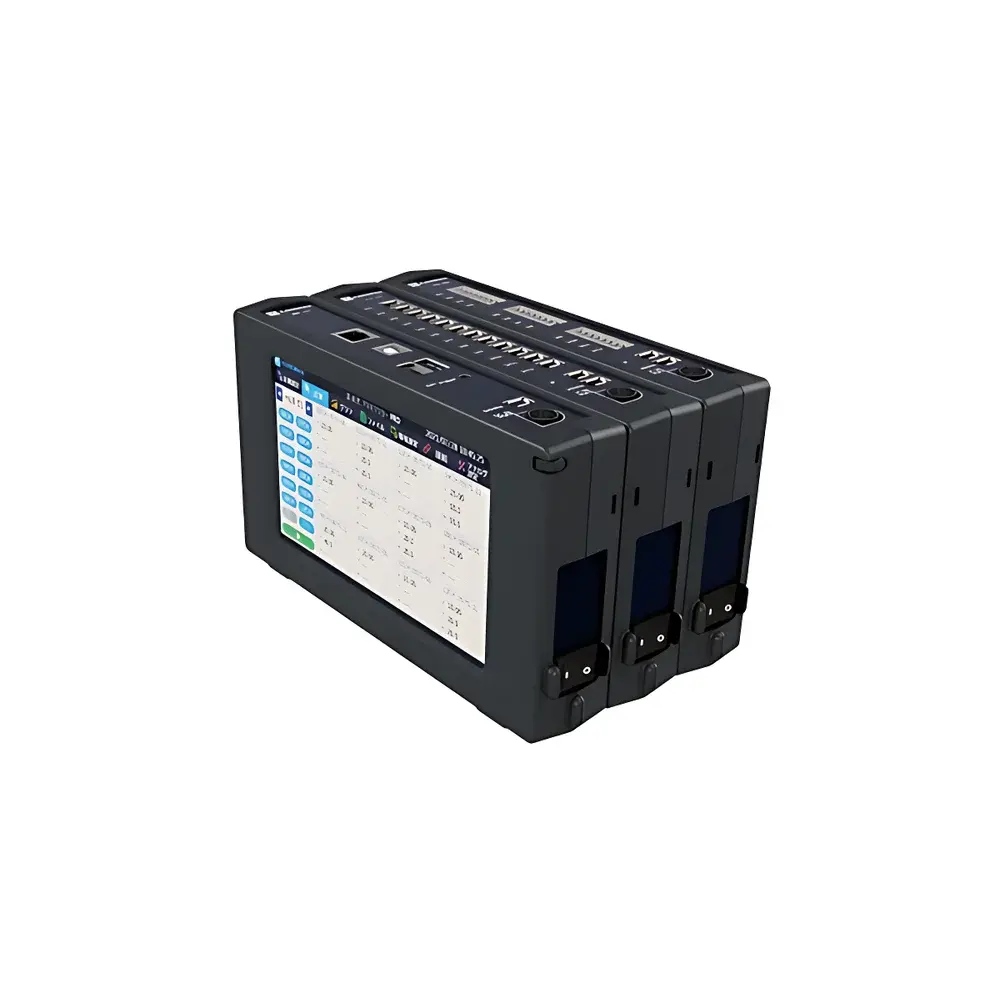
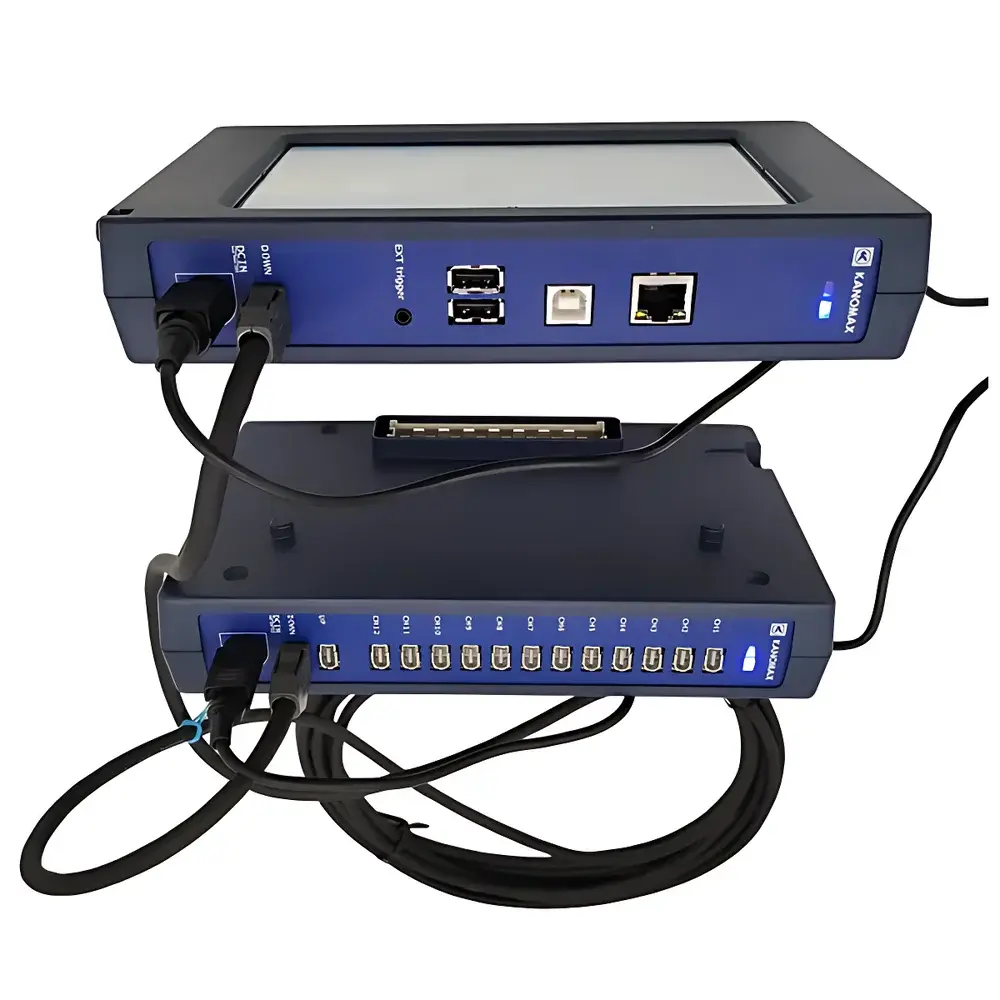
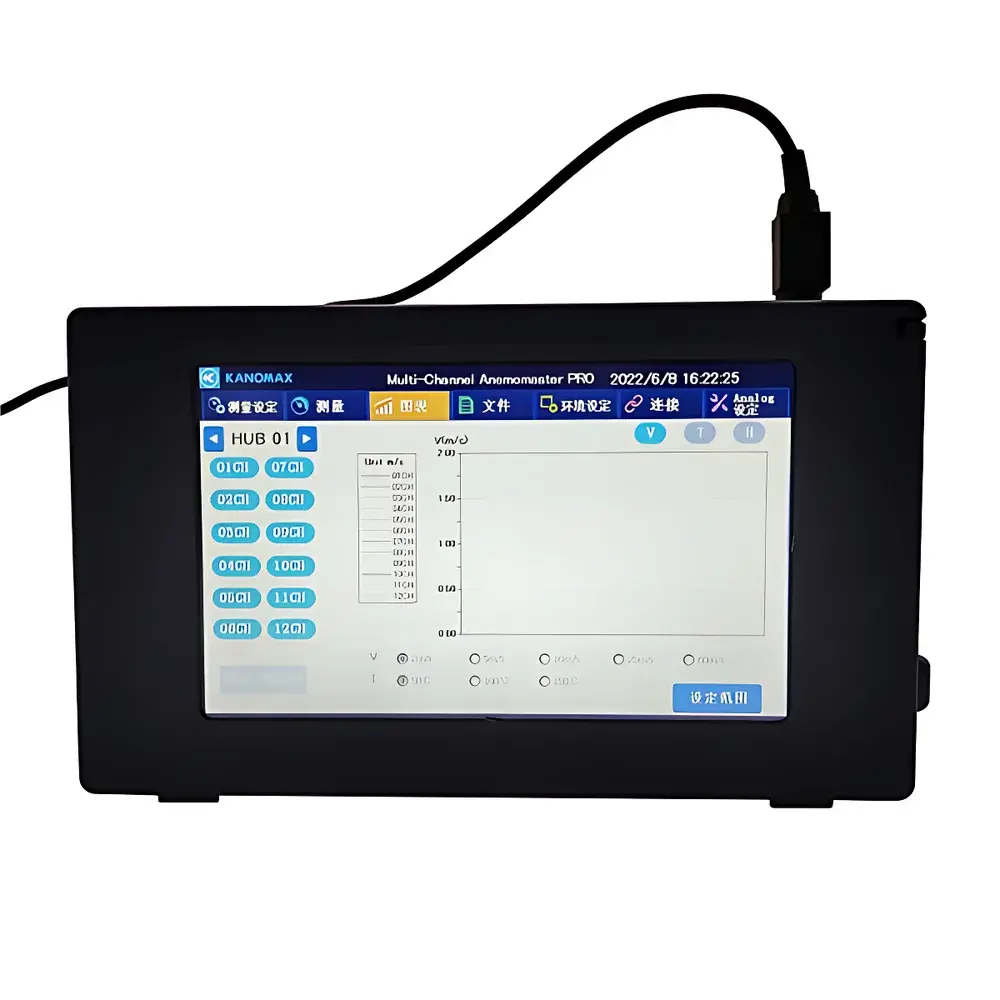
Kanomax Multi-Channel Thermal Anemometer System Model 1590-0C
| Brand | Kanomax |
|---|---|
| Origin | Japan |
| Instrument Type | Thermal Anemometer |
| Resolution | 0.01 m/s |
| Measurement Range | 0.01–50.0 m/s |
| Accuracy | ±2% of reading or ±0.02 m/s (whichever is greater) |
| Operating Temperature | 5–40 °C |
| Operating Humidity | 0–85% RH (non-condensing) |
| Display | 7-inch color LCD touchscreen |
| Max Channels | 144 (12 modules × 12 probes/module) |
| Power Supply | AC 100–240 V / DC 12–24 V |
| Data Storage | 8 GB internal memory (24,500 measurements per module) |
| Communication | USB / LAN |
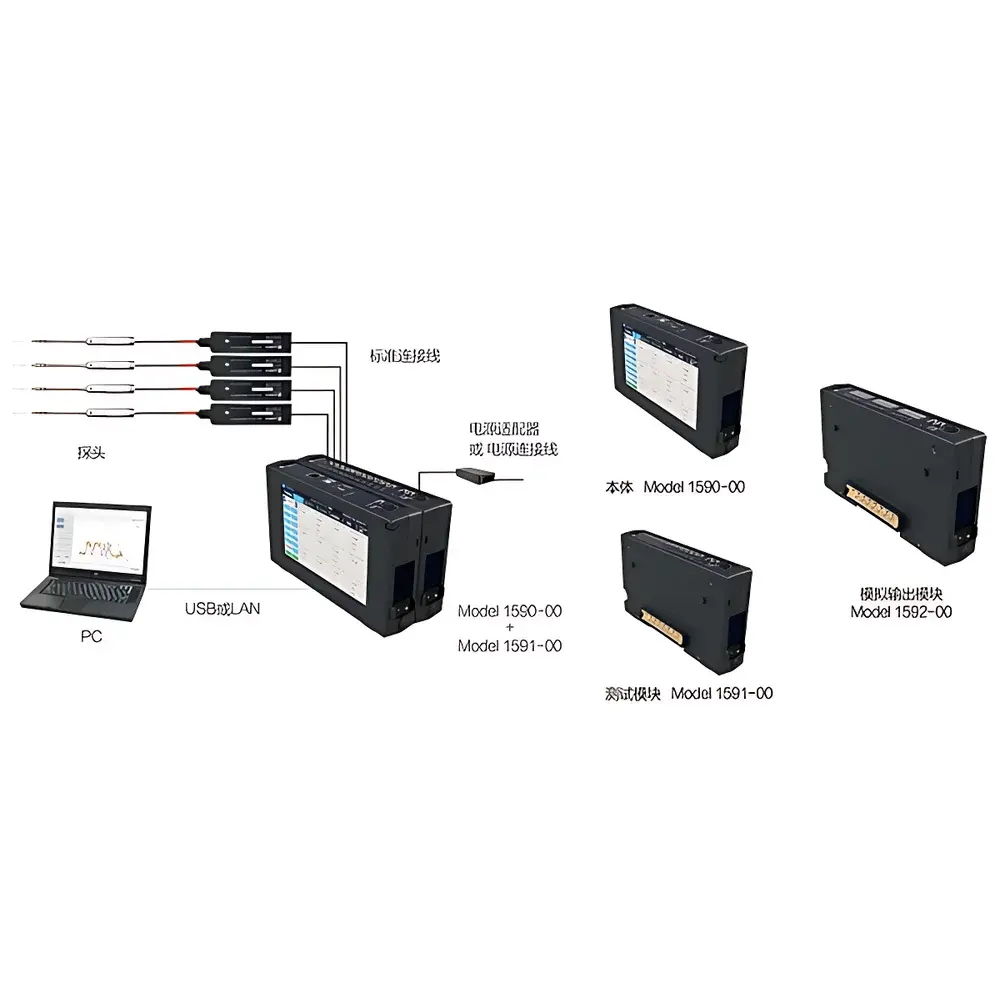
| Output Options | 0–5 V / 4–20 mA (via Model 1592-0C module) |
| Compliance | CE-marked |
Overview
The Kanomax Multi-Channel Thermal Anemometer System Model 1590-0C is a modular, high-fidelity environmental monitoring platform engineered for simultaneous, synchronized measurement of air velocity, temperature, and relative humidity across up to 144 spatially distributed points. Based on constant-temperature anemometry (CTA), the system employs thermally sensitive hot-wire and hot-film probe elements whose resistance changes proportionally with convective heat loss—directly correlating to local airflow velocity. This principle enables stable, low-noise detection down to 0.01 m/s, making it suitable for critical applications in cleanroom qualification, HVAC commissioning, laminar flow verification, and laboratory ventilation validation. Unlike single-point handheld instruments, the 1590-0C architecture decouples sensing, signal conditioning, and data aggregation into three interoperable hardware layers: the central controller (Model 1590-0C), expandable 12-channel measurement modules (Model 1591-0C), and application-specific probes. Its scalable topology supports both fixed-installation monitoring networks and mobile field deployments—including vehicle-mounted configurations—without sacrificing metrological integrity.
Key Features
- Modular scalability: One Model 1590-0C controller supports up to 12 Model 1591-0C measurement modules, each accommodating 12 interchangeable probes—enabling up to 144 concurrent measurement channels.
- Probe flexibility: 15 probe variants—including directional and omnidirectional thermal anemometers, high-temperature models rated to 120 °C, and ultra-compact probes (minimum diameter 3.2 mm)—all share mechanical and electrical compatibility via standardized serial interface.
- Integrated human-machine interface: 7-inch capacitive touchscreen display enables full system configuration, real-time channel visualization, alarm threshold setting, and on-device data review—eliminating dependency on external PCs during setup or field operation.
- Temperature-compensated sensing: All probes incorporate integrated Pt1000 or NTC thermistors with embedded compensation algorithms, ensuring velocity accuracy remains within specification across the full operating range (5–40 °C ambient).
- Dual-power architecture: Supports universal AC input (100–240 V) and wide-range DC input (12–24 V), facilitating use in battery-powered mobile rigs, cleanroom utility panels, and industrial control cabinets.
- Configurable analog output: Optional Model 1592-0C modules provide isolated 0–5 V or 4–20 mA outputs per channel, programmable per probe type and scaling factor—enabling seamless integration with PLCs, SCADA systems, and legacy DAQ hardware.
Sample Compatibility & Compliance
The Model 1590-0C system accommodates diverse sampling geometries through its probe interchangeability and compact form factor. Probes are validated for use in ISO Class 5–8 cleanrooms (per ISO 14644-3), fume hood face velocity surveys (per ANSI/ASHRAE 110), and pharmaceutical facility air change rate verification (per EU GMP Annex 1). While the instrument itself carries CE marking and conforms to IEC 61000-6-3 (EMC) and IEC 61000-6-2 (immunity), its operational compliance depends on correct probe selection and calibration traceability. Kanomax provides NIST-traceable calibration certificates (optional) for individual probes, supporting audit readiness under FDA 21 CFR Part 11 when paired with the system’s built-in audit trail features—such as timestamped configuration logs, user access records, and immutable CSV export with digital signature metadata.
Software & Data Management
Kanomax’s proprietary Windows-based software (v3.x, compatible with Windows 10/11) provides full system orchestration via USB 2.0 or 10/100BASE-T Ethernet. It supports real-time multi-channel plotting with configurable time axes (100 ms–24 h), statistical overlays (min/max/mean/std dev), and dynamic alarm thresholds per channel. Each probe’s serial number, calibration date, and sensitivity coefficient are auto-detected and stored with every dataset. Data export follows strict CSV formatting compliant with ASTM E2911-22 (Standard Practice for Digital Data Exchange in Environmental Monitoring), enabling direct ingestion into LIMS, ELN, or statistical process control platforms. Internal memory retains 24,500 measurement cycles per module (at 1 Hz sampling), with automatic rollover and timestamped file naming. No cloud upload or remote telemetry is implemented—ensuring full data sovereignty for regulated environments.
Applications
- Cleanroom certification: Mapping ISO-defined uniformity zones per ISO 14644-3 using directional probes with <3° angular tolerance.
- HVAC balancing: Quantifying supply/return grilles, duct traverses, and terminal unit discharge velocities with traceable uncertainty budgets.
- Pharmaceutical isolator validation: Monitoring glove port inflow, transfer hatch differential pressure effects, and HEPA filter face velocity at 0.01 m/s resolution.
- Automotive cabin airflow analysis: Deploying miniature probes (<4 mm OD) inside climate control ducts and vent outlets under dynamic thermal load conditions.
- Academic aerodynamics labs: Capturing transient wake profiles behind bluff bodies using synchronized 144-point arrays with sub-second temporal resolution.
- Industrial oven and dryer profiling: Utilizing 120 °C-rated probes to map convective heat transfer coefficients in thermal processing equipment.
FAQ
What is the maximum sampling frequency supported per channel?
The system acquires data at 1 Hz by default; higher rates (up to 10 Hz) are achievable with reduced channel count and require firmware configuration.
Can the system operate unattended for extended periods?
Yes—internal storage supports >27 days of continuous 1 Hz logging per module; external USB drives enable indefinite archiving.
Is probe recalibration required after replacement?
Each probe contains factory-programmed calibration coefficients; no manual recalibration is needed upon swap—but periodic NIST-traceable verification is recommended annually per ISO/IEC 17025.
Does the software support automated report generation?
Raw CSV exports include all metadata required for custom reporting; third-party tools (e.g., Python pandas, MATLAB) can generate PDF/Excel reports with statistical summaries.
How is channel synchronization maintained across modules?
All modules derive timing from the master 1590-0C controller’s internal oscillator, achieving inter-channel skew <10 ms over 144 channels.
Related Products







