
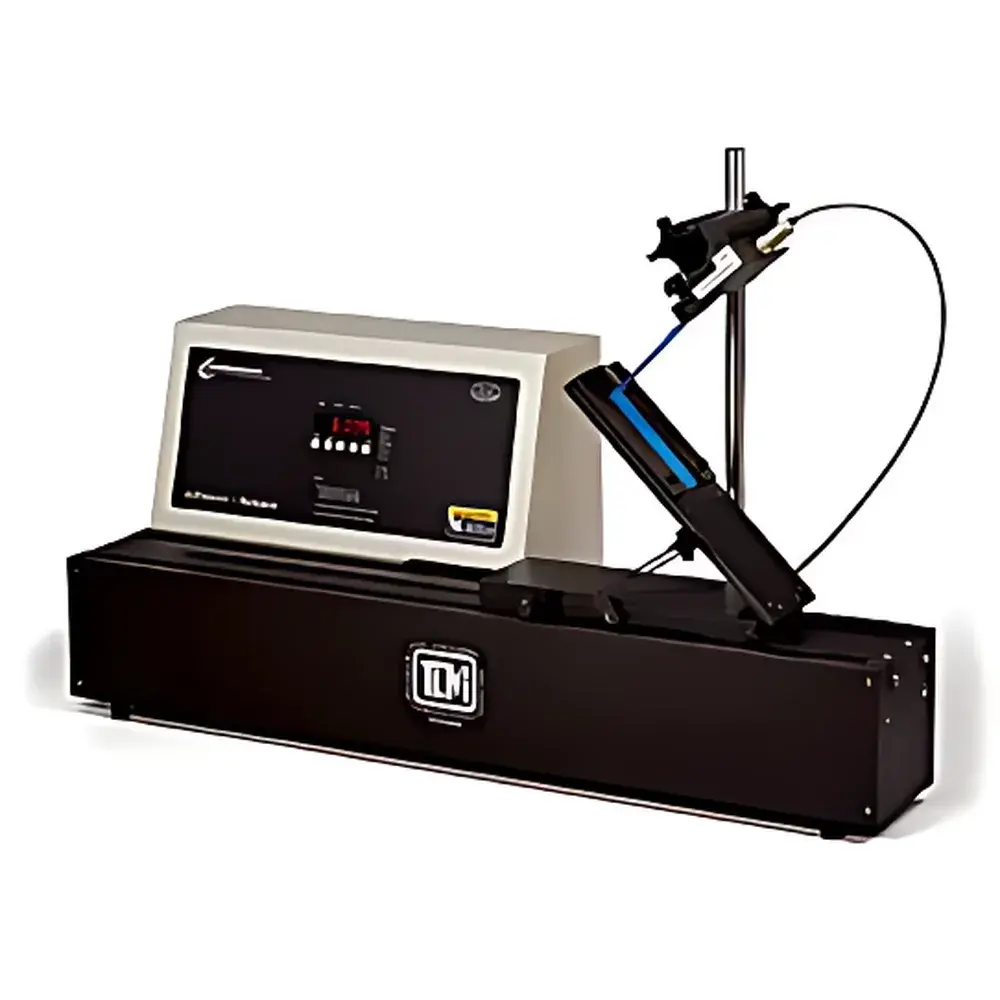
ChemInstruments AR-1000 Adhesion/Release Tester
| Origin | USA |
|---|---|
| Manufacturer Type | Authorized Distributor |
| Origin Category | Imported |
| Model | AR-1000 |
| Price Range | USD 7,000–14,000 |
| Instrument Type | Digital Electromechanical Tensile Testing System |
| Maximum Test Load | 25 lbf (111.2 N) |
| Load Cell Options | 2 lbf, 5 lbf, 10 lbf, 25 lbf |
| Load Accuracy | ±0.1% of full scale |
| Travel Distance | 1000 mm |
| Displacement Resolution | ±0.01 mm |
| Speed Range | 30–3048 mm/min (1.2–120 in/min) |
| Peel Angle Adjustment | 90° to 180° |
| Operating Temperature | 0–70 °C |
| Data Acquisition Rate | 400 Hz |
| Display Units | g, kg, oz, lb, N |
| Data Storage Capacity | 20 independent test records |
| Interface | RS-232 serial |
| Software | EZ-Lab v3.x for real-time plotting, statistical analysis, and GLP-compliant reporting |
Overview
The ChemInstruments AR-1000 Adhesion/Release Tester is a precision-engineered electromechanical tensile testing system designed specifically for quantitative measurement of peel adhesion, release force, and tack performance of pressure-sensitive adhesives (PSAs), labels, tapes, laminates, and coated films. It operates on the fundamental principle of controlled uniaxial tension applied at defined angles and speeds to standardized specimens, generating force–displacement curves that comply with internationally recognized test methodologies. Unlike generic universal testers, the AR-1000 integrates mechanical, sensor, and software subsystems calibrated and validated for adhesive-specific protocols—ensuring traceable, repeatable, and auditable results required in R&D, quality control, and regulatory submissions.
Key Features
- Dual-mode digital load cell architecture supporting interchangeable 2 lbf, 5 lbf, 10 lbf, and 25 lbf transducers—enabling optimal signal-to-noise ratio across low-force (e.g., liner release) and high-force (e.g., structural tape peel) applications.
- Motor-driven crosshead with closed-loop speed feedback control, maintaining ±0.1% speed accuracy over the full range of 30–3048 mm/min (1.2–120 in/min), critical for ASTM D3330 Method A (90° peel) and FINAT FTM 1 (180° peel).
- Manually adjustable peel angle fixture (90°–180°) with angular vernier scale and locking mechanism, ensuring mechanical repeatability within ±0.5°—essential for comparative studies between PSTC-101 variants (A–F) and AFERA 4001 P11.
- High-resolution displacement encoder (±0.01 mm resolution) synchronized with 400 Hz data acquisition, capturing transient force events such as adhesive stringing, cohesive failure onset, or substrate yielding.
- Integrated front-panel digital display showing real-time force (N/lb), displacement (mm/in), peak load, average peel force, and standard deviation—without requiring external PC connection for basic operation.
- Robust aluminum-and-steel frame (610 × 910 × 330 mm; 42 kg) with reinforced base plate and vibration-dampening feet, suitable for shared lab environments and ISO 17025-accredited testing laboratories.
Sample Compatibility & Compliance
The AR-1000 accommodates standard specimen widths (e.g., 25 mm per ASTM D3330, 1 in per PSTC-101) and supports rigid substrates (stainless steel TP-26 test plates, 50 × 150 mm), flexible backings (PET, PP, paper), and liner materials. Its mechanical design and calibration protocol are aligned with ISO/IEC 17025 requirements for measurement uncertainty estimation. The system meets the essential performance criteria of multiple international standards—including ASTM D3330 (peel adhesion), PSTC-101 (various peel configurations), TLMI L-IA1–L-IA3 (label release), FINAT FTM 1–6, 10–11 (tape and label testing), and AFERA 4001 (adhesive classification). All load cells are NIST-traceable and supplied with individual calibration certificates valid for 12 months.
Software & Data Management
EZ-Lab software (v3.x) provides a GLP-compliant environment for test method definition, real-time curve visualization, statistical summary (mean, SD, CV%), and export to CSV/PDF formats. It supports audit trail logging per FDA 21 CFR Part 11 (with optional user authentication module), including operator ID, timestamp, method parameters, and raw data integrity verification. Up to 20 test records can be stored internally and transferred via RS-232 to laboratory information management systems (LIMS) or enterprise QA databases. The software allows overlay comparison of up to six curves, automatic calculation of 10-point moving averages, and customizable report templates compliant with internal SOPs or customer-facing documentation requirements.
Applications
- Quantification of liner release force in medical device packaging and pharmaceutical blister foil applications.
- Peel strength validation of automotive interior trim tapes under thermal cycling (0–70 °C operational range).
- Comparative evaluation of acrylic vs. rubber-based PSA formulations across multiple substrates (glass, stainless steel, HDPE).
- QC release testing of label stock against FINAT FTM 2 (quick stick) and FTM 3 (holding power) specifications.
- Root-cause analysis of delamination failures in multilayer flexible packaging using force–displacement signature analysis.
- Support for ASTM D6252 (loop tack) and D2979 (probe tack) when used with optional accessories (not included).
FAQ
Does the AR-1000 meet FDA 21 CFR Part 11 requirements for electronic records?
Yes—when configured with EZ-Lab’s optional audit trail and electronic signature modules, the system supports ALCOA+ principles (Attributable, Legible, Contemporaneous, Original, Accurate) and satisfies Part 11 compliance for regulated industries.
Can I switch load cells without recalibration?
No. Each load cell must be individually calibrated using the supplied NIST-traceable reference weights. EZ-Lab supports multi-load-cell configuration profiles but requires verified calibration before use.
Is the 1000 mm travel sufficient for long-stroke peel tests?
Yes—the travel length exceeds the minimum 300 mm specified in ASTM D3330 and PSTC-101, and accommodates extended dwell-time peel sequences used in accelerated aging studies.
What environmental conditions affect measurement stability?
Ambient temperature fluctuations >±2 °C/hour may induce thermal drift in load cell output. For GLP-grade results, operation within 23±2 °C and 50±5% RH is recommended, per ISO 291.
Are test fixtures included with the base system?
The standard configuration includes TP-26 stainless steel test plates (10 pcs), HR-100 hand roller (2 kg), and SC-100 sample cutter. Additional fixtures (e.g., loop tack jig, probe tack assembly) are available as optional accessories.



