
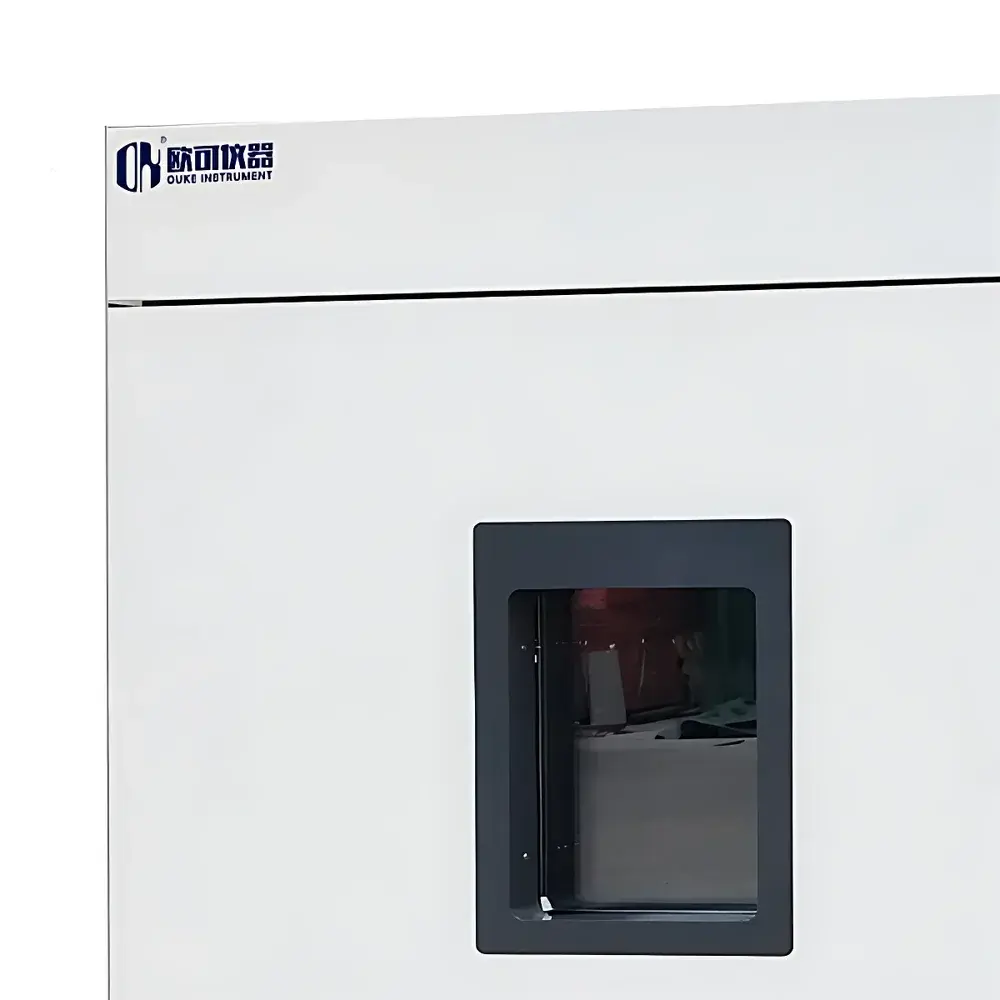
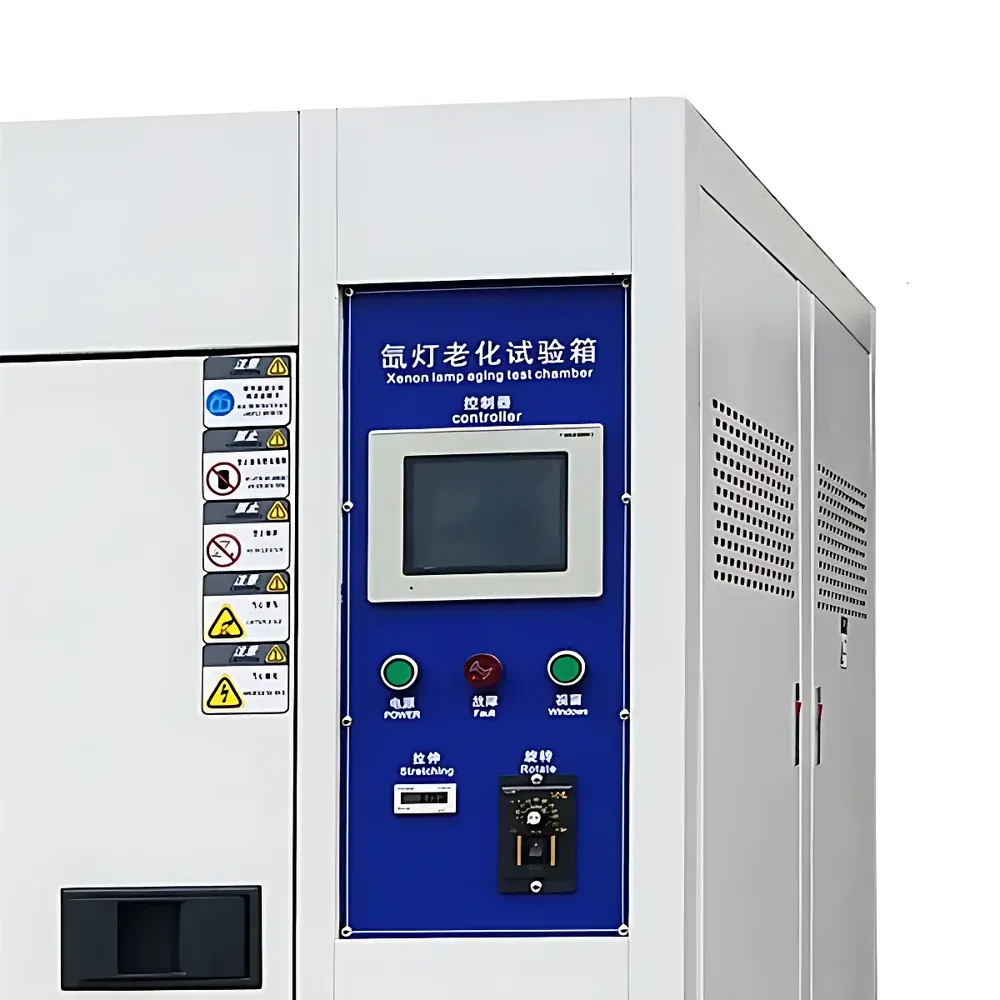
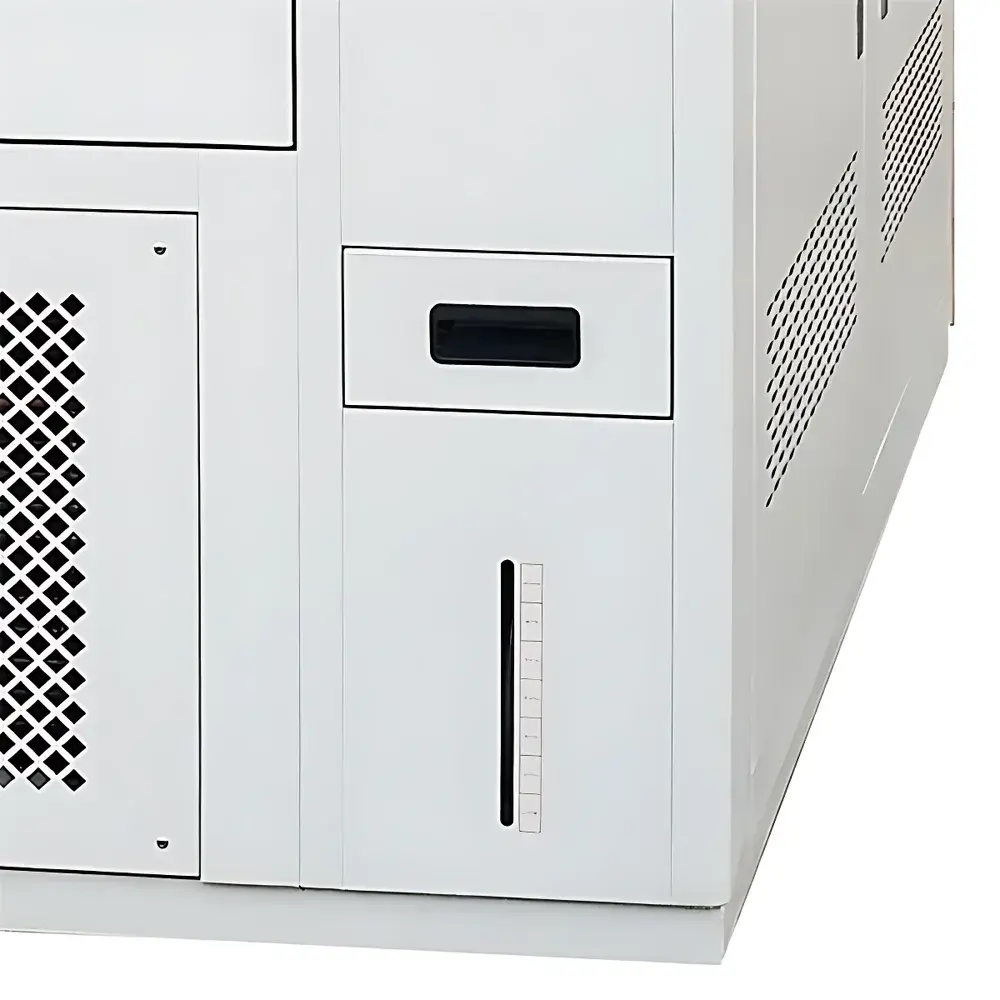
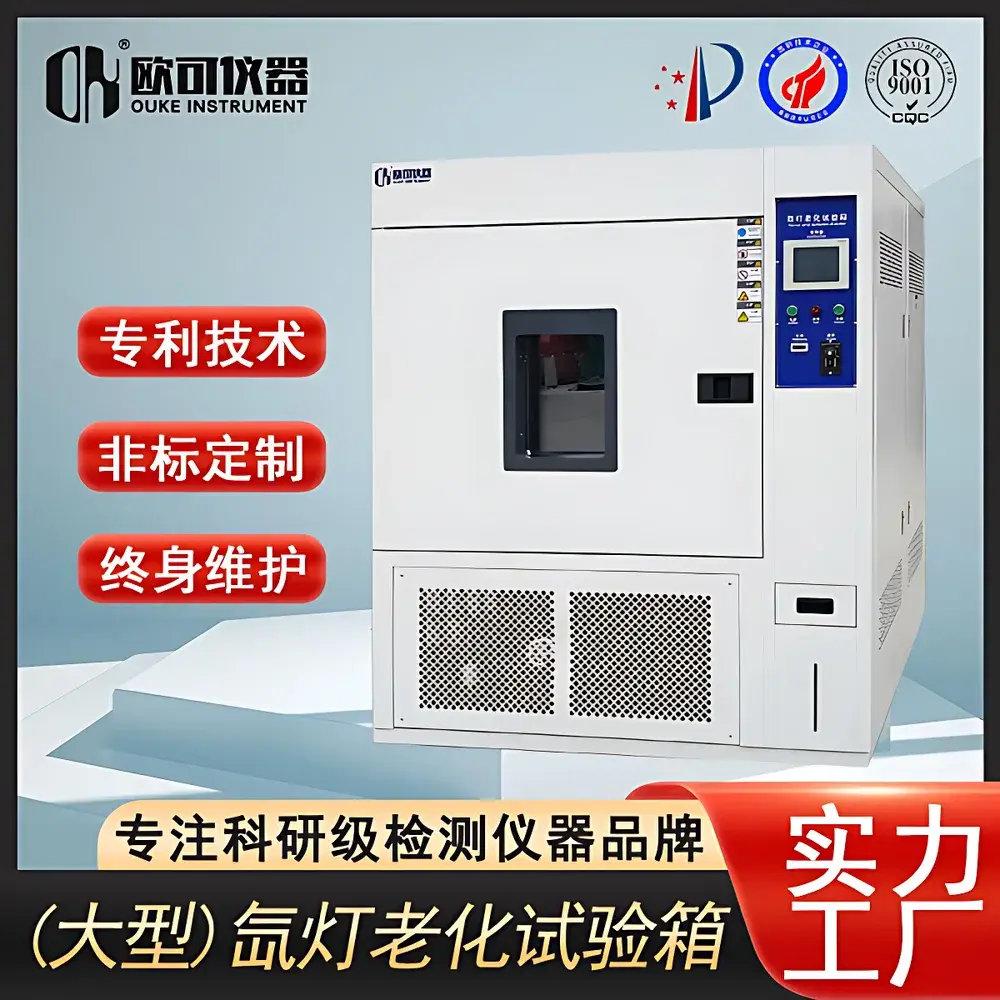
OK Xenon Arc Weathering Test Chamber OK-XD-225.0
| Brand | OK Instruments |
|---|---|
| Origin | Guangdong, China |
| Manufacturer Type | Direct Manufacturer |
| Model | OK-XD-225.0 |
| Xenon Lamp Power | 3 kW |
| Irradiance Range | ≤1200 W/m² |
| Light Cycle Setting Range | 1–999 hours/minutes/seconds (continuously adjustable) |
| Humidity Range (Light Cycle) | 20–75% RH |
Overview
The OK Xenon Arc Weathering Test Chamber OK-XD-225.0 is an engineered environmental simulation system designed to replicate and accelerate the complex outdoor weathering conditions that materials experience under natural solar exposure. It employs a 3 kW air-cooled xenon arc lamp as its primary radiation source — selected for its spectral power distribution closely matching terrestrial sunlight across UV (290–400 nm), visible (400–700 nm), and near-infrared (700–1100 nm) wavelengths. This full-spectrum fidelity enables physicochemical degradation pathways — including photo-oxidation, hydrolysis, thermal cycling stress, and moisture-induced swelling — to proceed in a manner highly correlated with real-world field aging. The chamber integrates tightly coupled control of irradiance, black panel temperature (BPT), chamber air temperature, relative humidity, and programmable water spray/cold condensation cycles — all synchronized via a PID-regulated microprocessor controller. Unlike narrowband UV testers, this system models multi-factor synergism: simultaneous UV photolysis, thermal activation, hygroscopic stress, and mechanical erosion from simulated rainfall — essential for evaluating color stability, gloss retention, chalking, cracking, tensile loss, and surface morphology evolution in polymeric, coated, textile, and composite systems.
Key Features
- 3 kW air-cooled xenon arc lamp with integrated reflector assembly and quartz envelope optimized for long-term spectral stability
- Interchangeable optical filter system: Daylight (CIRA/soda-lime), Window Glass (WG), and Extended UV filters — compliant with ISO 4892-2 and ASTM G155 spectral requirements
- Precise irradiance control: Real-time monitoring via calibrated silicon photodiode sensor; automatic lamp power modulation maintains ±5% irradiance uniformity across specimen plane (300–400 nm or 340 nm band)
- Independent dual-zone climate control: Air temperature range: 10–80°C; Black panel temperature range: 30–100°C; Humidity range: 20–75% RH during light cycle (non-condensing)
- Programmable water delivery: Front-mounted spray nozzles (deionized water only) deliver uniform 0.2–0.6 L/min/m² rain simulation; optional backside condensation mode via controlled dew-point cooling
- Rotating specimen rack (5° tilt, 1 rpm) ensures ±5% irradiance uniformity per ISO 4892-2 Annex A; stainless steel 316L chamber interior with insulated double-wall construction
- 7-inch capacitive touch HMI with embedded PLC; supports up to 100 user-defined test profiles with ramp/soak segments, event-triggered spray, and real-time data logging (time-stamped irradiance, temp, RH, spray status)
Sample Compatibility & Compliance
The OK-XD-225.0 accommodates flat-panel specimens up to 225 mm × 450 mm (standard rack capacity: 20 × 75 mm strips or 10 × 150 mm plaques). Compatible substrates include thermoplastics (PP, ABS, PC), elastomers (EPDM, SBR), architectural coatings, automotive OEM paints, textile weaves (polyester, nylon, acrylic), leather finishes, PV module backsheets (TPT, PET), and sealants (silicone, polyurethane). All operational parameters align with internationally recognized weathering test standards: ISO 4892-2 (Plastics — Methods of exposure to laboratory light sources — Part 2: Xenon-arc lamps), ASTM G155 (Standard Practice for Operating Xenon Arc Light Apparatus for Exposure of Non-Metallic Materials), ASTM D2565 (Plastics — Exposure to Solar Radiation Using a Xenon-Arc Lamp), AATCC TM16 (Colorfastness to Light), and GB/T 16422.2 (Chinese national standard equivalent to ISO 4892-2). System architecture supports GLP-compliant operation: audit trail enabled, user access levels (operator/admin), electronic signature capability, and exportable CSV/Excel data logs traceable to NIST-traceable calibration records.
Software & Data Management
The embedded control firmware implements deterministic real-time scheduling for multi-parameter synchronization. Test profiles are defined using ISO/ASTM-compliant parameter sets — e.g., “Cycle A” per ASTM G155: 102 min light (65°C BPT, 50% RH) + 18 min dark (50°C chamber, 95% RH, spray active). All sensor outputs — irradiance (W/m² @ 340 nm), black panel temperature (°C), chamber air temperature (°C), relative humidity (% RH), and spray on/off status — are sampled at 1 Hz and stored with millisecond timestamps. Data export supports CSV, PDF report generation (including trend plots and pass/fail flags against user thresholds), and direct integration with LIMS via Modbus TCP/IP. Firmware updates are performed via USB; calibration coefficients for irradiance and temperature sensors are digitally signed and write-protected. For regulatory environments, optional 21 CFR Part 11 compliance package includes electronic signature workflows, role-based permissions, and immutable audit logs.
Applications
- Automotive: Accelerated validation of instrument panel substrates, door trims, seat fabrics, and exterior clearcoats per SAE J2412/J2527 protocols
- Coatings & Inks: Quantitative assessment of chalking resistance (ASTM D4214), gloss retention (ASTM D523), and color shift (ΔE* CIEDE2000) in architectural and industrial coatings
- Polymers & Elastomers: Monitoring embrittlement onset (notched Izod impact), yellowing index (YI per ASTM E313), and carbonyl index growth via post-test FTIR
- Textiles & Nonwovens: Correlating accelerated exposure to outdoor service life for awnings, geotextiles, and military-grade camouflage fabrics
- Photovoltaics: Evaluating encapsulant browning (EVA, POE), backsheet delamination, and adhesion loss in module laminates per IEC 61215 sequence
- Building Materials: Testing UV resistance of PVC window profiles, silicone sealants, and wood-plastic composites under cyclic wet/dry conditions
FAQ
What spectral filters are included with the OK-XD-225.0, and how do they align with test standards?
The standard configuration includes daylight (CIRA/soda-lime) and window glass (WG) filters — both certified per ISO 4892-2 spectral tolerances. Optional extended UV filters are available for high-acceleration testing per ASTM D4459.
Is the irradiance sensor factory-calibrated, and what is the recommended recalibration interval?
Yes — each unit ships with NIST-traceable calibration certificate for the 340 nm band sensor. Annual recalibration is recommended; OK Instruments provides accredited third-party service with turnaround under 10 business days.
Can the chamber operate without water spray during dark cycles?
Yes — spray activation is fully decoupled from light/dark timing. Users may configure condensation-only, spray-only, or combined modes independently per segment.
What maintenance is required for optimal spectral stability over lamp lifetime?
Xenon lamps require replacement after 1,500 ±200 hours of operation. Quartz envelopes and optical filters must be cleaned weekly with spectroscopic-grade methanol; filter replacement is recommended every 3,000 lamp-hours or per visual inspection for haze.
Does the system support remote monitoring and alarm notification?
Yes — Ethernet connectivity enables SNMP-based alerts (email/SMS) for critical faults (lamp failure, temperature excursion >±5°C, low water level). Web-based dashboard (HTTPS) allows real-time parameter viewing and profile upload/download.



