
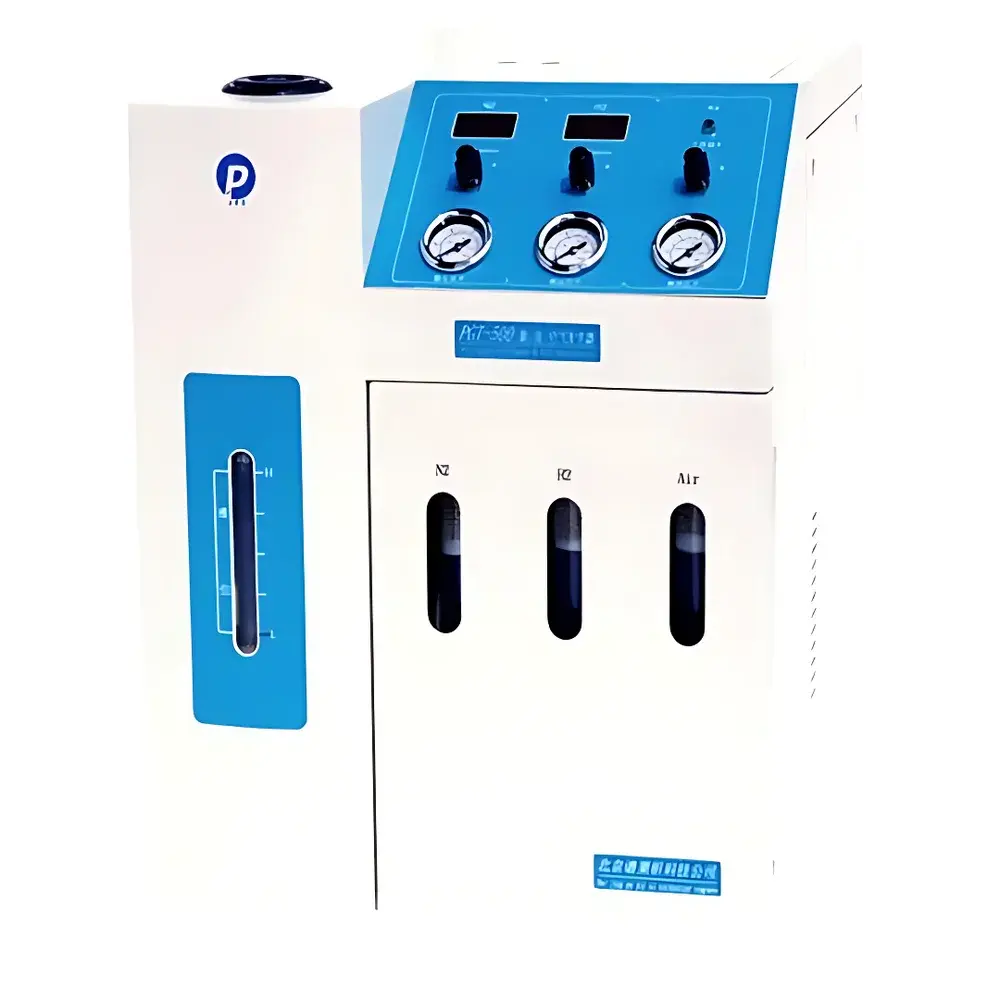
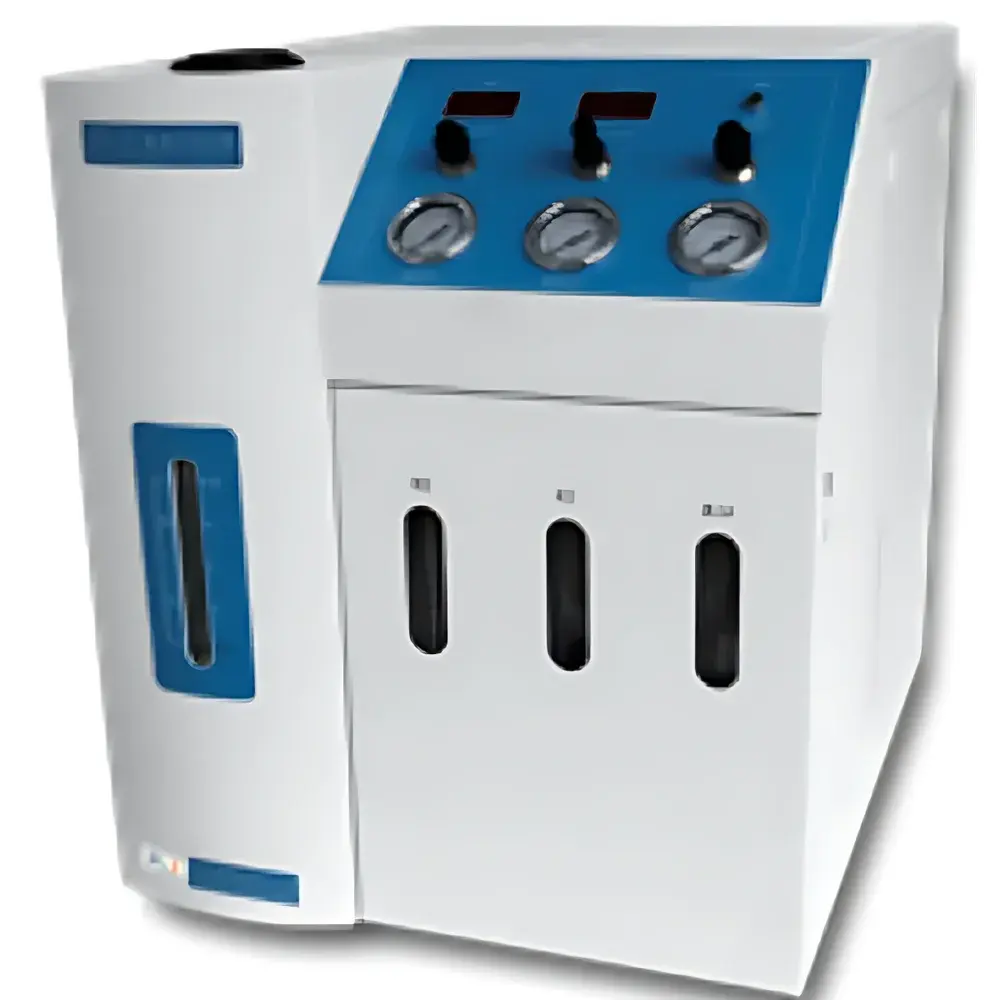
Huayisanpu PGT-300/500 Integrated Nitrogen-Hydrogen-Air Gas Generator
| Brand | Beijing Huayisanpu |
|---|---|
| Origin | Beijing, China |
| Model | PGT-300/500 Integrated N₂–H₂–Air Generator |
| Nitrogen Purity | 99.994% (O₂ ≤ 60 ppm) |
| Hydrogen Purity | 99.999% (O₂ + H₂O ≤ 1 ppm) |
| Air Purity | Oil-free, Class 3 per ISO 8573-1 |
| Nitrogen Flow Rate | 0–300 mL/min (PGT-300) / 0–500 mL/min (PGT-500) |
| Hydrogen Flow Rate | 0–300 mL/min (PGT-300) / 0–500 mL/min (PGT-500) |
| Air Flow Rate | 0–2 L/min (PGT-300) / 0–5 L/min (PGT-500) |
| Output Pressure | 0.4 MPa (adjustable, stability ≤ ±0.01 MPa) |
| Power Supply | AC 220 V, 50 Hz |
| Max. Power Consumption | 350 W (PGT-300) / 450 W (PGT-500) |
| Dimensions (L×W×H) | 505 × 400 × 460 mm |
| Weight | 40 kg (PGT-300) / 42 kg (PGT-500) |
| Operating Environment | 0–45 °C, RH < 85%, non-corrosive, low-dust |
| Water Requirement | Deionized or distilled water only |
| Design | Integrated monolithic chassis with independent gas modules and shared control logic |
Overview
The Huayisanpu PGT-300/500 Integrated Nitrogen-Hydrogen-Air Gas Generator is an engineered solution for laboratories requiring reliable, on-demand supply of high-purity carrier, fuel, and combustion-support gases for gas chromatography (GC) systems—particularly those equipped with Flame Ionization Detectors (FID), Thermal Conductivity Detectors (TCD), and Electron Capture Detectors (ECD). Unlike conventional cylinder-based gas delivery, this generator employs three parallel, physically isolated gas generation technologies within a single robust enclosure: pressure-swing adsorption (PSA) with multi-stage purification for nitrogen; alkaline electrolysis using a high-efficiency tubular electrolytic cell for hydrogen; and multi-stage filtration (coalescing, activated carbon, and molecular sieve) for oil-free air. All subsystems operate under precise pressure regulation (0.4 MPa nominal, ±0.01 MPa stability), enabling seamless integration with GC inlets, detectors, and auxiliary modules without flow interruption or purity drift over time.
Key Features
- Integrated monolithic architecture with independent N₂, H₂, and air modules—eliminates cross-contamination risk while enabling simultaneous or selective gas output.
- Nitrogen subsystem utilizes a multi-layer plate-type PSA column with re-purification cycling, achieving 99.994% purity (residual O₂ ≤ 60 ppm), suitable for FID carrier gas and TCD reference applications per ASTM D6299 and ISO 10101-2 requirements.
- Hydrogen subsystem employs a high-aspect-ratio tubular alkaline electrolyzer with integrated oxygen venting, low-temperature operation (< 45 °C), and real-time electrolyte level monitoring—delivering 99.999% H₂ (total impurities ≤ 1 ppm) compliant with USP & EP monographs for GC-grade hydrogen.
- Air subsystem incorporates three-stage purification (particulate → oil vapor → moisture), dual-stage pressure stabilization, and automatic condensate drainage—meeting ISO 8573-1 Class 3 specifications for particle count, oil content, and dew point.
- Digital LED flow displays for N₂ and H₂ outputs provide real-time, calibrated volumetric readouts (mL/min); air flow is indicated via analog pressure gauge with calibrated scale.
- Fail-safe engineering includes non-return liquid traps on both N₂ and H₂ lines, over-pressure relief valves, electrolyte low-level cutoff, and thermal shutdown—fully compliant with IEC 61010-1 for laboratory electrical safety.
- Energy-efficient switch-mode power supply reduces standby consumption and improves electrolysis current efficiency versus legacy linear designs.
Sample Compatibility & Compliance
The PGT-300/500 is designed for direct interfacing with all major GC platforms—including Agilent, Thermo Fisher, Shimadzu, and PerkinElmer—via standard 1/8″ stainless steel tubing and Swagelok fittings. Its stable output pressure (0.4 MPa) matches typical GC inlet and detector operating ranges, eliminating need for external regulators. The instrument meets CE marking requirements for EMC and LVD directives. While not certified to FDA 21 CFR Part 11 out-of-the-box, its operational logs (power-on duration, runtime hours, and alarm events) are stored in non-volatile memory and exportable via USB for GLP/GMP audit trails. All gas purity levels satisfy minimum thresholds defined in USP , EP 2.2.42, and ISO/IEC 17025 Annex A for GC method validation.
Software & Data Management
The PGT-300/500 operates as a standalone hardware system with no embedded microprocessor or network interface. All control logic resides in discrete analog/digital circuitry, ensuring deterministic response and immunity to firmware corruption. Operational status—including power-on time, cumulative runtime, and fault codes (e.g., “H₂ Low Water”, “N₂ High Temp”)—is logged internally and accessible via front-panel diagnostic mode. No proprietary software is required for commissioning or routine use; however, optional RS-232 or Modbus RTU interfaces (available upon request) enable integration into centralized lab infrastructure management systems for remote monitoring and preventive maintenance scheduling.
Applications
- Carrier gas supply for capillary GC columns (N₂ at 300–500 mL/min, 0.4 MPa).
- Fuel gas for FID detectors (H₂ at 300–500 mL/min, stoichiometric ratio optimized for hydrocarbon detection).
- Make-up or combustion air for FID and NPD detectors (oil-free air at 2–5 L/min).
- Reference gas for TCD operation requiring inert, low-thermal-conductivity background (N₂).
- Lab-wide replacement for high-pressure gas cylinders—reducing storage hazards, rental fees, and delivery logistics.
- Support for multi-instrument GC labs where synchronized gas delivery across 2–4 systems is required.
FAQ
What is the expected service life of the electrolytic cell?
Under normal operation with deionized water replenishment every 7–10 days (based on 8 h/day usage), the tubular electrolyzer maintains ≥95% initial efficiency for ≥5 years.
Can the nitrogen and hydrogen outputs be used simultaneously without cross-interference?
Yes—the N₂ and H₂ modules are fully isolated by physical barriers and dedicated gas pathways; no shared internal manifolds or common purge lines exist.
Is compressed air input required for the air generator section?
No—the air module draws ambient air, filters it through three stages, compresses it internally, and delivers regulated oil-free output.
Does the unit require annual calibration or certification?
No scheduled calibration is mandated; however, users may verify flow accuracy annually using a NIST-traceable wet-test meter per ISO 5167 guidelines.
What maintenance is required beyond water refills?
Annual replacement of air filter cartridges and desiccant in the air module; biannual inspection of PSA carbon molecular sieve integrity; no consumables in N₂ or H₂ subsystems.



