
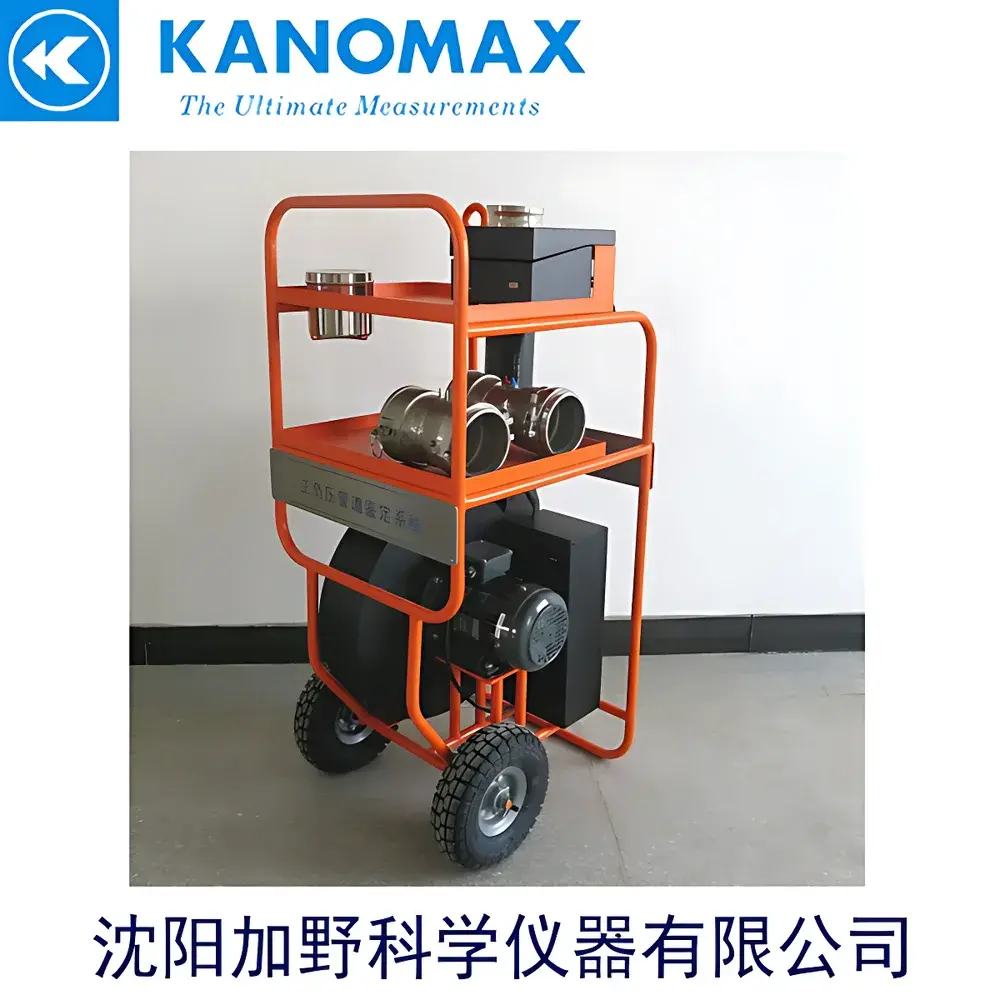
Kanomax DAL T6900 Positive/Negative Pressure Duct Leakage Tester
| Brand | Kanomax |
|---|---|
| Origin | China (Liaoning) |
| Model | DALT 6900 |
| Airflow Range | 36–640 m³/h (nozzle range: 4–36 m³/h) |
| Accuracy | ±2.5% of reading ±0.1 m³/h (airflow), ±1% of reading ±1 Pa (static pressure) |
| Resolution | 0.01 m³/h (airflow), 0.1 Pa (pressure), 0.1 °C (temperature), 0.1 kPa (atmospheric pressure) |
| Static Pressure Range | ±2500 Pa |
| Temperature Range | 0–60 °C |
| Atmospheric Pressure Range | 70–130 kPa |
| Power Supply | DALT 6900-0E: 110–120 V, 1Φ, 50/60 Hz, 16 A |
| DALT 6900-1E | 220–240 V, 1Φ, 50/60 Hz, 10 A |
| Weight | ~72 kg |
| Dimensions | 540 × 500 × 1200 mm |
| Data Storage | 1000 test records |
| Display | 4.7-inch color LCD touchscreen |
Overview
The Kanomax DAL T6900 Positive/Negative Pressure Duct Leakage Tester is a fully integrated, standards-compliant instrument engineered for quantitative assessment of air leakage in HVAC duct systems under controlled pressurization conditions. It operates on the principle of constant-pressure differential testing—applying regulated positive or negative static pressure to sealed duct sections while precisely measuring volumetric airflow required to maintain that pressure. This method directly quantifies leakage rate in accordance with internationally recognized duct airtightness protocols. Unlike manual calculation-based systems, the DAL T6900 performs real-time computation and pass/fail evaluation in accordance with preloaded compliance criteria, eliminating operator-dependent arithmetic errors and reducing test cycle time by up to 40%. Its dual-mode pressure control architecture enables seamless transition between +2500 Pa overpressure and –2500 Pa underpressure testing without hardware reconfiguration—critical for verifying both supply and return system integrity in commercial and institutional HVAC installations.
Key Features
- Full-range bidirectional static pressure control (±2500 Pa) with closed-loop digital regulation and automatic zero-point compensation
- Dual-sensor airflow measurement system: high-flow turbine meter (36–640 m³/h) and low-flow calibrated nozzle array (4–36 m³/h), each optimized for dynamic range and Reynolds-number stability
- Integrated environmental monitoring: simultaneous real-time acquisition of static pressure, ambient temperature (0–60 °C), and atmospheric pressure (70–130 kPa)
- 4.7-inch capacitive touchscreen interface with intuitive icon-driven workflow navigation and multilingual UI support (English, Spanish, French, Chinese)
- Onboard pass/fail logic engine compliant with EN 1507:2006, EN 12237:2002, Eurovent 2/2, DW/143, SMACNA HVAC Air Duct Leakage Test Manual, and GB 50243–2002
- Internal non-volatile memory stores up to 1000 complete test records—including timestamp, pressure curve, leakage profile, environmental metadata, and compliance status
- Rugged industrial chassis (72 kg, powder-coated steel frame) designed for field deployment; modular pneumatic connections and tool-free nozzle interchange
Sample Compatibility & Compliance
The DAL T6900 is validated for use across all common HVAC duct construction types—including galvanized steel, aluminum, fiberglass-reinforced polymer (FRP), and flexible ducting—regardless of cross-sectional geometry (rectangular, round, oval). It supports both sectional testing (individual duct runs) and whole-system verification (entire air handling unit to terminal device). The instrument’s firmware embeds mandatory acceptance thresholds per standard: Class A (tightest), Class B, and Class C per EN 1507; SMACNA’s Low-, Medium-, and High-Pressure classifications; and GB 50243–2002’s three-tiered leakage limits based on system static pressure class. All internal calibration routines are traceable to NIST-certified reference standards, and the device meets CE marking requirements for electromagnetic compatibility (EN 61326-1) and safety (EN 61010-1). It is routinely deployed in third-party commissioning audits requiring ISO/IEC 17025-accredited test documentation.
Software & Data Management
Test data export is supported via USB 2.0 host port (FAT32-formatted flash drive) in CSV and PDF report formats, both containing embedded digital signatures and full audit trails. Optional Kanomax DuctLink™ PC software (Windows 10/11) enables centralized fleet management, comparative analysis across multiple test sites, automated report generation with company letterhead, and integration with BIM-based commissioning platforms. All stored records include immutable timestamps, operator ID fields, GPS-tagged location metadata (when paired with optional Bluetooth GNSS module), and version-stamped firmware identifiers—ensuring full alignment with GLP and ISO 9001 documentation requirements. The system maintains full 21 CFR Part 11 readiness through user-level access controls, electronic signature workflows, and tamper-evident record history.
Applications
- Pre-commissioning verification of ductwork installed per ASHRAE Guideline 1 and IECC Section C403.2.2
- Post-construction air barrier validation for LEED v4.1 EQ Credit: Enhanced Indoor Air Quality Strategies
- Periodic maintenance auditing of aging HVAC infrastructure in hospitals, laboratories, and cleanrooms
- Third-party certification testing for building code compliance (IBC Chapter 16, IMC Section 603)
- Energy performance diagnostics supporting ASHRAE Standard 202–2018 Commissioning Process
- Research-grade leakage characterization for duct sealing material development and retrofit efficacy studies
FAQ
Does the DAL T6900 require external calibration certificates for field use?
No—each unit ships with a factory-issued calibration certificate traceable to national metrology institutes. Annual recalibration is recommended and supported by Kanomax-authorized service centers globally.
Can test results be exported directly to building commissioning management platforms?
Yes—CSV exports contain all raw sensor values and derived metrics; PDF reports include QR-coded verification links for remote audit validation.
Is the instrument suitable for high-static-pressure duct systems exceeding 2000 Pa?
Yes—the ±2500 Pa pressure range accommodates Class III and IV SMACNA systems, including high-rise pressurization shafts and industrial process ducts.
How does the system handle temperature and barometric drift during extended tests?
Real-time environmental compensation algorithms continuously adjust airflow calculations using concurrent temperature and atmospheric pressure inputs, maintaining accuracy across ambient shifts of up to 30 °C and 20 kPa.
What safety protections are built into the pressure control system?
Hardware-limited pressure relief valves, redundant digital pressure cutoffs, and audible/visual overpressure alarms ensure operator and duct integrity protection at all times.
Related Products







