
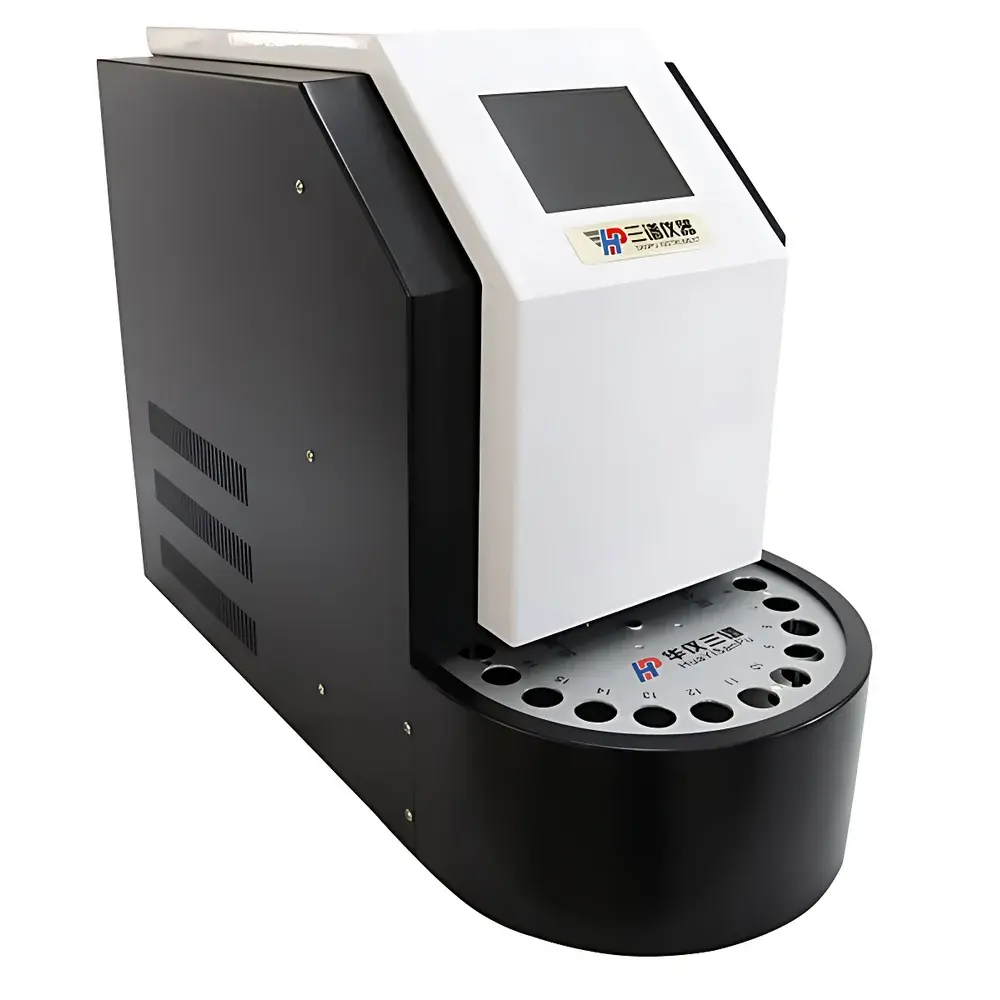
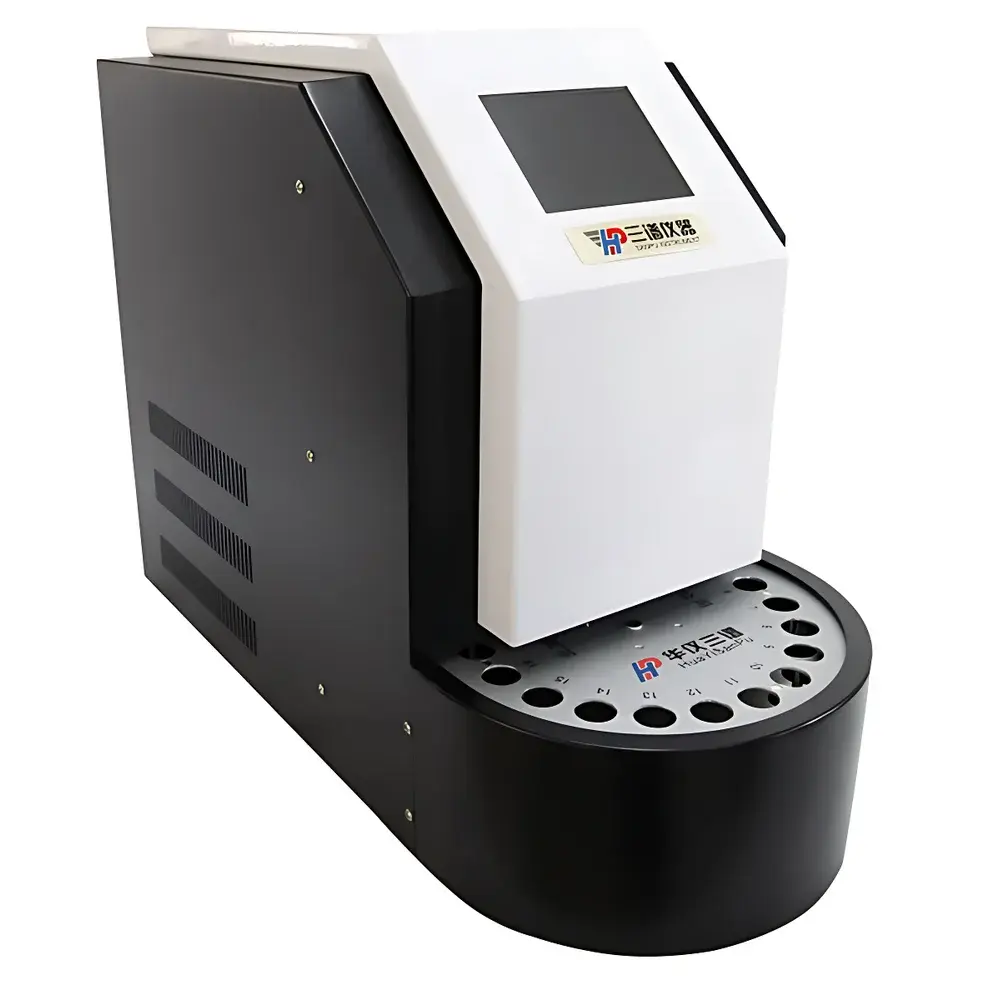
Huayisanpu ADHS-8890A Automated Purge-and-Trap Sampler
| Brand | Beijing Huayisanpu |
|---|---|
| Origin | Beijing, China |
| Model | ADHS-8890A |
| Sample Capacity | 20 positions |
| Injection Precision | RSD < 2.5% (GC-dependent) |
| Trap Temperature Range | Ambient to 380 °C |
| Purge Vial Heating Range | Ambient to 250 °C |
| Chilled Vial Temperature Range | 4–10 °C |
| Cold Trap Temperature Range | Ambient to −40 °C |
| Water Removal Trap Range | Ambient to −30 °C |
| Desorption Ramp Rate | >250 °C/min |
| Carrier Gas Pressure Regulation | 0–0.4 MPa |
| Purge Flow Rate | 0–500 mL/min |
| Tubing & Line Heating Range | Ambient to 250 °C |
| Power Consumption | <1000 VA |
| Dimensions (H×W×D) | 500×400×650 mm |
| Weight | ~40 kg |
Overview
The Huayisanpu ADHS-8890A Automated Purge-and-Trap Sampler is a fully integrated, laboratory-grade sample introduction system engineered for trace-level volatile organic compound (VOC) analysis in aqueous and solid matrices. It operates on the principle of dynamic headspace extraction: inert gas continuously purges VOCs from a heated or chilled sample vial, transferring analytes through temperature-controlled transfer lines into a cryogenically cooled trap (typically packed with sorbent material such as Tenax®, Carbopack™, or custom blends). Following purge completion, the trap undergoes rapid thermal desorption (>250 °C/min) directly into a gas chromatograph (GC) inlet—ensuring quantitative transfer, minimal band broadening, and high sensitivity (sub-ppt detection achievable with compatible GC–MS systems). Designed for water, soil, sediment, and sludge analysis per EPA Methods 502.2, 524.2, 624, and ISO 15681-2, the ADHS-8890A supports regulatory compliance workflows in environmental testing laboratories, municipal water quality control centers, and industrial hygiene monitoring programs.
Key Features
- 20-position autosampler carousel with programmable vial handling, enabling unattended batch processing of heterogeneous sample types—including 10 mL, 20 mL, and 30 mL standard and custom vials.
- Independent, PID-controlled thermal zones: purge vial heater (ambient to 250 °C, ±0.5 °C), cold trap (ambient to −40 °C, ±1 °C), water removal trap (ambient to −30 °C, ±1 °C), desorption oven (ambient to 380 °C, ±0.5 °C), and all transfer line segments (ambient to 250 °C, ±1 °C).
- High-fidelity flow and pressure regulation: digitally controlled purge gas flow (0–500 mL/min, calibrated and displayed) and external carrier gas pressure (0–0.4 MPa, adjustable via integrated pressure regulator).
- Safety-engineered low-voltage heating architecture across all thermal modules, eliminating high-voltage hazards while maintaining rapid ramp rates (>250 °C/min for trap desorption and water trap regeneration).
- Seven independently programmable external event outputs (TTL/relay), supporting synchronization with GC start signals, valve actuation, data acquisition triggers, or auxiliary instrumentation.
- Configurable trap hardware: stainless steel, quartz glass, or fused silica capillary traps; customizable sorbent packing (e.g., multi-bed combinations for broad polarity coverage) and trap conditioning protocols (bake-out, aging, blank runs).
- Integrated sample chilling module (4–10 °C) to suppress volatilization of thermally labile compounds during storage and transfer—critical for preserving integrity of BTEX, chlorinated ethenes, and low-boiling aldehydes.
Sample Compatibility & Compliance
The ADHS-8890A accommodates liquid samples (groundwater, surface water, wastewater), semi-solids (soil slurries, digested sediments), and solid-phase matrices (freeze-dried soils, activated carbon extracts) when prepared according to ASTM D3690, EPA SW-846 Method 5035B, and ISO 15681-2. Its modular trap design allows method-specific optimization for target analyte classes—from C2–C12 hydrocarbons to polar oxygenates (e.g., MTBE, acetone) and sulfur-containing compounds (e.g., H₂S, mercaptans). The instrument meets mechanical and electrical safety requirements per IEC 61010-1 and supports audit-ready operation under GLP and ISO/IEC 17025 frameworks. All temperature and timing parameters are logged with timestamps, and method files include version control—facilitating FDA 21 CFR Part 11 compliance when paired with validated LIMS or chromatography data systems (CDS) that support electronic signatures and audit trails.
Software & Data Management
Controlled via a dedicated Windows-based application with intuitive graphical workflow builder, the ADHS-8890A enables full method development—including multi-step temperature ramps, timed valve switching, flow modulation, and trap regeneration cycles. Each method stores complete configuration metadata (trap type, sorbent lot, calibration dates, operator ID), and execution logs record real-time sensor values (temperature, pressure, flow, event status) at user-defined intervals. Raw log files export in CSV format for integration with third-party data analysis tools. The system provides TTL and RS-232 interfaces for bidirectional GC communication, including precise trigger synchronization (<2 s latency) and error-state feedback (e.g., pressure fault, temperature deviation, vial misalignment). No proprietary drivers are required—standard COM port enumeration ensures compatibility with Agilent, Thermo Fisher, Shimadzu, and PerkinElmer GC platforms.
Applications
- Regulatory environmental analysis: drinking water compliance (EPA 524.2), landfill leachate screening (EPA 624), and wastewater discharge monitoring (ISO 15681-2).
- Soil vapor intrusion assessment: quantification of chloroethenes (PCE, TCE), benzene, and naphthalene in field-collected soil gas condensates.
- Pharmaceutical residual solvent testing: trace-level detection of Class 2 solvents (e.g., dichloromethane, ethyl acetate) in drug substance batches per ICH Q2(R2) and USP <467>.
- Food and beverage safety: off-flavor compound profiling (e.g., geosmin, 2-methylisoborneol) in drinking water and bottled beverages.
- Forensic toxicology: headspace analysis of ethanol, acetone, and isopropanol in blood serum samples using static-dynamic hybrid protocols.
FAQ
What sample matrices can the ADHS-8890A process without derivatization or pre-concentration?
It directly handles aqueous samples (1–30 mL), homogenized soils (up to 25 g in 40 mL vials), and sediment slurries—provided they meet viscosity and particulate limits specified in EPA Method 5035B.
Is the cold trap compatible with liquid nitrogen or mechanical cryocooling?
The system uses Peltier-based cooling for the main cold trap (−40 °C) and water removal trap (−30 °C); no LN₂ or external cryogens are required, reducing operational complexity and safety overhead.
Can trap desorption parameters be optimized independently for different analyte volatility ranges?
Yes—desorption temperature, hold time, and transfer line temperature are fully decoupled and programmable per method, allowing simultaneous optimization for light gases (e.g., vinyl chloride) and heavier aromatics (e.g., naphthalene).
Does the instrument support automated trap conditioning between runs?
Yes—integrated bake-out routines (up to 380 °C, programmable duration and purge flow) ensure carryover-free operation; conditioning status is logged and reportable.
How is data integrity ensured during extended unattended operation?
All critical events (vial pickup, trap cool-down, desorption initiation, GC trigger) are timestamped and stored locally with checksum validation; optional network logging enables remote verification and backup.





