
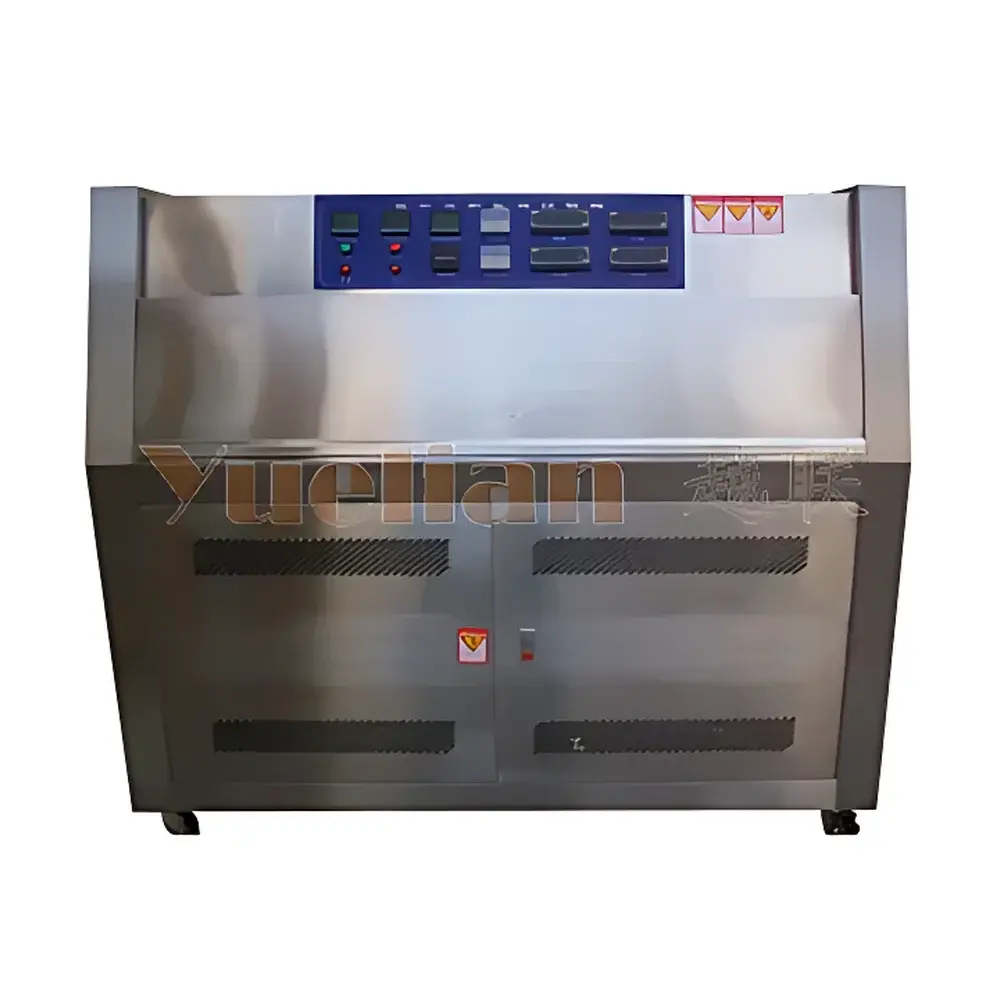
QUV UV Weathering Tester Yuelian YL-2206QK
| Brand | Yuelian |
|---|---|
| Origin | Guangdong, China |
| Manufacturer Type | Authorized Distributor |
| Product Origin | Domestic (China) |
| Model | YL-2206QK |
| Price | Upon Request |
| Temperature Range | RT+10°C to 70°C |
| Humidity Range | ≥95% RH |
| Temp. Uniformity | ≤±2°C |
| Temp. Stability | ≤±0.5°C |
| Humidity Uniformity & Stability | ≤±2% RH |
| Black Panel Temperature | 40°C–65°C |
| Lamp Spacing | 35 mm |
| Sample-to-Lamp Distance | 50 mm |
| Lamp Power | 40 W per tube |
| UV Spectrum | 290–400 nm (UVA-340 or UVB-313 selectable) |
| Condensation Cycle Duration | 0–99 h |
| UV Exposure Duration | 0–99 h |
| Specimen Size | 150 × 75 mm |
| Capacity | ~40 specimens |
| Total Test Duration Range | 0–9999 h |
| Irradiance | ≤50 W/m² |
| Chamber Dimensions (W×D×H) | 1170 × 450 × 500 mm |
Overview
The Yuelian YL-2206QK QUV UV Weathering Tester is an engineered acceleration chamber designed for controlled simulation of solar ultraviolet (UV) radiation and condensation-induced moisture stress on non-metallic materials. It operates on the principle of fluorescent UV lamp exposure—specifically UVA-340 (peak at 340 nm) or UVB-313 (peak at 313 nm)—to replicate the most photochemically damaging portion of terrestrial sunlight. Unlike xenon arc systems that reproduce full-spectrum solar irradiance, this tester isolates and intensifies the short-wavelength UV band responsible for polymer chain scission, pigment degradation, and surface embrittlement. The integrated condensation cycle mimics nocturnal dew formation via controlled water vapor saturation on cooled specimen surfaces—enabling realistic hygrothermal aging mechanisms without immersion or spray. This dual-stress methodology conforms to established accelerated weathering protocols used in R&D, quality assurance, and regulatory pre-compliance screening across coatings, plastics, elastomers, and architectural finishes.
Key Features
- Eight 40 W UV fluorescent lamps arranged symmetrically (4 per side), supporting interchangeable UVA-340 or UVB-313 spectral configurations based on application requirements;
- Dynamic lamp replacement protocol: systematic rotation of lamps every 25% of rated service life (e.g., at ~125 h for standard tubes; ~400–450 h for imported lamps) to maintain stable irradiance output over extended test durations;
- Precise black panel temperature control (40–65°C) with stability ≤±0.5°C and uniformity ≤±2°C, critical for correlating thermal activation energy with photodegradation kinetics;
- High-humidity condensation system with programmable duration (0–99 h), enabling reproducible dew-point cycling independent of UV exposure timing;
- Uniform irradiance distribution achieved via fixed 50 mm sample-to-lamp distance and 35 mm inter-lamp spacing, minimizing edge effects and ensuring ISO/ASTM-compliant exposure geometry;
- Digital keypad interface with independent timers for UV exposure, condensation, and total test duration (0–9999 h), supporting multi-stage sequential protocols;
- Stainless steel interior chamber (1170 × 450 × 500 mm W×D×H) resistant to UV-induced corrosion and humidity-driven oxidation.
Sample Compatibility & Compliance
The YL-2206QK accommodates up to 40 flat specimens measuring 150 × 75 mm—suitable for coated panels, molded plastic coupons, rubber strips, textile swatches, and adhesive tapes. Its operational envelope satisfies key national and international standards including GB/T 14522–1993 (Mechanical Properties of Paint Films After Artificial Weathering), GB/T 16422.3–1997 (Plastics—Methods of Exposure to Laboratory Light Sources—Part 3: Fluorescent UV Lamps), and GB/T 16585–1996 (Rubber—Artificial Weathering—Fluorescent UV Lamp Method). While not certified to ASTM G154 or ISO 4892-3 by default, its hardware architecture and control logic are fully compatible with those test methods when configured with UVA-340 lamps and validated irradiance monitoring. Users implementing GLP or ICH-aligned workflows may integrate external radiometers and log data manually to support audit-ready traceability.
Software & Data Management
This model features a dedicated microprocessor-based controller with non-volatile memory for parameter retention during power interruption. All setpoints—including black panel temperature, condensation interval, UV exposure time, and total cycle count—are stored locally and recalled upon reboot. Though it lacks Ethernet connectivity or cloud-based reporting, the system supports manual logging of operational timestamps, lamp replacement records, and chamber condition snapshots—essential for internal QA documentation and supplier qualification dossiers. For laboratories requiring electronic records compliant with FDA 21 CFR Part 11, integration with third-party SCADA or LIMS platforms via RS-232 or analog outputs (optional) enables centralized archiving of runtime events and alarm history.
Applications
- Evaluation of UV stabilizer efficacy in polyolefins, PVC, and engineering thermoplastics;
- Correlation studies between accelerated QUV exposure and real-world field performance of automotive clearcoats and exterior trim;
- Comparative ranking of pigment fade resistance in architectural paints under controlled UVA vs. UVB spectra;
- Pre-screening of encapsulant durability in photovoltaic module development;
- Validation of adhesive bondline integrity under combined UV/humidity stress in medical device packaging;
- Supporting ISO 11341 (Paints and varnishes—Artificial weathering and exposure to artificial radiation) Annex B test planning.
FAQ
What UV spectrum options are available, and how do they differ in application?
UVA-340 lamps closely match terrestrial solar UV below 360 nm and are recommended for outdoor durability testing of coatings, plastics, and textiles. UVB-313 lamps emit shorter, more aggressive wavelengths and are typically used for rapid screening or testing highly UV-resistant materials.
Is irradiance calibration included or supported?
The unit does not include built-in radiometric feedback, but features standardized lamp geometry and spacing to ensure repeatable irradiance ≤50 W/m². Users should employ NIST-traceable UV-A or UV-B broadband radiometers for periodic verification.
Can the chamber accommodate non-standard specimen sizes?
Only specimens conforming to 150 × 75 mm dimensions are guaranteed to fit within the designated rack layout and maintain specified lamp-to-sample distance. Custom fixtures require mechanical validation to avoid shadowing or thermal deviation.
How often must lamps be replaced, and what is the expected lifetime?
Standard domestic lamps have a nominal service life of ~500 h; imported equivalents last 1600–1800 h. Per the staggered replacement protocol, one lamp is substituted every 25% of that lifetime to sustain spectral and irradiance consistency.
Does the system meet FDA or ISO 17025 requirements for accredited testing?
As supplied, it functions as a validated test platform—not a certified reference instrument. Full compliance requires user-performed IQ/OQ/PQ, documented maintenance logs, and external irradiance metrology aligned with ISO/IEC 17025 Clause 6.4.



