
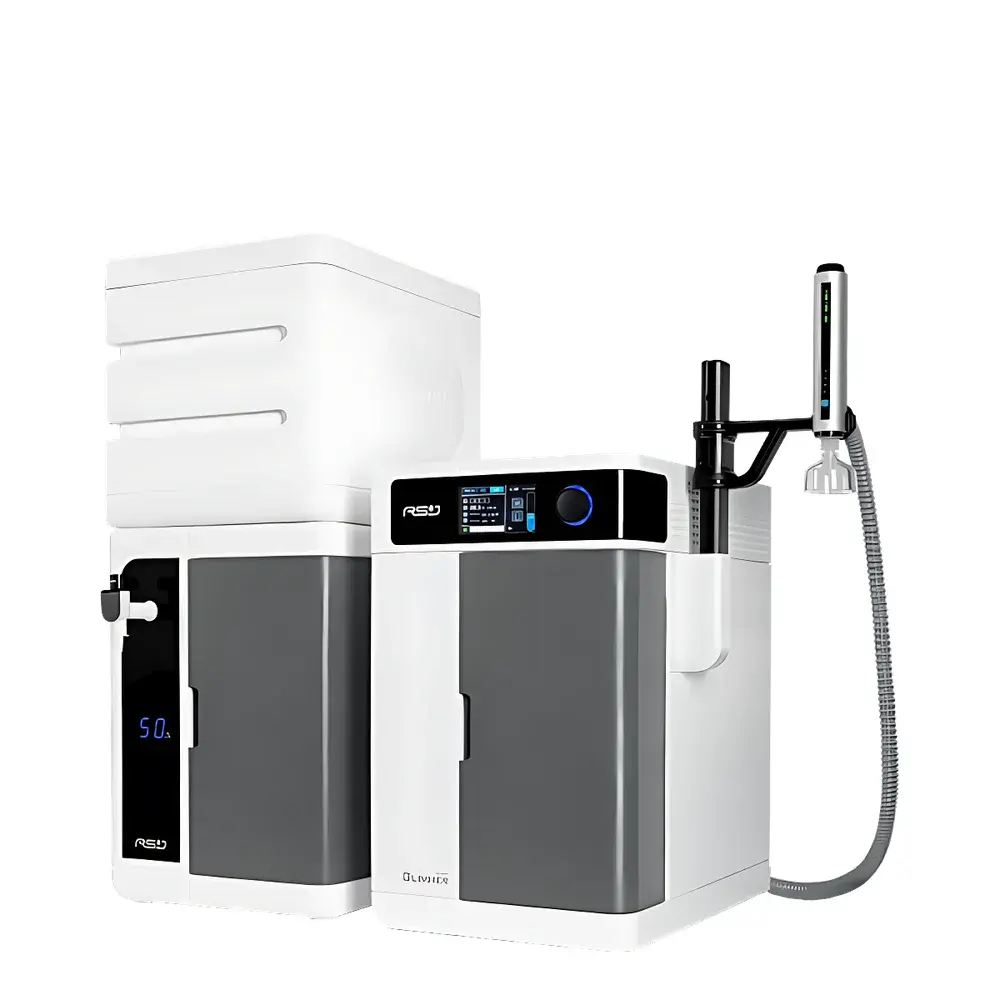
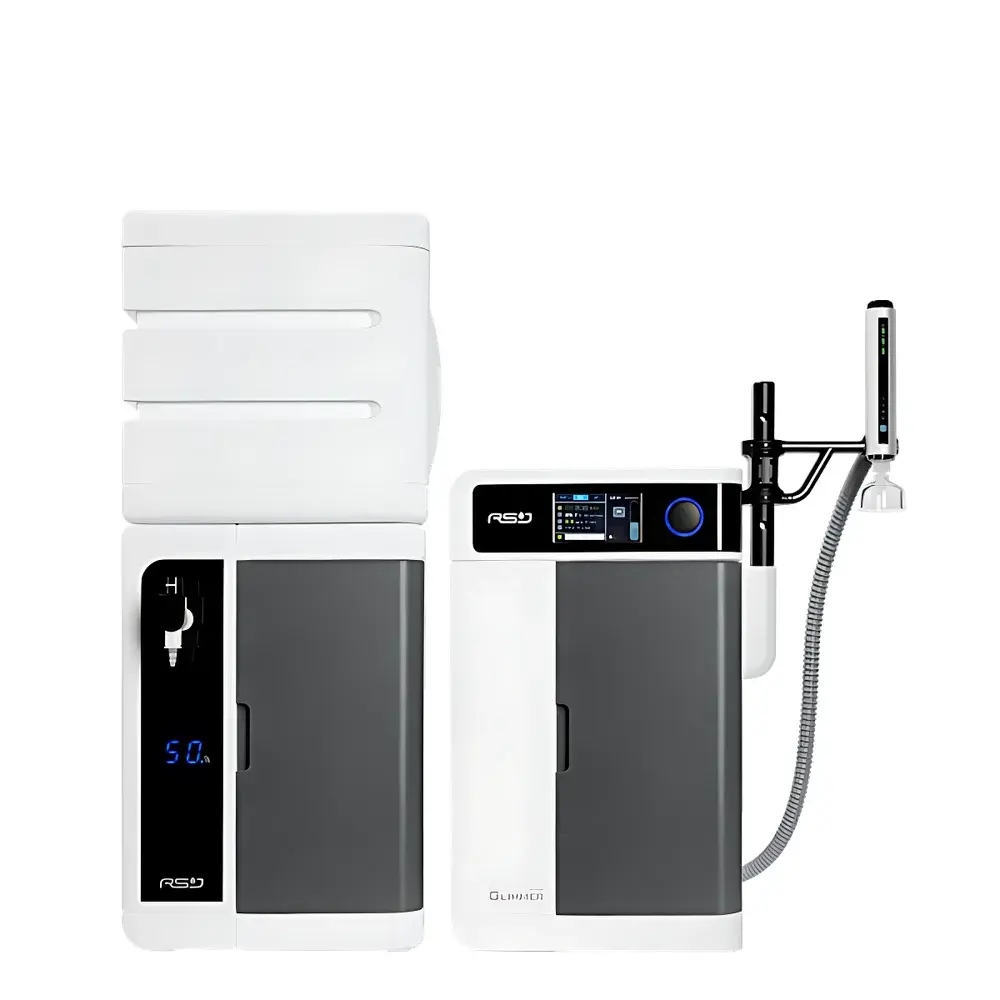
Glimmer Trace-Analysis Grade Ultra-Pure Water System by RSJ
| Brand | RSJ |
|---|---|
| Origin | Fujian, China |
| Manufacturer Type | Direct Manufacturer |
| Product Category | Domestic |
| Model | Glimmer |
| Pricing | Upon Request |
| Purified Water Grade | ASTM Type I / ISO 3696 Grade 1 |
| Resistivity | 18.2 MΩ·cm @ 25 °C |
| Heavy Metals & Soluble Silica | < 1 ppt |
| Total Organic Carbon (TOC) | < 3 ppb (real-time online monitoring) |
| Particles (> 0.1 µm) | < 1 particle/mL |
| Feed Water | Municipal tap water, 5–40 °C, 1–6 bar pressure |
| Maximum Flow Rate | 2 L/min |
| TOC Measurement Range | 0.1–999 ppb |
| Integrated Reservoir Capacity | 40 L |
| Power Supply | AC 100–240 V, 50 Hz |
| Power Consumption | 120 W |
| Dimensions (Pre-treatment + Tank Unit) | 339 × 410 × 904 mm (W×D×H) |
| Dimensions (Main Unit) | 374 × 508 × 538 mm (W×D×H) |
| Net Weight (Pre-treatment + Tank Unit) | 15 kg |
| Net Weight (Main Unit) | 24 kg |
Overview
The Glimmer Trace-Analysis Grade Ultra-Pure Water System is an engineered solution for laboratories requiring ultralow background interference in trace elemental and isotopic analysis. Designed specifically for applications where reagent blank contribution must be minimized—such as ICP-MS, HR-ICP-MS, and low-level ion chromatography—the system employs a multi-stage purification architecture grounded in UTA (Ultra-Trace Assurance) technology. UTA integrates three critical design principles: (1) ultra-low leaching materials across all wetted surfaces—including fluoropolymer-lined tanks, high-purity quartz and PFA fluid paths, and semiconductor-grade EPDM-free seals; (2) dual-stage polishing with real-time intermediate quality monitoring via a dedicated inline conductivity/TOC sensor positioned between the final deionization and UV oxidation stages; and (3) closed-loop recirculation with 185/254 nm dual-wavelength UV photooxidation to suppress microbial regrowth and organic regeneration. This architecture ensures continuous compliance with ASTM D1193 Type I and ISO 3696 Grade 1 specifications while maintaining sub-ppt metal ion stability over extended operational cycles.
Key Features
- UTA Core Architecture: Dual-column polishing train with embedded mid-stage water quality verification—enables early fault detection and prevents off-spec water from reaching the point-of-use.
- Real-Time TOC Monitoring: Integrated 185 nm UV-oxidation + NDIR detection module delivers continuous, calibrated TOC readouts from 0.1 to 999 ppb with ±0.2 ppb repeatability—traceable to NIST SRM 1597a.
- Smart Cartridge Management: RFID-tagged consumables auto-identify type, lot number, and installation date; firmware enforces correct sequence logic and blocks incompatible configurations.
- Cloud-Enabled Remote Oversight: Secure TLS 1.3–encrypted MQTT communication allows remote status review, maintenance scheduling, and consumable lifecycle tracking via web dashboard or iOS/Android mobile application.
- Zero-Contact Dispensing Interface: Optional air-gap dispensing valve with integrated particle counter (<0.1 µm resolution) minimizes operator-induced contamination during critical sample preparation steps.
Sample Compatibility & Compliance
The Glimmer system is validated for use in GLP- and ISO/IEC 17025-accredited laboratories conducting trace metal analysis per EPA Method 200.8, ASTM D511, and ISO 17294-2. All wetted components comply with USP and EU Pharmacopoeia Chapter 3.1.1 for extractables profiling. The system supports full audit trail generation—including user login events, parameter changes, alarm logs, and cartridge replacement timestamps—in accordance with FDA 21 CFR Part 11 requirements when paired with optional electronic signature modules. Reservoir and distribution loop designs meet ASME BPE-2021 surface finish standards (Ra ≤ 0.4 µm electropolished 316L SS), ensuring compatibility with cleanroom Class 100 (ISO 5) environments typical in semiconductor FAB support labs.
Software & Data Management
Firmware v4.2 includes embedded data logging at 1-second intervals for resistivity, TOC, temperature, pressure, and flow rate—exportable as CSV or PDF reports with embedded digital signatures. The RSJ Cloud Platform provides configurable alert thresholds (e.g., TOC > 2.5 ppb triggers SMS/email notification), historical trend visualization with overlay comparison across multiple instruments, and automated calibration certificate synchronization with internal QA databases. All data storage adheres to GDPR-compliant encryption-at-rest (AES-256) and role-based access control (RBAC) with four-tier permission levels (Operator, Supervisor, QA Manager, Admin).
Applications
- ICP-MS and HR-ICP-MS blank reduction in environmental, clinical, and geochemical laboratories—particularly for isotopic ratio measurements (e.g., Pb, Sr, Nd) where procedural blanks dominate uncertainty budgets.
- Wet bench preparation of reference standards and calibration stock solutions for certified reference material (CRM) production facilities.
- Final rinse water in photomask cleaning, wafer etch validation, and electronic specialty chemical formulation QC workflows.
- Mobile phase preparation for ultra-trace LC-ICP-MS coupling where carbon-based interferences compromise detection limits.
- Cell culture media supplementation in single-cell omics studies requiring endotoxin-free, nuclease-free, and metal-free water matrices.
FAQ
What validation documentation is provided with the Glimmer system?
Factory-installed IQ/OQ protocols compliant with ISO 9001:2015 and ASTM E2500-13 are included, along with a Certificate of Conformance listing material certifications (e.g., ASTM A269 TP316L, USP Class VI biocompatibility), TOC sensor calibration traceability (NIST-traceable standard solutions), and full electrical safety test reports.
Can the system integrate with existing laboratory information management systems (LIMS)?
Yes—via RESTful API endpoints supporting JSON payloads, the Glimmer system enables bidirectional data exchange with major LIMS platforms (e.g., LabWare, Thermo Fisher SampleManager, STARLIMS) for automatic instrument status injection and consumable inventory synchronization.
Is the 40 L reservoir suitable for continuous high-flow demand?
The reservoir is optimized for intermittent high-flow dispensing (up to 2 L/min peak) with recirculation-driven stabilization; for sustained >1.5 L/min usage over >8-hour shifts, RSJ recommends the optional 100 L pressurized buffer tank upgrade with redundant UV irradiation.
How frequently must the TOC sensor be recalibrated?
Initial calibration is performed at factory using NIST-traceable sucrose standards; field recalibration is recommended every 90 days or after any major consumable replacement—automated prompts appear in the UI with guided step-by-step procedures.
Does the system support GMP-regulated environments?
When configured with optional 21 CFR Part 11-compliant electronic signatures, audit trail archiving, and periodic performance qualification (PQ) templates, the Glimmer meets core GMP Annex 11 requirements for computerized system validation in pharmaceutical water systems.



