
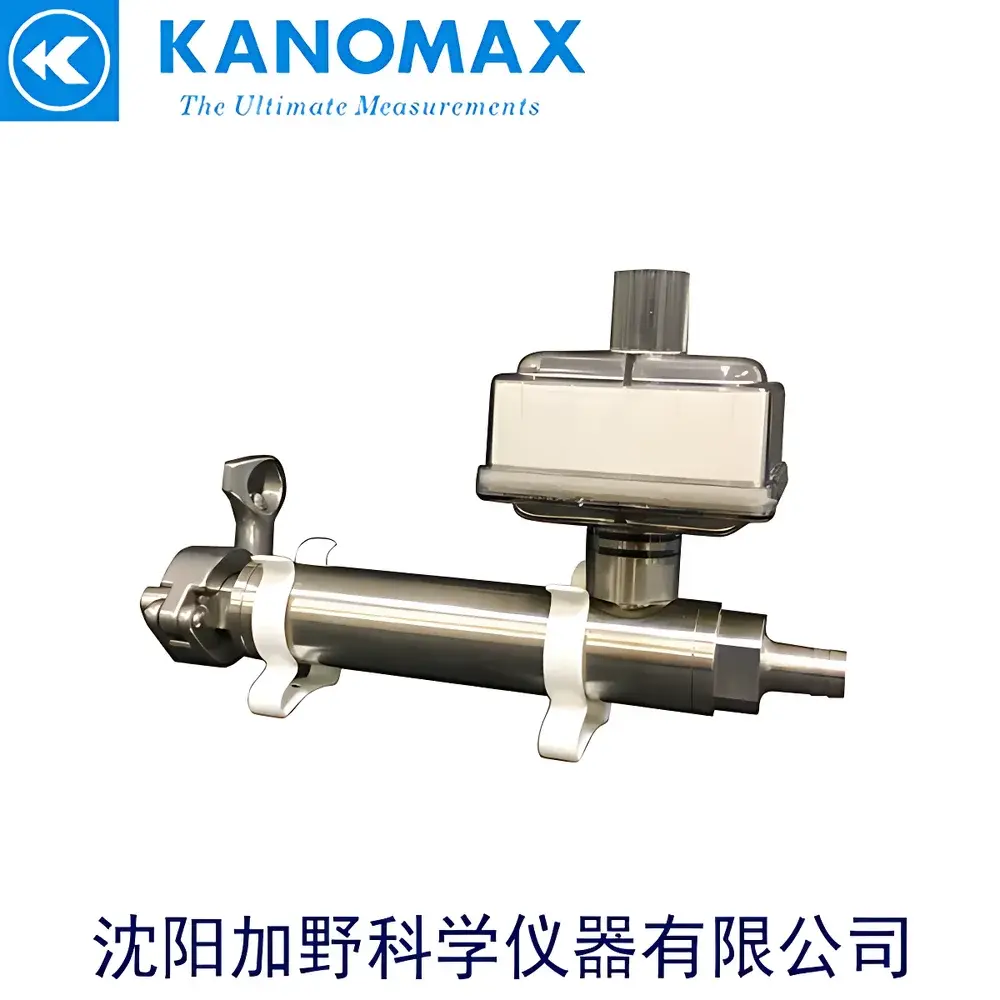
Kanomax High-Pressure Gas Diffuser Model 50/100 LPM for Particle Counters
| Brand | Kanomax |
|---|---|
| Flow Rate | 50 L/min or 100 L/min (selectable via configuration) |
| Operating Pressure Range | 18–125 psi (Model 50), 21–125 psi (Model 100) |
| Material | Stainless Steel |
| Inlet Connection | Stainless steel tubing, OD 12.7 mm with 25 mm clamp |
| Outlet Connection | 1/2-inch inner diameter hose barb |
| Dimensions (body) | Ø30 mm × 185 mm |
| Weight | ~1.0 kg |
| Ambient Operating Conditions | 10–35 °C, 0–85% RH (non-condensing) |
| Compatible Gases | Clean, dry air and non-toxic inert gases |
| Compliance Context | Designed to support ISO 14644-1, ISO 14698-1, EU GMP Annex 1, and USP <797>/<800> environmental monitoring workflows |
Overview
The Kanomax High-Pressure Gas Diffuser Model 50/100 LPM is an engineered flow-conditioning device designed specifically for integration into compressed gas sampling systems used in cleanroom environmental monitoring and pharmaceutical manufacturing compliance. It operates on the principle of controlled pressure reduction and laminar flow diffusion—converting high-pressure, turbulent inlet gas streams into stable, low-velocity, uniformly distributed output flows suitable for sensitive downstream instrumentation. This diffuser addresses a critical technical challenge in regulated environments: maintaining consistent volumetric flow delivery to particle counters (e.g., Kanomax LPC-3910 and LPC-3920) and active air samplers under variable upstream pressure conditions (18–125 psi). Its stainless-steel construction ensures chemical compatibility with clean dry air and inert gases such as nitrogen or argon, while eliminating particulate shedding and corrosion-related contamination risks.
Key Features
- Two calibrated flow configurations: 50 L/min and 100 L/min—selected via dedicated inlet port geometry and internal orifice design, not software or valve adjustment
- Robust stainless-steel body (AISI 316L-compatible finish) with precision-machined internal diffuser vanes for repeatable flow conditioning
- Wide operating pressure range: 18–125 psi for the 50 L/min variant; 21–125 psi for the 100 L/min variant—enabling compatibility with standard industrial compressors and nitrogen generators
- Thermal and humidity resilience: validated performance across 10–35 °C and 0–85% RH (non-condensing), supporting deployment in HVAC-controlled cleanrooms and isolator vestibules
- Modular mechanical interface: standardized 12.7 mm OD stainless-steel inlet tubing with 25 mm clamping collar; 1/2-inch ID outlet barb compatible with common silicone or fluoropolymer sampling hoses
- No moving parts or consumables—designed for long-term stability, minimal maintenance, and traceable calibration history
Sample Compatibility & Compliance
The diffuser supports only clean, dry, non-toxic, and chemically inert gases—including compressed air meeting ISO 8573-1 Class 1:2:1 (solid particles, water, oil) and nitrogen per ASTM D1946 Grade 5. It is not rated for corrosive, flammable, or humidified gas streams. In regulated settings, it functions as a critical component in environmental monitoring systems aligned with ISO 14644-1 (cleanroom classification), ISO 14698-1 (biocontamination control), EU GMP Annex 1 (2022 revision), and USP chapters and . When paired with Kanomax LPC-3910 (50 L/min) or LPC-3920 (100 L/min) particle counters, the assembly supports audit-ready data collection required under FDA 21 CFR Part 11 when integrated with compliant data acquisition software featuring electronic signatures and audit trails.
Software & Data Management
As a passive hardware component, the Kanomax High-Pressure Gas Diffuser does not incorporate embedded firmware, sensors, or digital interfaces. Its role is purely physical: ensuring metrologically sound flow delivery to connected instrumentation. Therefore, all data integrity, calibration verification, and operational logging are managed externally by the host particle counter or air sampler. Users must maintain documented evidence—including installation qualification (IQ), operational qualification (OQ), and periodic requalification—per ICH Q9 and ISO/IEC 17025 requirements. Calibration certificates for the diffuser itself are not issued; however, its geometric specifications and material certification (e.g., RoHS, REACH, EN 10204 3.1) are provided to support risk assessments and change control documentation.
Applications
- Continuous airborne particle monitoring in Grade A/B cleanrooms per EU GMP Annex 1
- Compressed air quality verification in pharmaceutical manufacturing lines (ISO 8573-1 compliance testing)
- Environmental surveillance in aseptic processing isolators and RABS
- Validation of HVAC filtration efficiency using isokinetic sampling protocols
- Supporting microbial air sampling with impactor-based floaters (e.g., MAS-100, RCS Plus) where stable flow rate is essential for colony-forming unit (CFU) quantification accuracy
- Research-grade aerosol dilution and conditioning in university and contract lab cleanroom facilities
FAQ
Is this diffuser compatible with non-Kanomax particle counters?
Yes—provided the instrument accepts 50 L/min or 100 L/min nominal flow rates and features a 1/2-inch ID inlet connection. However, optimal performance requires verification of isokinetic alignment and pressure drop characteristics specific to each instrument model.
Does the diffuser require recalibration over time?
No—this is a fixed-geometry passive device with no wear-prone elements. Recertification is not required unless physical damage occurs or material certification documentation is lost during facility audits.
Can it be used with humidified or oil-laden compressed air?
No. Exposure to moisture or lubricants may cause internal condensation, clogging, or surface oxidation, compromising flow uniformity and introducing measurement bias. Only ISO 8573-1 Class 1-compliant air or certified inert gases are permitted.
What is the maximum allowable backpressure at the outlet?
The device is optimized for near-atmospheric discharge conditions. Backpressures exceeding 5 psi at the outlet may induce flow instability and deviation from rated volumetric delivery—verify system-level pressure gradients during IQ/OQ.
Is CE or UKCA marking applied to this unit?
As a non-electrical, non-pressure-vessel mechanical component intended for integration into larger monitoring systems, it falls outside the scope of CE/UKCA directives. Conformity is demonstrated via material declarations and dimensional traceability to Kanomax’s internal manufacturing standards.
Related Products







