
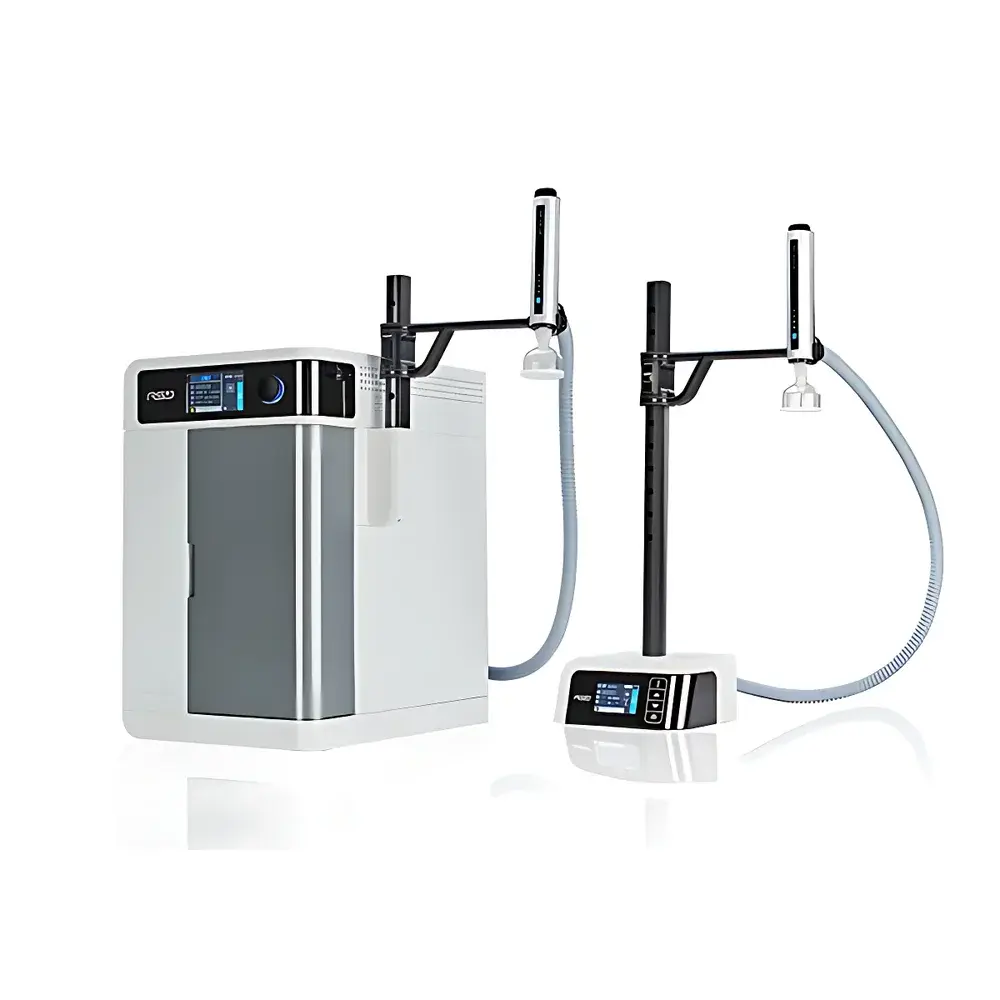
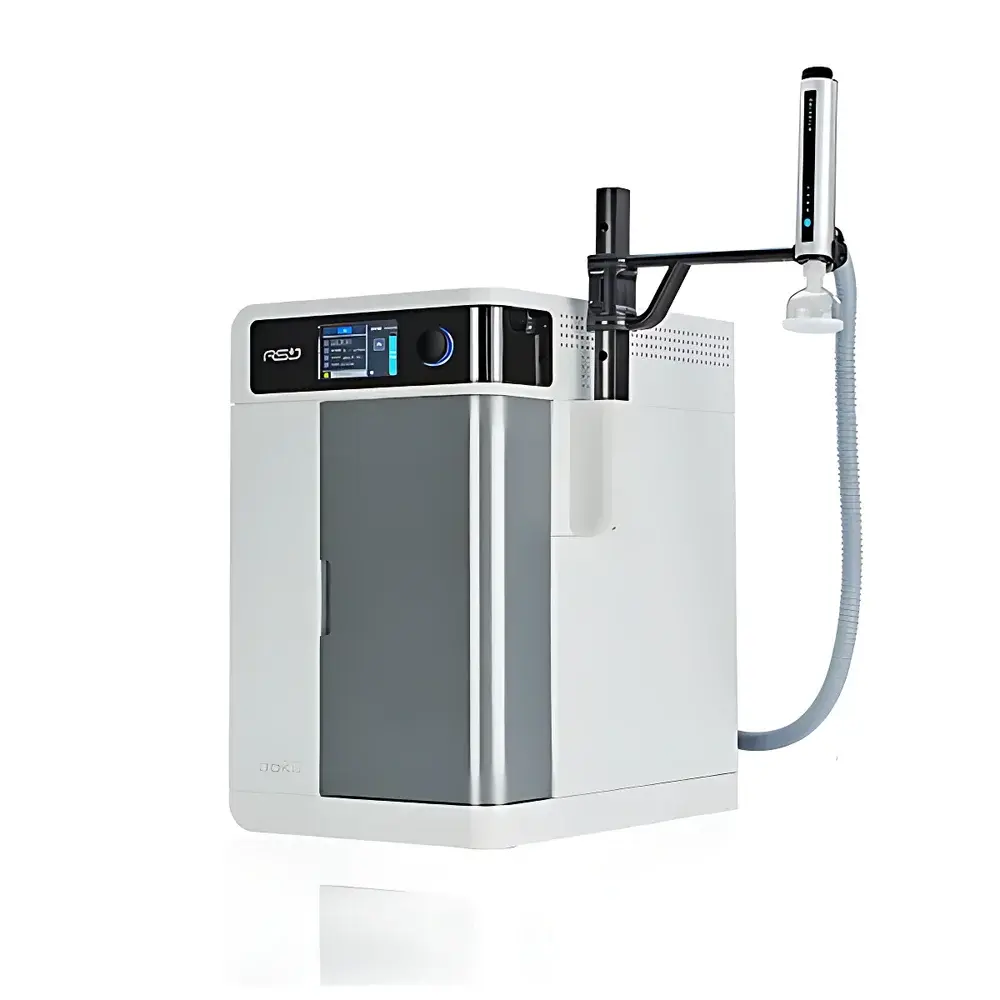
RSJ GOKU IoT-Enabled Ultra-Pure Water System
| Brand | RSJ |
|---|---|
| Origin | Fujian, China |
| Manufacturer Type | Direct Manufacturer |
| Model | GOKU |
| Purified Water Grade | Type I (ASTM D1193-2006 / GB 6682-2008 / GB 33087-2016) |
| Resistivity | 18.2 MΩ·cm @ 25 °C |
| Heavy Metals & Soluble Silica | < 0.01 ppb |
| Total Organic Carbon (TOC) | < 3 ppb |
| Microbial Count | < 0.001 CFU/mL |
| Endotoxin | < 0.001 EU/mL |
| Particles (>0.1 µm) | < 1 particle/mL |
| UV Lamps | Dual-wavelength (185 nm + 254 nm) |
| TOC Range | 0.1–999 ppb |
| Flow Rate | Adjustable from dropwise to 2 L/min (4-step control) |
| Accuracy of Quantitative Dispensing | ±1% |
| Power Supply | AC 100–240 V, 50 Hz |
| Power Consumption | 85 W |
| Dimensions (Main Unit) | 374 × 508 × 538 mm (W×D×H, excluding arm/mast/bracket) |
| Weight (Empty) | 20 kg |
Overview
The RSJ GOKU IoT-Enabled Ultra-Pure Water System is an integrated, modular laboratory water purification platform engineered for reproducible production of Type I ultrapure water per ASTM D1193-2006, GB 6682-2008, GB 33087-2016, and GB 11446.1-2013 standards. It accepts pre-purified feedwater—such as reverse osmosis (RO), deionized (DI), or EDI effluent—with conductivity ≤50 µS/cm and pressure up to 6 bar. The system employs a multi-stage purification architecture comprising dual-wavelength UV photooxidation (185 nm + 254 nm), continuous-recirculating ultrafiltration, and sub-micron terminal filtration to achieve stringent performance benchmarks: resistivity ≥18.2 MΩ·cm at 25 °C, TOC <3 ppb, endotoxin <0.001 EU/mL, DNase <4 pg/mL, RNase 0.1 µm <1/mL. Designed for mission-critical applications in analytical chemistry, molecular biology, and cell culture, the GOKU system integrates real-time physicochemical monitoring with industrial-grade IoT connectivity for traceable, auditable, and remotely managed water production.
Key Features
- Industrial IoT Architecture: Dual-mode connectivity (Wi-Fi + 4G LTE) enables secure, encrypted data transmission to a cloud-based management platform. Remote diagnostics, predictive maintenance alerts, and historical operational analytics—including uptime, consumable lifecycle, and failure event logs—are accessible via web dashboard or mobile application.
- Multi-Point Real-Time Monitoring: Four independent conductivity sensors monitor feedwater, RO permeate, DI loop, and final ultrapure output. Integrated online TOC analyzer (0.1–999 ppb range) provides continuous oxidation-efficiency feedback; dual UV lamps ensure consistent photolytic degradation of organic contaminants.
- Smart Cartridge Management: RFID-enabled consumables embed model number, batch ID, installation date, and remaining service life. System validates correct orientation and sequence during replacement and issues warnings for misinstallation or expired media.
- Modular Service Design: All purification modules—including UV chambers, UF cartridges, and terminal filters—are tool-free, front-accessible, and field-replaceable without technician support. Maintenance intervals and procedures are embedded in HMI guidance workflows.
- Flexible Dispensing Interface: Motorized articulating arm (height/angle adjustable), wall-mountable remote dispensing station (optional), four-step flow control (dropwise to 2 L/min), footswitch activation, programmable volume dispensing, and on-arm LCD display—all configurable via touch interface.
- Secure Multi-User Operation: Role-based access control (four-tier PIN-protected permissions), optional RFID card reader integration (RMMS), and configurable per-user water grade allocation with volumetric billing logic compliant with shared-lab cost-recovery protocols.
Sample Compatibility & Compliance
The GOKU system delivers water meeting or exceeding specifications required for high-sensitivity instrumentation and regulated biological workflows. Its output is validated for compatibility with HPLC, UHPLC, LC-MS, ICP-MS, AAS, and GF-AAS; supports sterile tissue culture media preparation (including embryonic stem cell lines); and satisfies nucleic acid integrity requirements for qPCR, NGS library prep, and capillary electrophoresis. All electrical components operate at SELV (Safety Extra-Low Voltage) levels. Mechanical safety includes dual independent leak detection circuits, thermal cutoffs, overpressure relief valves, and cartridge position verification sensors. Firmware supports audit trail generation per FDA 21 CFR Part 11 Annex 11 and GLP/GMP documentation requirements when configured with time-stamped user actions and system event logging.
Software & Data Management
The embedded Linux-based controller runs proprietary firmware with TLS 1.2–secured MQTT communication to the RSJ Cloud Platform. Data streams include sensor values (temperature, pressure, conductivity, TOC), actuator states (pump speed, valve positions), consumable metrics (usage hours, cycle counts), and alarm history. Export formats include CSV and PDF reports with ISO/IEC 17025–aligned metadata (operator ID, timestamp, instrument ID, calibration status). Optional integration with LIMS via RESTful API enables automatic water quality certificate generation upon dispense completion. All configuration changes, user logins, and critical events are immutably logged with cryptographic hashing for forensic review.
Applications
- Analytical Instrumentation: Mobile phase preparation for HPLC/UHPLC, diluent and standard solution preparation for ICP-MS and AAS, rinse solutions for autosamplers and nebulizers.
- Molecular Biology: Nuclease-free buffer preparation for CRISPR editing workflows, DNA/RNA extraction kits, RT-qPCR master mixes, and sequencing reaction setups.
- Cell Culture & Regenerative Medicine: Formulation of serum-free and chemically defined media, passaging solutions for primary neurons and iPSC-derived organoids, and wash buffers for bioreactor harvests.
- Pharmaceutical QC/QA: USP TOC compliance testing, WFI surrogate validation, and cleaning verification for aseptic processing equipment.
- General Laboratory Use: Glassware rinsing, reagent preparation for titrations and spectrophotometry, and feedwater for autoclaves, washer-disinfectors, and environmental chambers.
FAQ
Does the GOKU system support regulatory compliance for GMP environments?
Yes—when deployed with enabled audit trail, electronic signature, and role-based access controls, it meets baseline requirements for FDA 21 CFR Part 11 and EU Annex 11 for computerized systems used in pharmaceutical water supply.
Can TOC and resistivity data be exported to our internal LIMS?
Yes—via RESTful API or scheduled CSV export; metadata fields include ISO/IEC 17025–compliant traceability tags (e.g., calibration certificate IDs, operator credentials, environmental conditions).
What terminal filtration options are available for endotoxin-sensitive applications?
Optional 0.1 µm and 0.22 µm PES membranes, plus dedicated endotoxin-removing ultrafilters (MWCO 5 kDa) and mycoplasma-retentive cartridges—each certified per USP and .
Is remote firmware update capability supported?
Yes—over-the-air (OTA) updates are delivered through the cloud platform with version rollback, checksum verification, and maintenance window scheduling to prevent operational disruption.
How is microbial contamination prevented during recirculation?
Continuous UV irradiation (254 nm) combined with periodic hot-water sanitization cycles (up to 85 °C) and automatic loop-flush routines suppress biofilm formation in the distribution manifold and dispensing arms.



