
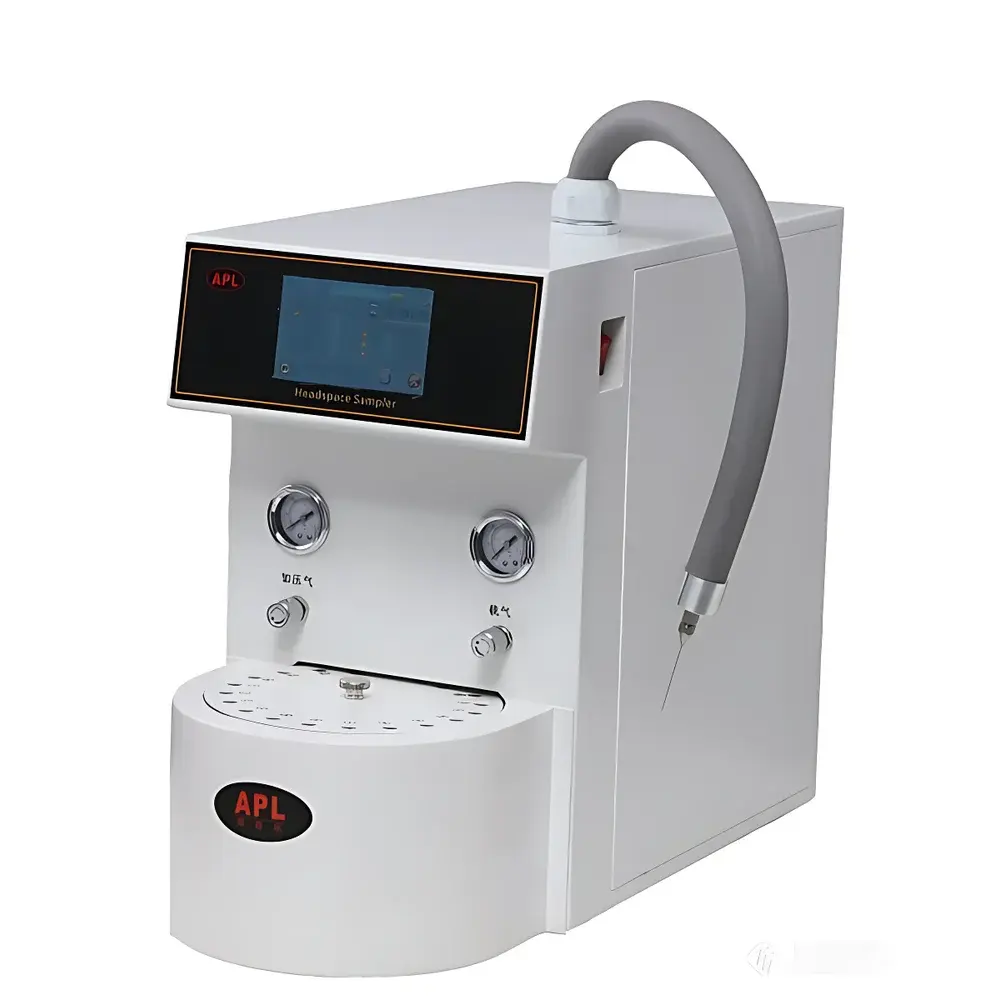
APL HS-20D Automated Static Headspace Sampler
| Brand | APL |
|---|---|
| Origin | Sichuan, China |
| Manufacturer Type | Direct Manufacturer |
| Instrument Type | Static Headspace Sampler |
| Automation Level | Fully Automated |
| Sample Tray Capacity | 20 positions |
| Vial Size | 20 mL (standard), 10 mL (optional) |
| Oven Temperature Range | Ambient to 260 °C |
| Valve & Transfer Line Temperature Range | Ambient to 220 °C |
| Loop Volume | 1 mL |
| Pressure Control Range | 0–0.4 MPa (adjustable) |
| Purge Flow Rate | 0–400 mL/min (adjustable) |
| Temperature Stability | < ±0.1 °C |
| Precision | RSD ≤ 1% (200 ppm ethanol in water, n = 5) |
Overview
The APL HS-20D Automated Static Headspace Sampler is a precision-engineered sample introduction system designed for seamless integration with gas chromatography (GC) platforms. It operates on the principle of static headspace analysis—equilibrating volatile analytes between a liquid or solid sample matrix and its overlying vapor phase at controlled temperature and pressure, followed by quantitative transfer of the equilibrated headspace gas into the GC injector. Engineered for reproducibility and method robustness, the HS-20D supports regulatory-compliant workflows in environmental testing, pharmaceutical residual solvent analysis (per USP and ICH Q3C), food flavor profiling, forensic toxicology, and polymer outgassing studies. Its all-in-one thermal management architecture—featuring independent, PID-controlled heating zones for the sample oven, injection valve, and transfer line—ensures minimal thermal gradient-induced carryover and maximizes analyte integrity during transfer.
Key Features
- Fully automated batch processing of up to 20 standard 20 mL headspace vials (10 mL vials supported via optional adapter)
- Three-zone independent temperature control: sample oven (ambient to 260 °C), valve block (ambient to 220 °C), and transfer line (ambient to 220 °C), each with ±0.1 °C stability
- Pressure-balanced sampling mechanism delivering narrow peak profiles and high injection reproducibility (RSD ≤ 1% at 200 ppm ethanol in water, n = 5)
- Programmable time-sequence operation: automatic vial pressurization, equilibrium hold, loop fill, GC trigger, injection, and post-injection backflush
- Integrated backflush capability for both the injection valve and transfer line, adjustable from 0–400 mL/min, minimizing cross-contamination between samples
- Modular 1 mL sample loop with quick-release design; compatible with all major GC inlet types (split/splitless, PTV, cold on-column) across Agilent, Thermo Fisher, Shimadzu, and PerkinElmer platforms
- Self-diagnostic startup routine with real-time fault detection, error logging, and positional calibration of the sample carousel
Sample Compatibility & Compliance
The HS-20D accommodates aqueous, viscous, semi-solid, and heterogeneous matrices—including pharmaceutical tablets, soil slurries, polymer pellets, and beverage concentrates—without requiring derivatization or solvent extraction. Its sealed vial heating system maintains consistent headspace composition under inert conditions, supporting methods aligned with ASTM D7217 (volatile organic compounds in water), ISO 11843-4 (detection limits in headspace-GC), and EU Pharmacopoeia 2.2.48. The instrument’s firmware supports audit trail generation and user-access-level configuration (administrator/operator), facilitating alignment with GLP and GMP environments. While not inherently 21 CFR Part 11 compliant, it interfaces with validated LIMS and CDS platforms that provide electronic signature, change control, and data integrity safeguards.
Software & Data Management
Operation is managed via an embedded industrial-grade touchscreen interface running a deterministic real-time OS. Method parameters—including temperature ramps, pressure setpoints, timing intervals, and backflush profiles—are stored as encrypted .hsd files with timestamped version history. Raw method files can be exported in CSV format for external validation or archival. No proprietary PC software is required; however, optional RS-232/USB/Ethernet connectivity enables remote monitoring and synchronization with Chromatography Data Systems (CDS) such as OpenLab CDS, Chromeleon, or LabSolutions. All critical events—including vial position indexing, temperature deviation alerts, and pressure fault triggers—are logged with millisecond resolution and retained for ≥30 days.
Applications
- Residual solvent quantification in active pharmaceutical ingredients (APIs) and excipients per ICH Q3C guidelines
- BTEX (benzene, toluene, ethylbenzene, xylenes) analysis in groundwater and wastewater per EPA Method 502.2
- Alcohol content determination in beverages (e.g., ethanol in wine, beer, or spirits)
- Volatile organic compound (VOC) profiling in packaging materials and adhesives for migration safety assessment
- Decomposition gas analysis in lithium-ion battery electrolytes under thermal stress
- Flavor and fragrance compound screening in dairy, fruit, and fermented products
FAQ
What vial sizes does the HS-20D support?
The instrument accepts standard 20 mL crimp-top headspace vials as default; 10 mL vials are supported using an optional tray insert.
Is the 1 mL sample loop replaceable in the field?
Yes—the loop assembly is tool-free and designed for rapid exchange without recalibration.
Can the HS-20D be triggered externally by a GC start signal?
Yes—it features TTL-level GC start input and output ports for synchronized instrument control.
Does the system include validation documentation?
Factory-installed IQ/OQ documentation is available upon request; PQ protocols must be developed per site-specific SOPs and analytical method requirements.
What maintenance intervals are recommended for routine operation?
Daily: visual inspection of septa and vial caps; quarterly: valve seal replacement and transfer line bake-out; annually: full thermal calibration verification using NIST-traceable reference standards.




