
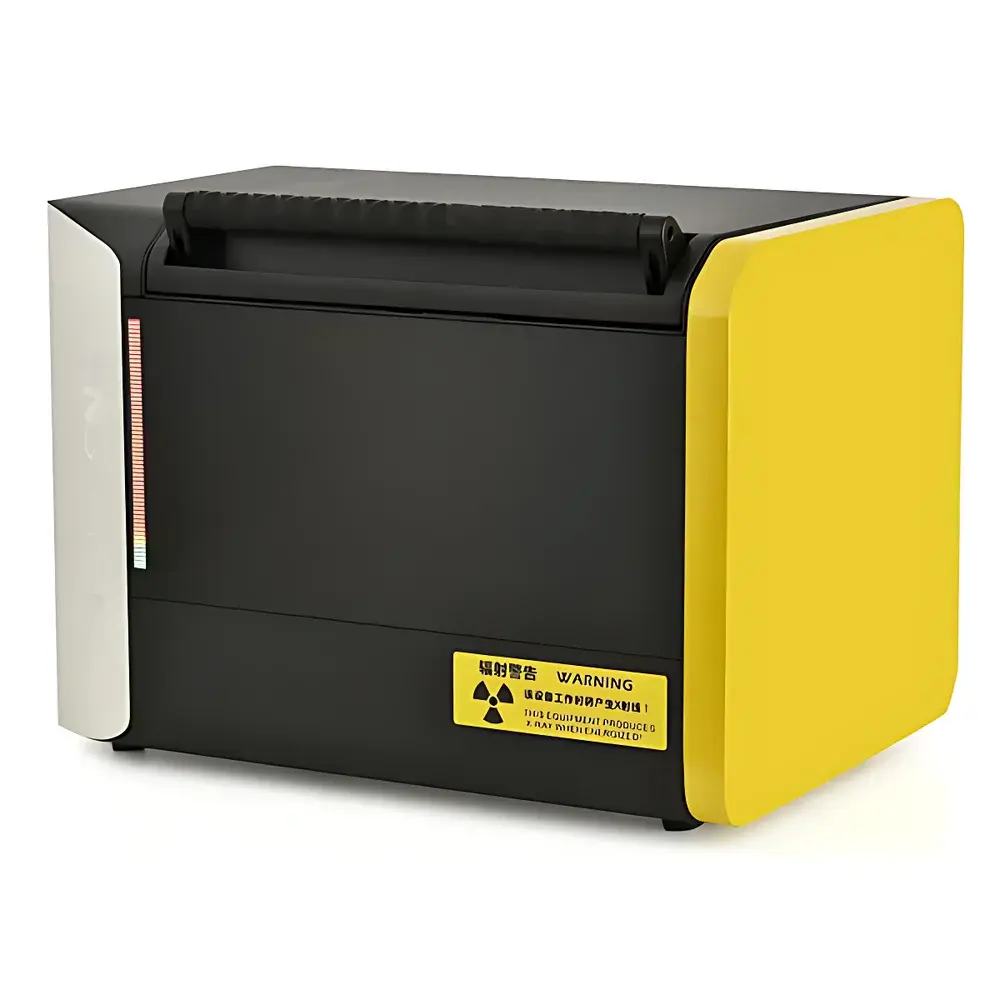
Brookfield ScopeX 800 Benchtop Energy Dispersive X-Ray Fluorescence Spectrometer
| Brand | LANScientific |
|---|---|
| Origin | Jiangsu, China |
| Manufacturer Type | Original Equipment Manufacturer (OEM) |
| Country of Origin | China |
| Model | ScopeX 800 |
| Configuration | Benchtop (non-vacuum) |
| Detector | High-resolution silicon drift detector (SDD), Peltier-cooled |
| Software | LANScientific XRF Analysis Suite v3.2 |
| Compliance | GB18871-2002, GBZ115-2002 |
| Sample Chamber | Sealed metal enclosure with interlocked safety shutter |
| Analysis Modes | Fundamental Parameters (FP), Calibration Curve, Empirical Matrix Correction |
| Report Export | PDF, Excel, CSV, XML |
| User Management | Role-based access control (Admin, Operator, Viewer) |
| Data Audit Trail | GLP-compliant timestamped logs |
Overview
The Brookfield ScopeX 800 is a benchtop energy dispersive X-ray fluorescence (ED-XRF) spectrometer engineered for precise, non-destructive elemental analysis of solid and powdered samples across diverse industrial and regulatory environments. Operating on the principle of X-ray excitation and characteristic secondary emission, the instrument irradiates samples with a micro-focused X-ray tube (typically Rh or Mo anode, 50 kV/1 mA max), inducing element-specific fluorescent photons detected by a high-resolution silicon drift detector (SDD). Its non-vacuum configuration eliminates the need for evacuation or helium purging—enabling rapid sample turnover while maintaining detection limits in the low parts-per-million (ppm) range for mid-to-high Z elements (e.g., Cr, Ni, Cu, Zn, Pb, Cd, Hg, Br, Cl). Designed for routine laboratory deployment rather than research-grade ultra-trace work, the ScopeX 800 delivers robust reproducibility (RSD < 2% for homogeneous alloys at 10 s counting time) and stable long-term calibration performance under ambient conditions.
Key Features
- Integrated Peltier-cooled SDD detector with <145 eV Mn Kα resolution ensures reliable peak separation for overlapping transitions (e.g., S Kα/Pb Mα, As Kα/Pb Lα).
- Optimized X-ray optics including primary beam collimation and multi-layer secondary target filtering to enhance signal-to-background ratio for light elements (Na–Cl).
- Motorized sample stage with programmable positioning supports automated batch analysis of up to 12 standard 32 mm diameter pellets or irregular solids ≤ 100 × 100 × 40 mm.
- Real-time spectrum visualization and live background subtraction during acquisition facilitate immediate quality assessment prior to quantification.
- Hardware interlocks and dual-stage radiation shielding—comprising lead-lined steel housing and fail-safe shutter mechanism—meet Chinese national radiation safety standards (GB18871-2002 and GBZ115-2002) without requiring external licensing for Class II device operation.
Sample Compatibility & Compliance
The ScopeX 800 accepts heterogeneous, non-conductive, and irregularly shaped specimens—including ores, slags, catalysts, polymer granules, coated metals, and pressed powder pellets—without mandatory surface polishing or vacuum-compatible preparation. Its large chamber accommodates flat, curved, or uneven surfaces; optional sample holders enable tilt-angle adjustment for optimized geometry. Method development aligns with ASTM E1621 (Standard Guide for XRF Elemental Analysis), ISO 21043 (XRF for RoHS compliance), and IEC 62321-5 (determination of Cd, Pb, Hg, Cr(VI), Br in electrotechnical products). While not validated per FDA 21 CFR Part 11 out-of-the-box, audit trail functionality (user login timestamps, parameter change logs, report generation history) supports GLP/GMP-aligned data integrity when deployed within controlled QA/QC workflows.
Software & Data Management
LANScientific XRF Analysis Suite v3.2 provides a Windows-based GUI with intuitive workflow navigation, supporting both guided wizard-driven analysis and expert-mode spectral deconvolution. Quantitative modules implement FP modeling with matrix correction libraries for geological, metallurgical, and polymer matrices; users may import certified reference material (CRM) data to build custom calibrations traceable to NIST SRMs. All analytical sessions generate immutable metadata—operator ID, acquisition parameters, detector status, and raw spectrum files—stored in encrypted SQLite databases. Export options include customizable PDF reports (with company logo, pass/fail flags, uncertainty estimates), Excel tables with full statistical summaries (mean, SD, RSD, confidence intervals), and CSV for LIMS integration. Role-based permissions enforce segregation of duties: administrators configure methods and manage users; operators execute analyses; viewers access historical reports only.
Applications
The ScopeX 800 serves as a primary screening and verification tool in regulated production environments where speed, repeatability, and regulatory defensibility are critical. In mining and metallurgy, it performs grade control of iron ore, bauxite, and copper concentrates; in petrochemical labs, it monitors catalyst poisoning (e.g., Ni/V in FCC feedstocks); in electronics manufacturing, it verifies RoHS/ELV compliance via rapid Pb/Cd/Hg/Br screening of PCB substrates and plastic housings. Environmental labs deploy it for soil heavy metal profiling (As, Cd, Cr, Pb) per EPA Method 6200 adaptations; polymer recyclers use it to detect flame retardants (Br, Cl) and stabilizers (Sn, Sb) in post-consumer streams. Its throughput—up to 60 samples/hour with auto-loader integration—makes it suitable for incoming raw material inspection, in-process alloy verification, and final product release testing.
FAQ
Does the ScopeX 800 require vacuum or helium purge for light element analysis?
No. The instrument operates in air mode and achieves reliable detection of Na through Cl using optimized excitation geometry and SDD energy resolution—no gas purge or vacuum pump is needed.
Can I import my own calibration standards into the software?
Yes. The software supports user-defined CRM libraries with certified concentrations, uncertainty values, and matrix composition for FP-based method adaptation.
Is remote monitoring or networked data export supported?
The system includes Ethernet connectivity and supports SMB file sharing for centralized report archiving; optional OPC UA interface enables integration with SCADA or MES platforms.
What maintenance is required for long-term stability?
Annual detector resolution verification using Mn Kα source and biannual X-ray tube output calibration using factory-certified reference foils are recommended per ISO/IEC 17025 guidance.
How does the system handle heterogeneous or layered samples?
Multi-point mapping mode allows raster scanning over 10 × 10 mm areas; average composition is reported with spatial variance metrics to flag segregation or coating inconsistencies.
Related Products




