
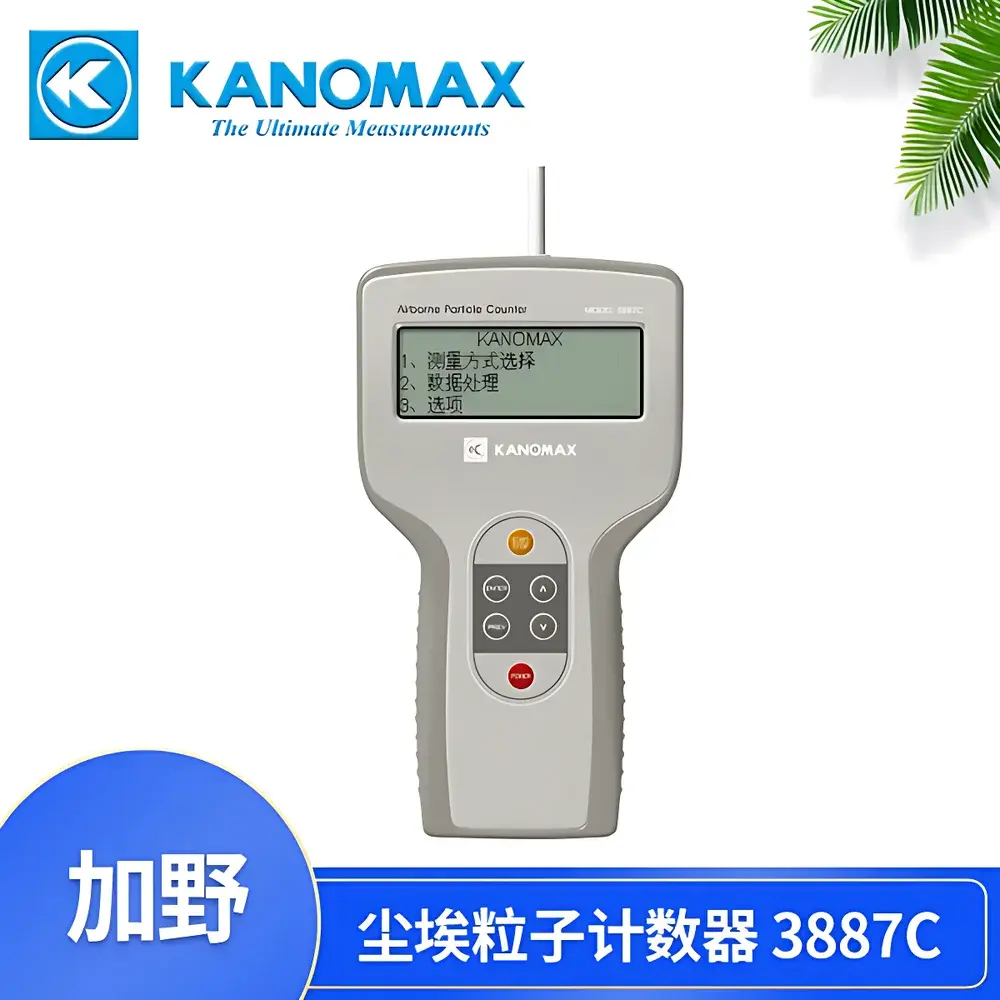
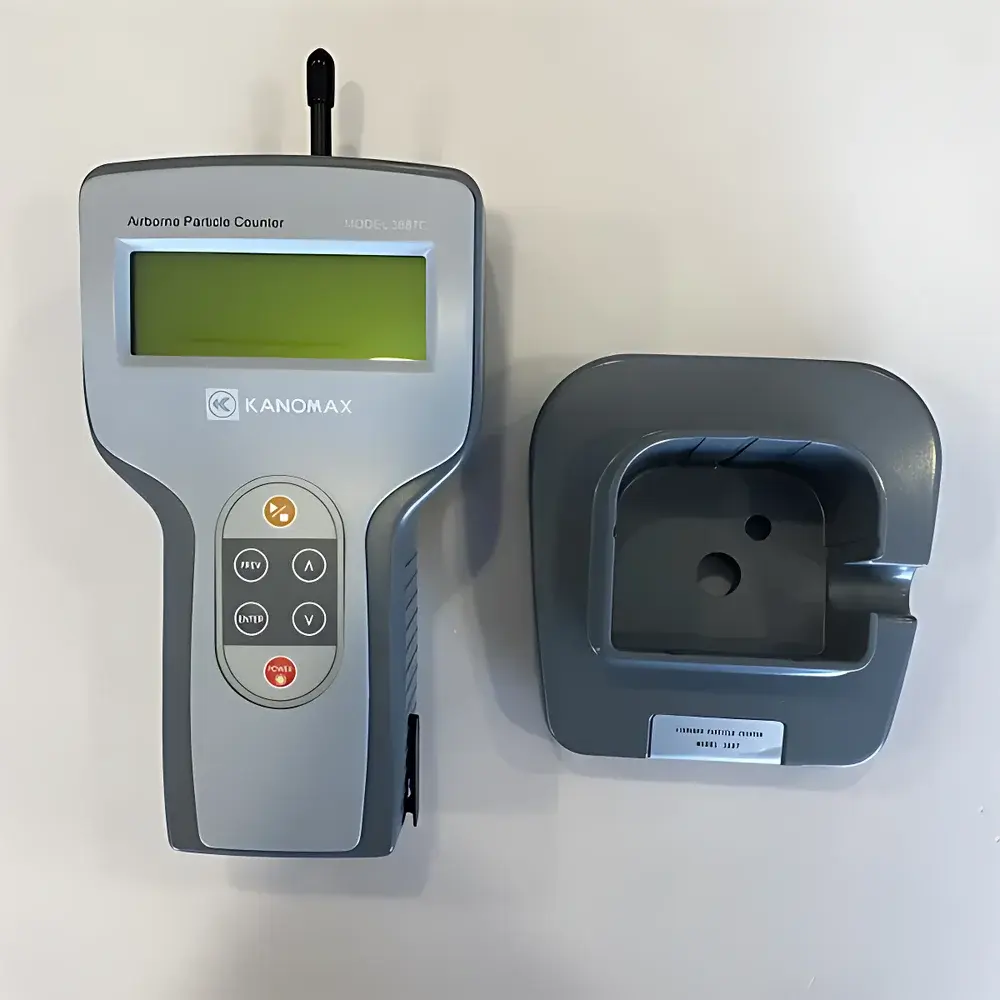
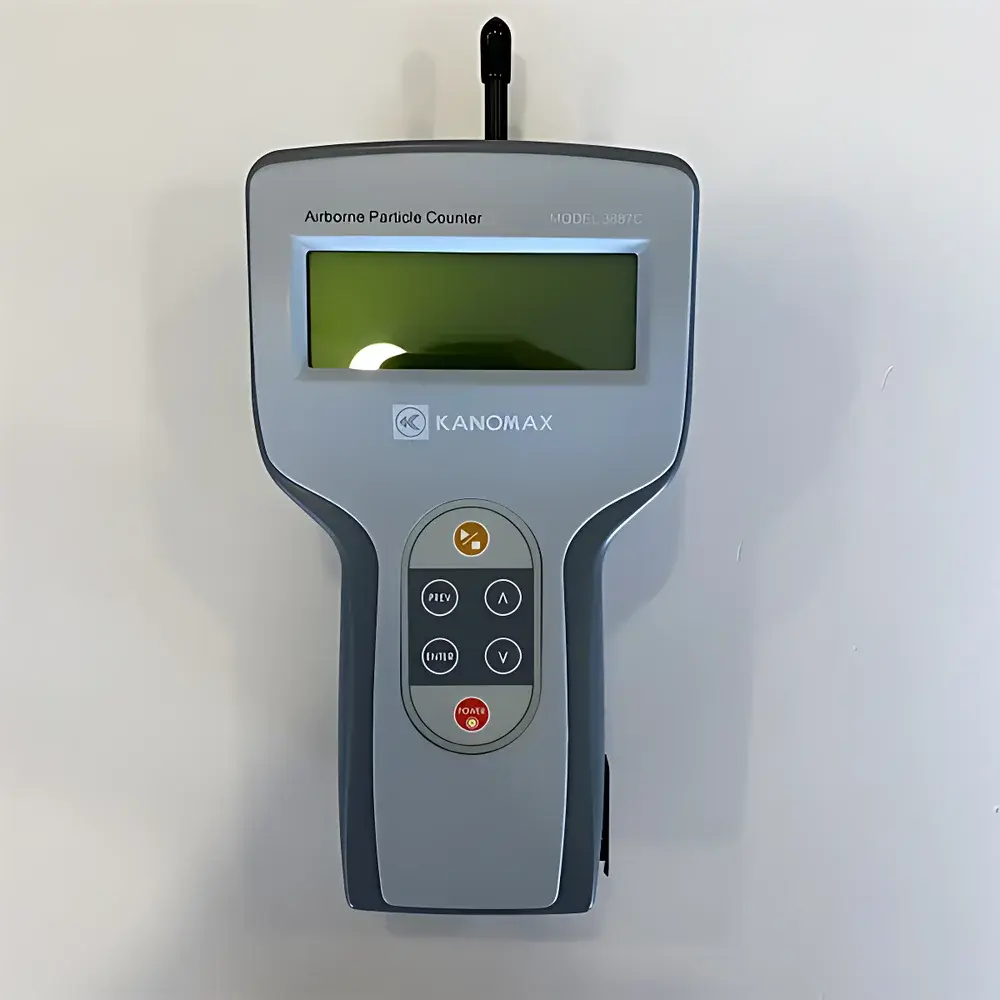
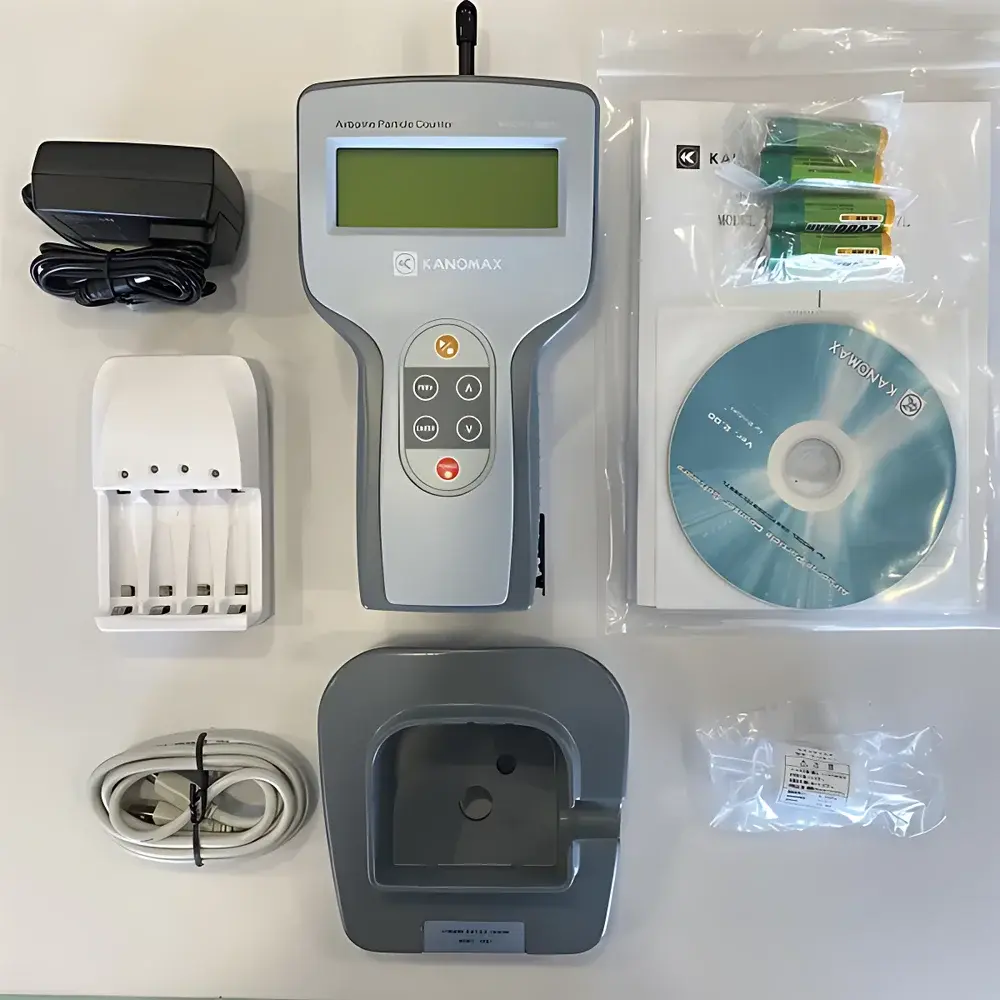
Kanomax 3887C Handheld Airborne Particle Counter
| Brand | Kanomax |
|---|---|
| Origin | Japan |
| Model | 3887C |
| Instrument Type | Handheld |
| Flow Rate | 2.83 L/min (0.1 cfm) |
| Flow Accuracy | < ±1 particle per 5 min |
| Timing Accuracy | ±1 s within 6-min sampling |
| Repeatability | ≤ ±10% FS |
| Size Distribution Error | ≤ ±30% |
| Indication Error | ≤ ±30% FS |
| Particle Size Channels | 0.3, 0.5, and 5.0 µm |
| Data Storage Capacity | 7,000 records |
| Sampling Duration | 10 sec to 99 min 59 sec |
| Sampling Modes | Single, Repeat, Continuous, Calculate, Remote, International, ISO (3887C/D only) |
| Count Alarm Range | 1–70,000,000 particles |
| Power Supply | 4× AA batteries (alkaline or Ni-MH), or AC adapter (100–240 V AC) |
| Dimensions | 108(W) × 68(D) × 196(H) mm |
| Weight | ~680 g (without batteries) |
| Compliance | GB/T 16292–2010, ISO 14644-1, China GMP (2010) Annex 1 |
Overview
The Kanomax 3887C Handheld Airborne Particle Counter is a precision-engineered instrument designed for real-time quantification of viable and non-viable particulate contamination in controlled environments. Based on the light scattering principle—where particles passing through a focused laser beam generate scattered photons detected by a photodiode—the 3887C delivers rapid, calibrated enumeration across three discrete size thresholds: 0.3 µm, 0.5 µm, and 5.0 µm. Its 2.83 L/min (0.1 cfm) volumetric flow rate conforms to international standard sampling protocols for cleanroom classification and monitoring, enabling direct correlation with ISO 14644-1 class limits and regulatory requirements under China’s GMP Annex 1 and USP /. The device operates independently of external vacuum sources, integrating a low-noise, brushless sampling pump with thermal mass-flow compensation to maintain stable flow under varying ambient pressure and temperature conditions—critical for repeatable data acquisition during qualification, routine surveillance, and environmental monitoring in pharmaceutical manufacturing, microelectronics fabrication, and aseptic processing suites.
Key Features
- Triple-channel optical detection system optimized for high signal-to-noise ratio at 0.3 µm—validated against NIST-traceable PSL standards
- Real-time display with intuitive Chinese-language interface and dual-unit readout (particles/m³ and particles/ft³)
- Seven programmable sampling modes: Single, Repeat, Continuous, Calculate (for UCL calculation), Remote (via RS-232), International (ISO 14644-1 compliant), and GMP-specific workflows
- Configurable delay start function (0–999 s) to eliminate operator-induced turbulence prior to measurement initiation
- Robust internal memory storing up to 7,000 complete test records—including timestamp, location ID, operator tag, and full channel-wise count data—with automatic overwrite protection
- Power-flexible operation: supports alkaline AA batteries (≥8 hr runtime), rechargeable Ni-MH packs (with included dedicated charger), or universal AC adapter (100–240 V)—no direct AC charging of batteries
- Compact ergonomic housing (108 × 68 × 196 mm; ~680 g) certified to IP42 ingress protection level for dust resistance and limited moisture exposure
Sample Compatibility & Compliance
The 3887C is validated for use in ISO Class 5–8 cleanrooms, laminar flow hoods, isolators, and critical utility systems (e.g., compressed air, nitrogen, and HVAC supply ducts). Its particle sizing accuracy meets the performance criteria defined in ISO 21501-4 for light-scattering airborne particle counters, with demonstrated traceability to national metrology institutes. Firmware includes preloaded compliance templates aligned with GB/T 16292–2010 (Chinese pharmaceutical cleanroom testing), ISO 14644-1:2015 (cleanroom classification), and China GMP Annex 1 (2010 revision) for sterile product manufacturing. All stored data retain immutable timestamps and user-assigned identifiers—supporting audit readiness for GLP, GMP, and FDA 21 CFR Part 11-compliant environments when paired with Kanomax’s optional PC-based data management software.
Software & Data Management
Data export is supported via RS-232 serial interface (standard) or optional USB-to-serial adapter. Raw measurement files are saved in ASCII CSV format compatible with Microsoft Excel, LabVIEW, and LIMS platforms. Kanomax’s proprietary KAN-View software (Windows-compatible, sold separately) enables automated report generation—including UCL (Upper Confidence Limit) calculations per ISO 14644-1 Annex B—and graphical trend analysis across multiple locations and timepoints. Audit trail functionality logs all configuration changes, user logins, and data export events—meeting ALCOA+ principles (Attributable, Legible, Contemporaneous, Original, Accurate, Complete, Consistent, Enduring, Available) required for regulated quality systems.
Applications
- Qualification and periodic re-certification of cleanrooms and controlled environments per ISO 14644-2
- In-process monitoring during aseptic filling, lyophilization, and sterile filtration operations
- Filter integrity verification (e.g., HEPA/ULPA downstream challenge testing)
- Compressed gas purity assessment in pharmaceutical and semiconductor facilities
- Environmental baseline establishment and deviation investigation in QC/QA laboratories
- Educational and research applications requiring portable, field-deployable particle counting capability
FAQ
What calibration standards does the 3887C support?
The instrument is factory-calibrated using NIST-traceable polystyrene latex (PSL) spheres; users may perform field verification with ISO 21501-4 reference aerosols.
Can the 3887C be used for ISO Class 4 or higher洁净度 environments?
While capable of detecting sub-0.3 µm particles, its specified lower detection limit is 0.3 µm—making it suitable for ISO Class 5 and above per ISO 14644-1; Class 4 requires instruments with 0.1 µm sensitivity.
Is firmware upgrade available?
Yes—Kanomax provides periodic firmware updates via downloadable HEX files and KAN-View software to enhance stability, expand compliance templates, and improve data security features.
Does the device meet FDA 21 CFR Part 11 requirements out-of-the-box?
The hardware supports electronic signatures and audit trails when used with validated KAN-View software and documented procedural controls—full compliance requires site-specific validation per organizational SOPs.
What is the recommended recalibration interval?
Annual recalibration is advised per ISO/IEC 17025 and manufacturer guidelines; more frequent verification is recommended after physical shock, extended storage, or exposure to extreme humidity or particulate overload.
Related Products







