
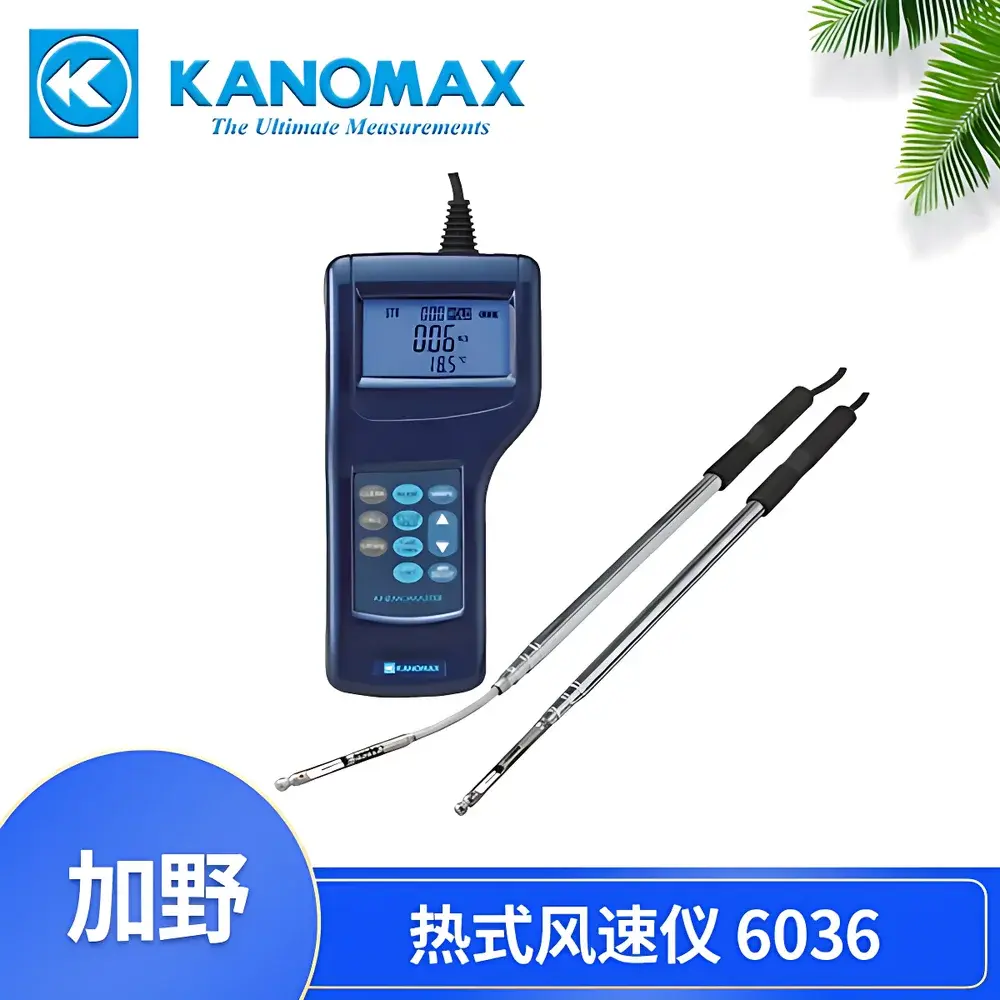
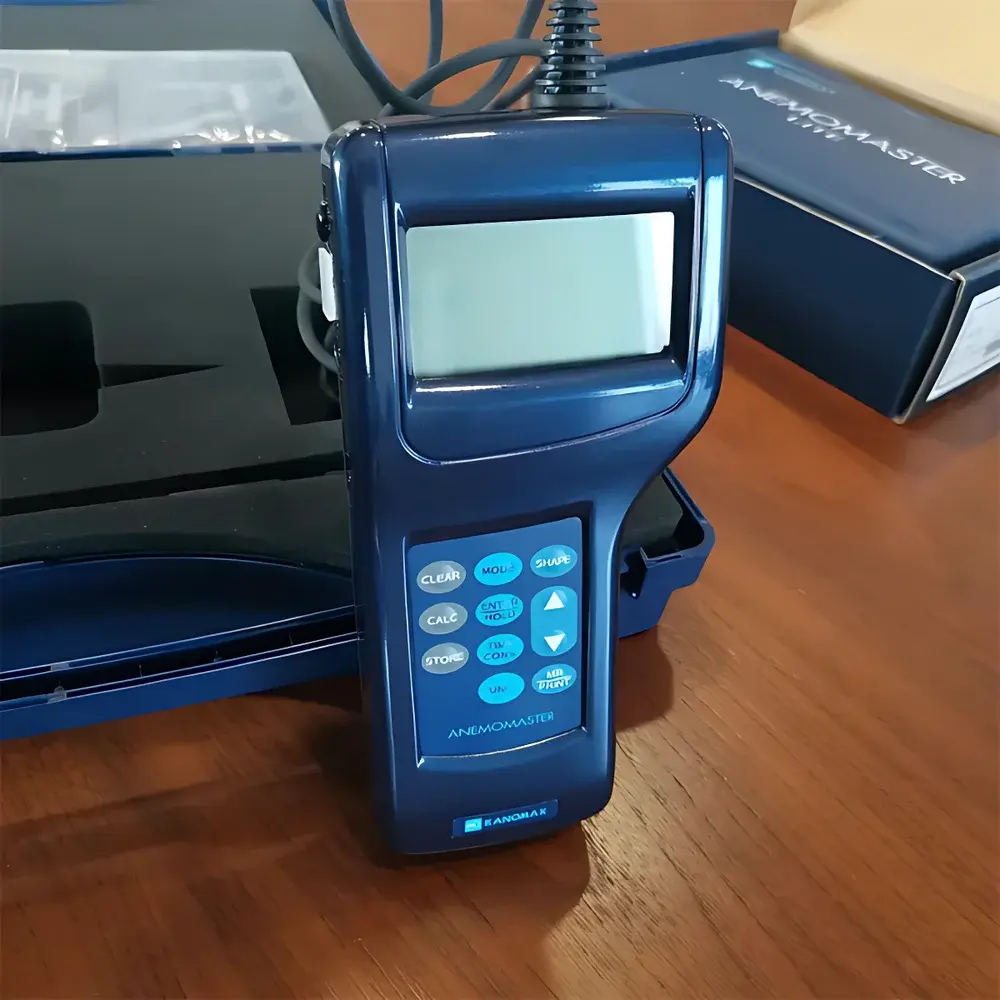
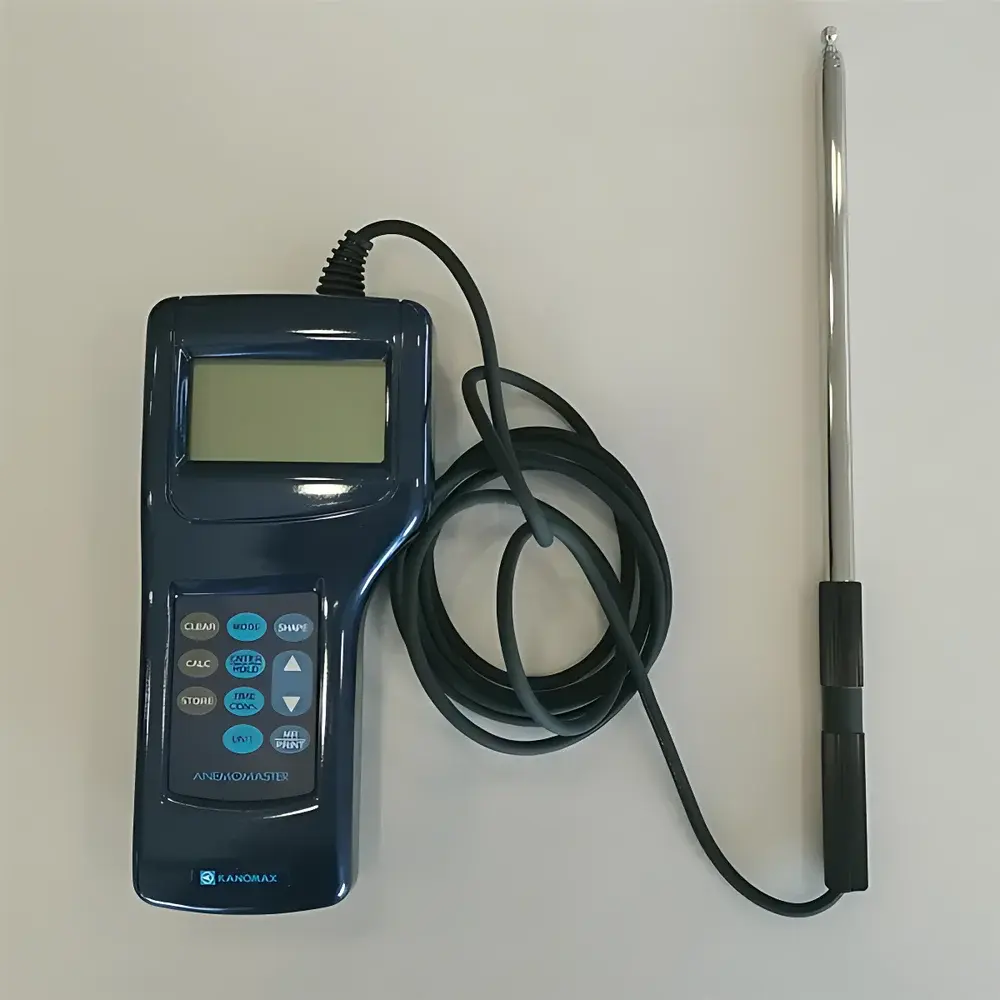
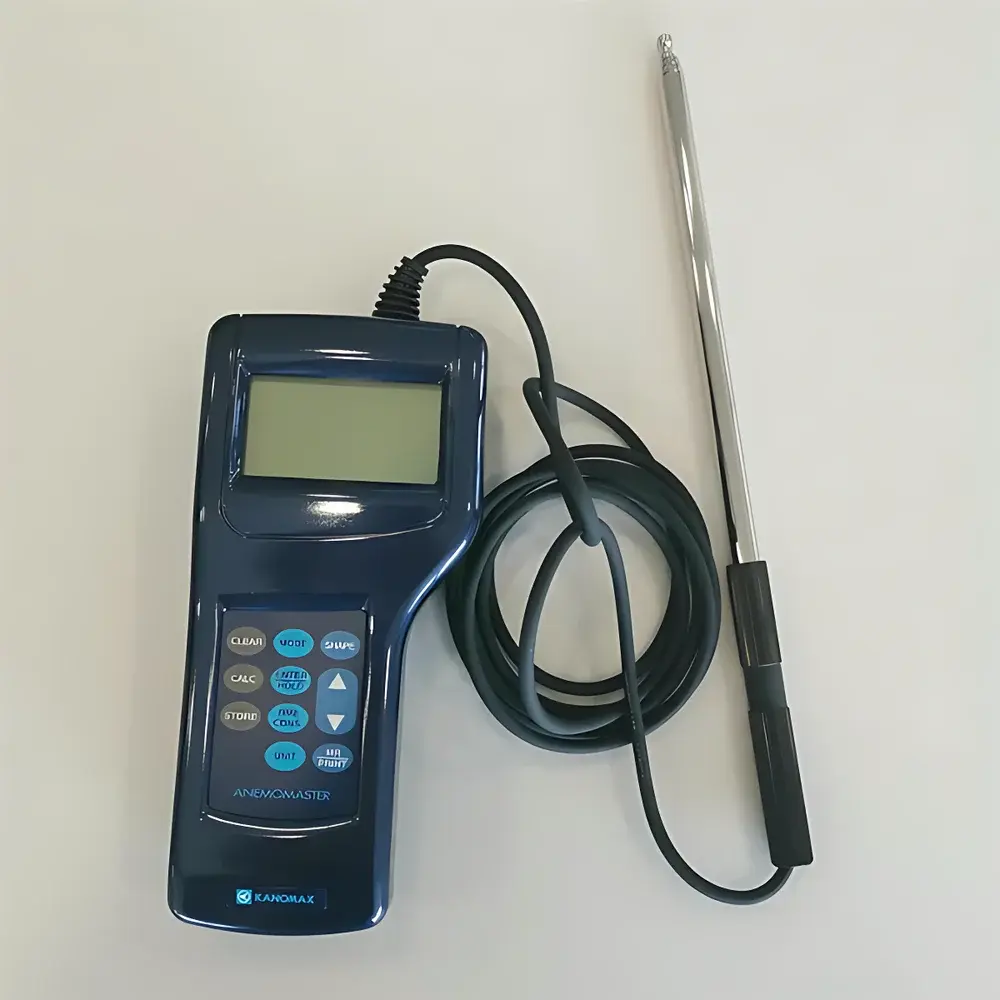
Kanomax 6036-0C Smart Environmental Anemometer & Air Flow Meter
| Brand | Kanomax |
|---|---|
| Origin | Liaoning, China |
| Manufacturer Type | Authorized Distributor |
| Country of Origin | China |
| Model | 6036-0C |
| Instrument Type | Thermal Anemometer |
| Resolution | 0.01 m/s |
| Measurement Range | 0.01–30.0 m/s |
| Accuracy | ±3% of reading |
| Operating Temperature | −20 to +70 °C |
| Operating Humidity | 0–100% RH |
| Temperature Range | −20 to +70 °C |
| Temperature Accuracy | ±0.5 °C |
| Pressure Range | −5.0 to +5.0 kPa |
| Pressure Accuracy | ±3% of reading |
| Data Storage Capacity | 1500 records |
| Interface | USB |
| Dimensions | 66 × 51 × 188 mm |
| Weight | 400 g (without batteries) |
Overview
The Kanomax 6036-0C Smart Environmental Anemometer & Air Flow Meter is a handheld, multi-parameter thermal anemometer engineered for precise in-situ measurement of air velocity, volumetric flow rate, temperature, and differential pressure in HVAC systems, cleanrooms, ventilation ducts, and industrial process environments. Utilizing constant-temperature anemometry (CTA), the instrument maintains a heated sensing element at a fixed temperature differential relative to ambient air; convective heat loss is directly correlated to airflow velocity, enabling high-reproducibility measurements across its full 0.01–30.0 m/s range. Unlike cup or vane anemometers, the thermal probe offers near-instant response time (<100 ms), minimal flow disturbance, and insensitivity to flow direction—critical for low-velocity laminar flow characterization and turbulent flow profiling. The device calculates volumetric air flow (m³/h or CFM) automatically upon user input of duct geometry (rectangular, circular, or irregular cross-section) and dimensions, eliminating manual conversion errors and supporting ISO 16813-compliant indoor air quality assessments.
Key Features
- Integrated thermal anemometer probe with flexible, telescoping, and bendable shaft for access to confined or hard-to-reach ducts and grilles
- Simultaneous real-time measurement of air velocity, temperature (−20 to +70 °C), and differential pressure (±5.0 kPa)
- On-device statistical functions: min/max/average calculation, data hold, and auto-zeroing for pressure offset compensation
- Internal memory stores up to 1500 timestamped measurement sets with channel-specific metadata (velocity, temp, pressure, date/time)
- USB interface enables direct connection to Windows-based PCs for firmware updates and data export via Kanomax’s proprietary data management software
- Rugged, ergonomic housing (66 × 51 × 188 mm, 400 g) with IP54-rated ingress protection against dust and water splashes
- Battery-powered operation (4 × AA alkaline, ~20 hours continuous use) with low-battery indicator and auto-power-off
Sample Compatibility & Compliance
The 6036-0C is validated for use in non-corrosive, non-explosive ambient air streams containing particulate levels typical of commercial HVAC, pharmaceutical cleanroom monitoring (ISO 14644-1 Class 5–8), and general industrial ventilation applications. It complies with IEC 61000-4-2 (ESD immunity) and IEC 61000-4-3 (radiated RF immunity) standards. While not intrinsically safe, it meets EN 61010-1 safety requirements for portable electrical measuring equipment. Its ±3% velocity accuracy and ±0.5 °C temperature accuracy align with ASTM D1078 and ISO 7726 guidelines for environmental parameter instrumentation used in thermal comfort studies (ASHRAE 55) and energy audit protocols (IPMVP Option B). Calibration certificates traceable to NIM (National Institute of Metrology, China) are available upon request.
Software & Data Management
The included Kanomax Data Manager software (Windows 10/11 compatible) supports real-time graphing, batch export to CSV/Excel, and customizable report generation—including duct geometry templates, measurement location tagging, and pass/fail thresholds per ASHRAE Standard 111. All stored datasets retain full audit trail metadata: operator ID (user-defined), measurement timestamp (with millisecond resolution), sensor status flags (e.g., probe out-of-range, low battery), and calibration due date. Software logs all user actions (data deletion, parameter changes) in an immutable log file, satisfying basic GLP documentation requirements. Exported files include embedded instrument serial number and firmware version, ensuring data provenance for internal QA review or regulatory submissions.
Applications
- HVAC system commissioning and balancing per ANSI/ASHRAE Guideline 12 and SMACNA Duct System Testing Procedures
- Cleanroom airflow uniformity and velocity mapping in ISO Class 5–8 controlled environments
- Exhaust hood face velocity verification (OSHA 1910.145 and ANSI Z9.5 compliance)
- Industrial ventilation surveying for TLV assessment and local exhaust effectiveness evaluation
- Building envelope leakage testing when paired with blower door systems (differential pressure mode)
- Educational laboratory instruction on fluid dynamics, thermodynamics, and environmental health physics
FAQ
Is the 6036-0C suitable for outdoor wind speed measurement?
No. It is designed for indoor and semi-enclosed environments with stable thermal conditions; outdoor use may exceed operating humidity limits and induce thermal drift due to solar loading.
Can the probe be calibrated independently of the main unit?
Yes—the thermal sensor assembly is field-replaceable and individually calibrated; NIST-traceable calibration certificates are issued per probe serial number.
Does the device support Modbus or BACnet communication protocols?
No. Communication is limited to USB virtual COM port mode; integration with building management systems requires third-party USB-to-BACnet gateways.
What is the recommended recalibration interval?
Annually under normal use, or after mechanical shock, exposure to condensation, or >500 hours of continuous operation—per Kanomax’s service bulletin K-6036-CAL-2023.
Is the pressure measurement referenced to ambient or sealed gauge?
It uses a differential pressure transducer with two ports; users must connect high/low sides manually—no built-in static reference chamber.







