
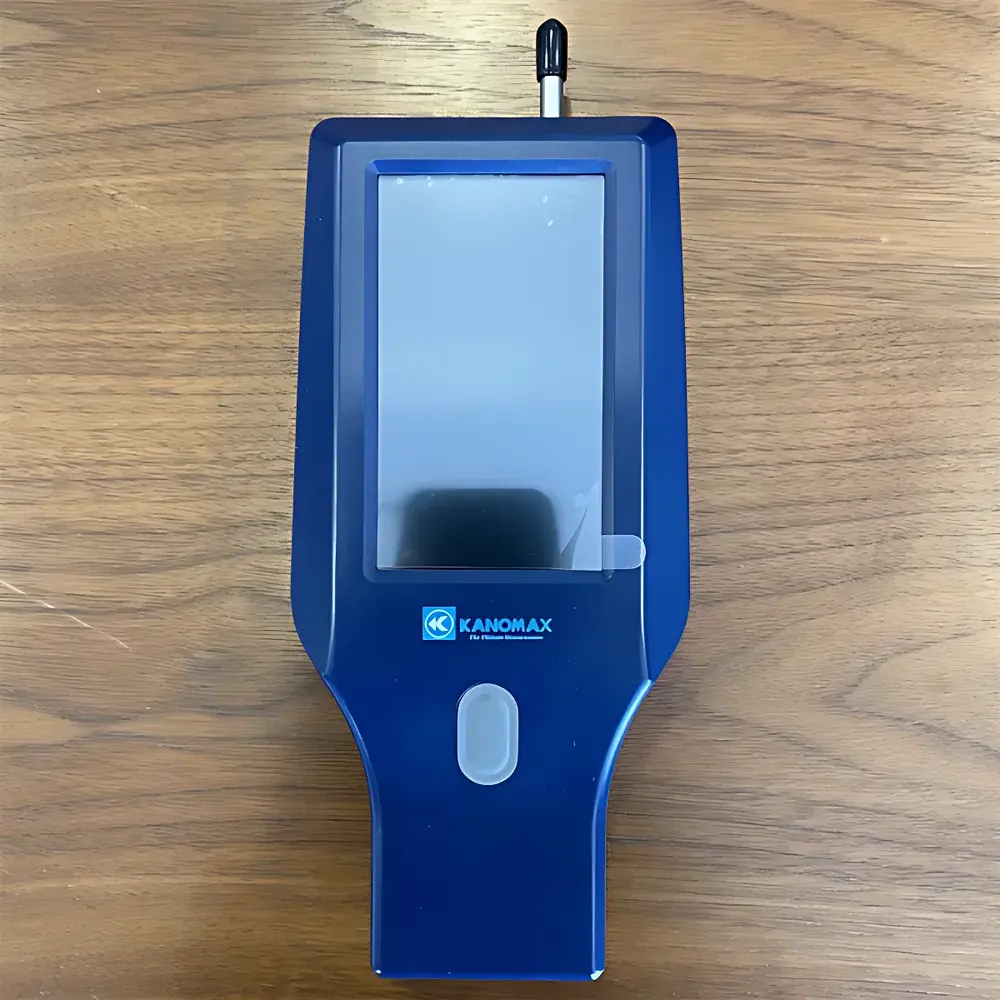
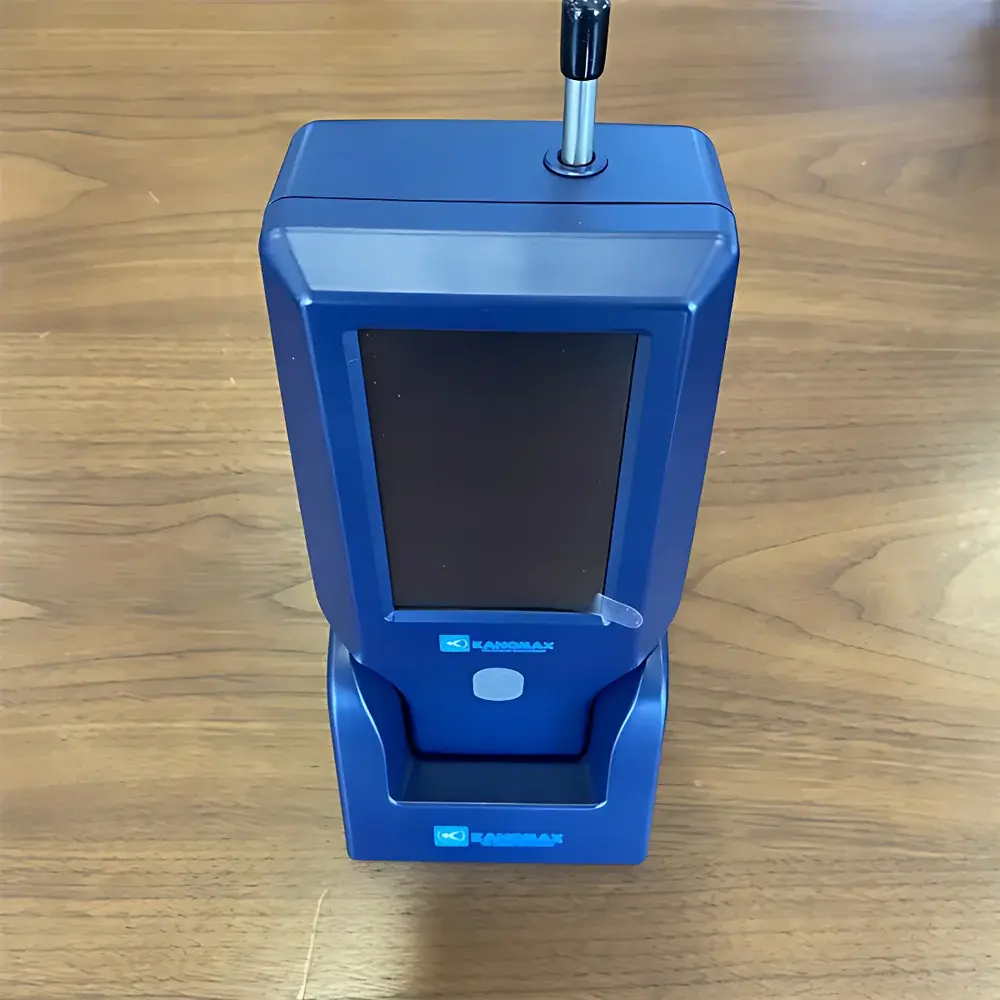
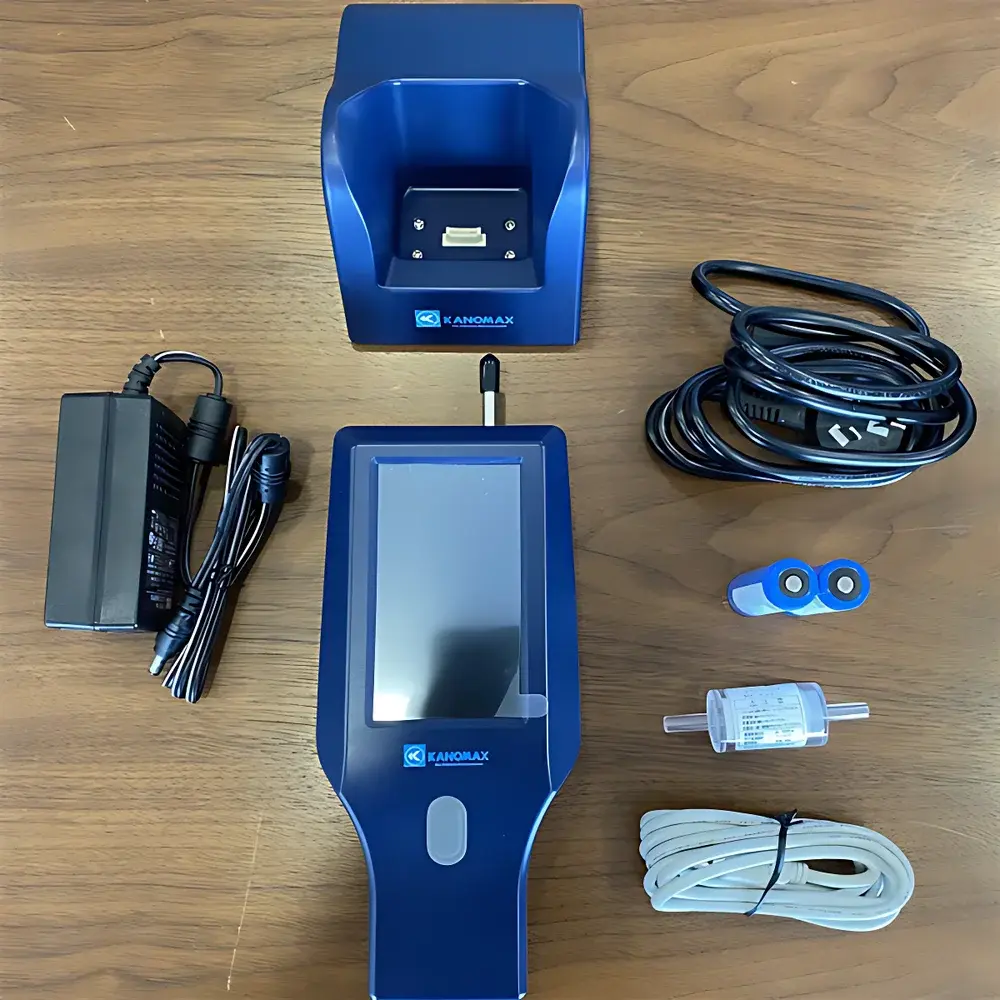
KANOMAX Model 3888 / 3889 Handheld Airborne Particle Counter for Pharmaceutical Cleanroom ISO & GMP Compliance
| Brand | KANOMAX |
|---|---|
| Origin | Japan |
| Model | 3888 / 3889 |
| Sampling Flow Rate | 2.83 L/min |
| Detectable Particle Sizes | 0.3, 0.5, 5.0 µm (3888) or 0.3, 0.5, 1.0, 3.0, 5.0, 10.0 µm (3889) |
| Light Source | Laser Diode |
| Counting Efficiency | Compliant with ISO 21501-4 and JIS B9921 |
| Maximum Concentration | 2,000,000 particles/ft³ |
| Sampling Time Range | 6 sec – 99 min 59 sec |
| Sampling Modes | Single, Repeat, Continuous, Calculate, ISO, GB |
| Data Storage Capacity | 10,000 records (CSV format) |
| Communication Interfaces | Dual USB (Host/Device), RS485, Ethernet, WiFi |
| Operating Temperature | 10–40 °C |
| Relative Humidity | 0–85 % RH (non-condensing) |
| Dimensions | 100 × 213 × 55 mm (W × H × D) |
| Weight | 650 g (body only, battery excluded) |
| Battery Life | Up to 5 hours (single-test mode) |
| Language Support | English, Chinese, Japanese, Spanish |
| Regulatory Compliance | ISO 21501-4, JIS B9921, GB/T 16292–2010, Annex 1 of EU GMP, FDA Guidance for Aseptic Processing |
Overview
The KANOMAX Model 3888 and 3889 are handheld airborne particle counters engineered for rigorous environmental monitoring in regulated pharmaceutical manufacturing environments. Based on light scattering principles using a stable laser diode source, these instruments detect and size particles in real time via calibrated optical sensing, enabling quantitative assessment of airborne particulate contamination across defined size thresholds. Designed explicitly for cleanroom qualification, routine monitoring, and ongoing verification per ISO 14644-1, EU GMP Annex 1, and USP /, the system delivers traceable, reproducible data essential for regulatory submissions and quality system audits. Its compact form factor, robust internal architecture, and dual-model configuration (3888 for 3-channel, 3889 for 6-channel detection) support both rapid point-of-use verification and structured mapping protocols in Grade A–D classified spaces.
Key Features
- Laser-based optical detection compliant with ISO 21501-4 and JIS B9921 for high counting efficiency and size resolution at 0.3 µm and above
- Fixed sampling flow rate of 2.83 L/min (0.1 CFM), aligned with international cleanroom testing standards and enabling direct comparison with ISO 14644-1 classification tables
- Configurable particle channels: Model 3888 monitors 0.3, 0.5, and 5.0 µm; Model 3889 extends coverage to six sizes—0.3, 0.5, 1.0, 3.0, 5.0, and 10.0 µm—for comprehensive distribution analysis
- Integrated firmware with six standardized test modes: Single, Repeat, Continuous, Calculate (for derived metrics such as particle concentration per m³), ISO-compliant classification, and GB/T 16292–2010 protocol execution
- Dual USB interfaces (Host and Device) plus optional RS485, Ethernet, and WiFi connectivity—enabling flexible integration into facility-wide environmental monitoring systems (EMS) and supporting remote parameter configuration and live data streaming
- Onboard storage of up to 10,000 measurement records in CSV format, with timestamp, location tag, and channel-specific counts—facilitating offline statistical review and audit-ready documentation
- Multi-language UI (English, Chinese, Japanese, Spanish) and intuitive touchscreen interface optimized for glove-compatible operation in controlled environments
Sample Compatibility & Compliance
The 3888/3889 is validated for use in non-viable airborne particle monitoring across ISO Class 3–8 (ISO 14644-1) and EU GMP Grades A–D environments. It supports critical applications including pre- and post-operational cleanroom certification, isolator and RABS performance validation, HVAC filter integrity checks (via upstream/downstream differential counting), and localized source identification during process interventions. Instrument calibration traceability follows ISO/IEC 17025-accredited procedures, and zero-count verification is performed using the supplied HEPA-filtered zero standard—ensuring baseline stability prior to each measurement sequence. The device meets requirements for data integrity under FDA 21 CFR Part 11 when used with validated software configurations and appropriate access controls.
Software & Data Management
KANOMAX’s dedicated PC software enables bidirectional communication via USB or network interfaces, supporting real-time graphical display of time-series particle counts per channel, automatic calculation of ISO classification results, and export of raw CSV logs for statistical process control (SPC) analysis. Audit trail functionality records user actions, parameter changes, and calibration events—meeting GLP/GMP documentation expectations. When deployed with optional WiFi-enabled base stations, multiple units can be synchronized for spatially distributed monitoring networks, with centralized data aggregation and alarm-triggered notifications. All stored data retain embedded metadata (date/time, operator ID, location code, instrument serial number), ensuring full traceability required by regulatory inspectors.
Applications
- ISO 14644-1 cleanroom classification and re-certification in pharmaceutical manufacturing suites
- Ongoing environmental monitoring (EM) programs per EU GMP Annex 1 and FDA guidance for aseptic processing
- Filter leak testing of HEPA/ULPA installations using challenge aerosols and differential counting
- Investigation of particle excursions during manufacturing deviations or equipment maintenance activities
- Validation of laminar airflow workstations, isolators, and transfer hatches
- Supporting risk-based monitoring strategies through trend analysis of historical particle count datasets
FAQ
What regulatory standards does the KANOMAX 3888/3889 comply with?
It conforms to ISO 21501-4 (instrument performance), ISO 14644-1 (cleanroom classification), JIS B9921 (Japanese national standard), GB/T 16292–2010 (Chinese pharmacopoeial standard), and supports compliance with EU GMP Annex 1 and FDA aseptic processing guidance.
Is the instrument suitable for Grade A (ISO Class 4.8) environments?
Yes—its 0.3 µm lower detection limit, low false count rate, and stable flow control meet the sensitivity and reproducibility requirements for unidirectional airflow zone monitoring.
How is zero-count verification performed?
Using the included zero-count filter, users conduct a ≥15-minute background measurement; stable counts below 1 particle per cubic foot over ≥10 seconds confirm optical chamber cleanliness prior to active sampling.
Can data be exported directly to LIMS or MES systems?
Yes—CSV-formatted logs are compatible with most laboratory information management systems; Ethernet and WiFi interfaces support automated transfer via secure FTP or custom API integrations.
Does the device support 21 CFR Part 11 compliance?
When operated with validated software, electronic signatures, audit trails, and role-based access control, it fulfills technical requirements for electronic records and signatures in regulated environments.







