
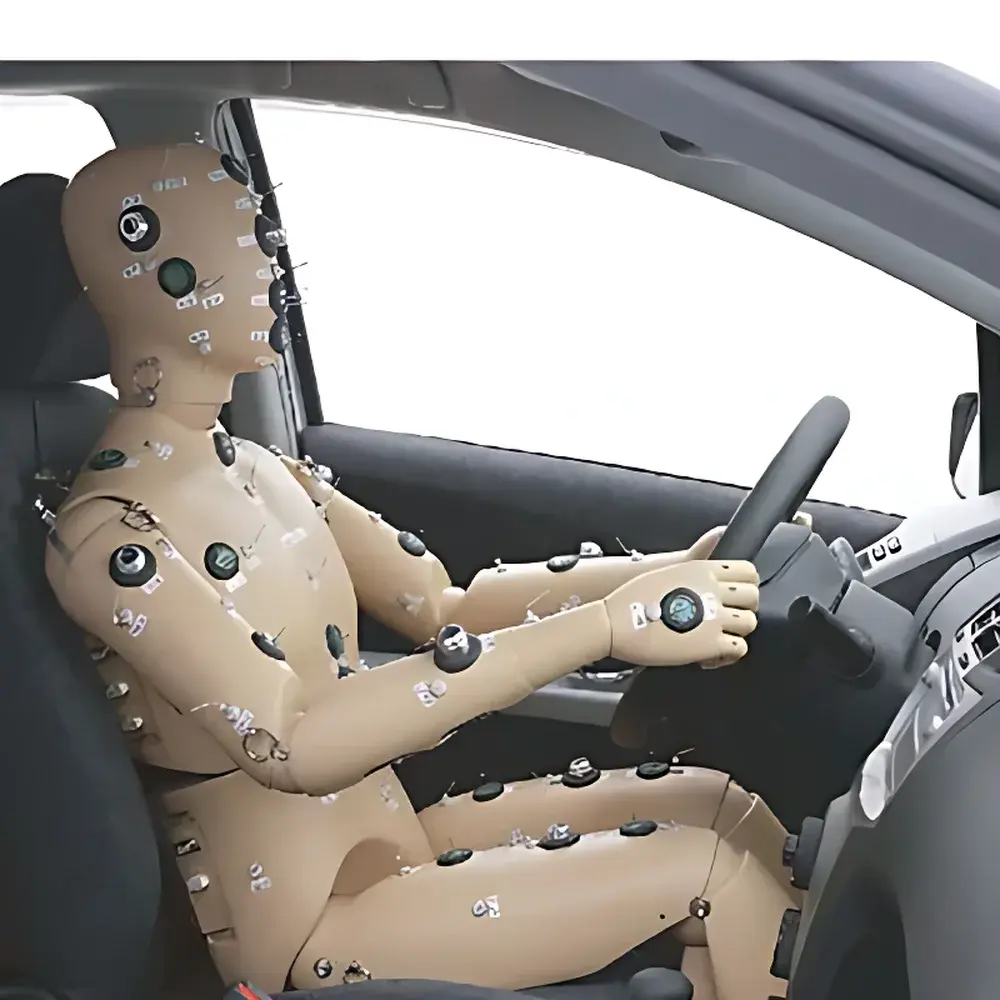
Kanomax KAN-1000 Automotive HVAC Thermal Manikin System
| Brand | Kanomax |
|---|---|
| Origin | Japan |
| Model | KAN-1000 |
| Wind Speed Range | 0.10–5.00 m/s (Accuracy: ±0.05 m/s) |
| Temperature Range | −30 to +70 °C (Accuracy: ±3.0 °C) |
| Relative Humidity Range | 3–95 %RH (Accuracy: ±3 %RH) |
| Radiant Heat Flux Range | 0–1 kW/m² (Accuracy: ±7 %) |
| Spectral Response | 0.3–40 µm |
| Height | ~170 cm |
| Weight | 40 kg |
| Construction Material | Fiberglass-Reinforced Plastic (FRP) |
| Sensor Distribution | Head (41 sensors), Upper Torso (213), Lower Torso (305), Total Sensors: 3678 |
| Wireless Data Transmission | Yes |
| Real-Time PMV/PPD Calculation | Yes |
| Software | Windows-based, Excel-compatible export, charting & historical data retrieval |
| Compliance | Designed for ISO 7730, ASHRAE 55, and EN 15251 thermal comfort evaluation protocols |
Overview
The Kanomax KAN-1000 Automotive HVAC Thermal Manikin System is a high-fidelity, anthropometrically accurate thermal manikin engineered for objective, spatially resolved assessment of cabin thermal environments in passenger vehicles. Based on the principles of heat balance modeling and validated physiological equivalence, the system measures local convective, radiative, conductive, and evaporative heat exchange across 3,678 discrete sensor nodes distributed over four anatomically segmented zones—head, upper torso, lower torso, and limbs. Each zone operates as an independent thermal unit with programmable heating/cooling capacity, enabling dynamic simulation of human metabolic response under transient HVAC conditions. Unlike passive thermal dummies, the KAN-1000 actively regulates surface temperature to emulate steady-state and transient thermoregulatory behavior, supporting quantitative evaluation of thermal comfort metrics including Predicted Mean Vote (PMV), Predicted Percentage Dissatisfied (PPD), and Local Thermal Discomfort (LTD) per ISO 7730 and ASHRAE Standard 55.
Key Features
- Four fully articulated, independently controlled thermal segments (head, upper torso, lower torso, legs) for spatially resolved thermal mapping
- 3,678 embedded micro-sensors: 41 in head, 213 in upper torso, 305 in lower torso, and distributed across limbs for comprehensive coverage
- Simultaneous multi-point measurement of air velocity (0.10–5.00 m/s, ±0.05 m/s), ambient temperature (−30 to +70 °C, ±3.0 °C), relative humidity (3–95 %RH, ±3 %RH), and mean radiant temperature (0–1 kW/m², ±7 %)
- Optimized spectral response (0.3–40 µm) ensures accurate long- and short-wave radiant heat detection across automotive interior surfaces and solar loading conditions
- Integrated wireless telemetry enables real-time data streaming to host PC without cable constraints—critical for moving-vehicle or rotating-platform testing
- FRP (fiberglass-reinforced plastic) construction provides mechanical rigidity, thermal stability, and electromagnetic compatibility in vehicle EMC environments
- Self-contained power management supports ≥4 hours of continuous operation on rechargeable Li-ion battery pack
Sample Compatibility & Compliance
The KAN-1000 is compatible with standard automotive seating configurations (bench, bucket, rear bench) and integrates seamlessly with climate wind tunnels, solar simulators, and on-road test vehicles. Its anthropometric profile (~170 cm height, 40 kg mass) conforms to the 50th-percentile adult male per SAE J2722 and ISO 15263. All thermal and airflow measurements are traceable to NIST-recognized reference standards. The system supports full compliance workflows for ISO 7730 (analytical determination of thermal comfort), ASHRAE 55-2023 (thermal environmental conditions for human occupancy), and EN 15251 (indoor environmental input parameters). Data logging meets GLP audit requirements with time-stamped, user-annotated sessions and immutable file hashing for regulatory review.
Software & Data Management
The proprietary Kanomax Thermal Analysis Suite (KTAS) v4.x runs natively on Windows 10/11 and provides synchronized visualization of all 3,678 sensor channels in real time. Users can define custom thermal zones, overlay contour maps on 3D manikin geometry, and compute localized PMV/PPD values using Fanger’s equations with adaptive clothing insulation (clo) and metabolic rate (met) inputs. All datasets export directly to .CSV or native Excel (.XLSX) format with embedded metadata (test ID, operator, vehicle ID, ambient conditions). Audit trails record every parameter change, calibration event, and export action—fully compliant with FDA 21 CFR Part 11 requirements for electronic records and signatures when deployed in regulated R&D environments.
Applications
- Validation of HVAC duct design, vent placement, and airflow distribution strategies under steady-state and transient cabin conditions
- Quantitative benchmarking of competing OEM systems against thermal comfort thresholds defined in UNECE Regulation No. 118 and GB/T 24552–2022
- Development and verification of predictive thermal comfort models for digital twin applications and AI-driven climate control algorithms
- Testing of smart seat heating/cooling integration, radiant panel effectiveness, and solar load mitigation strategies
- Supporting Type Approval documentation for electric vehicle thermal management systems under WLTP and China NCAP thermal sub-tests
- Academic research in occupant-centric thermal modeling, personalized climate control, and adaptive HVAC control theory
FAQ
What standards does the KAN-1000 support for thermal comfort reporting?
It natively computes PMV/PPD per ISO 7730 and ASHRAE 55, and exports data in formats accepted by certification bodies for UNECE R118, China NCAP, and Euro NCAP thermal assessments.
Can the manikin operate inside a running vehicle during on-road testing?
Yes—the wireless architecture, battery autonomy, and EMI-hardened sensor electronics enable stable operation during dynamic driving cycles, including acceleration, braking, and cornering maneuvers.
Is calibration traceable to national metrology institutes?
All factory calibrations are performed against NIST-traceable references; optional annual recalibration services include full uncertainty budget documentation per ISO/IEC 17025.
Does the system support custom metabolic profiles beyond standard sedentary activity?
Yes—KTAS allows user-defined time-varying met and clo inputs, enabling simulation of driver alertness states, passenger postures, or varying clothing ensembles.
How is sensor drift managed during extended testing sessions?
Each sensor node incorporates onboard temperature-compensated signal conditioning and automatic zero-drift correction at configurable intervals (1–30 min), verified via internal reference junctions.



