
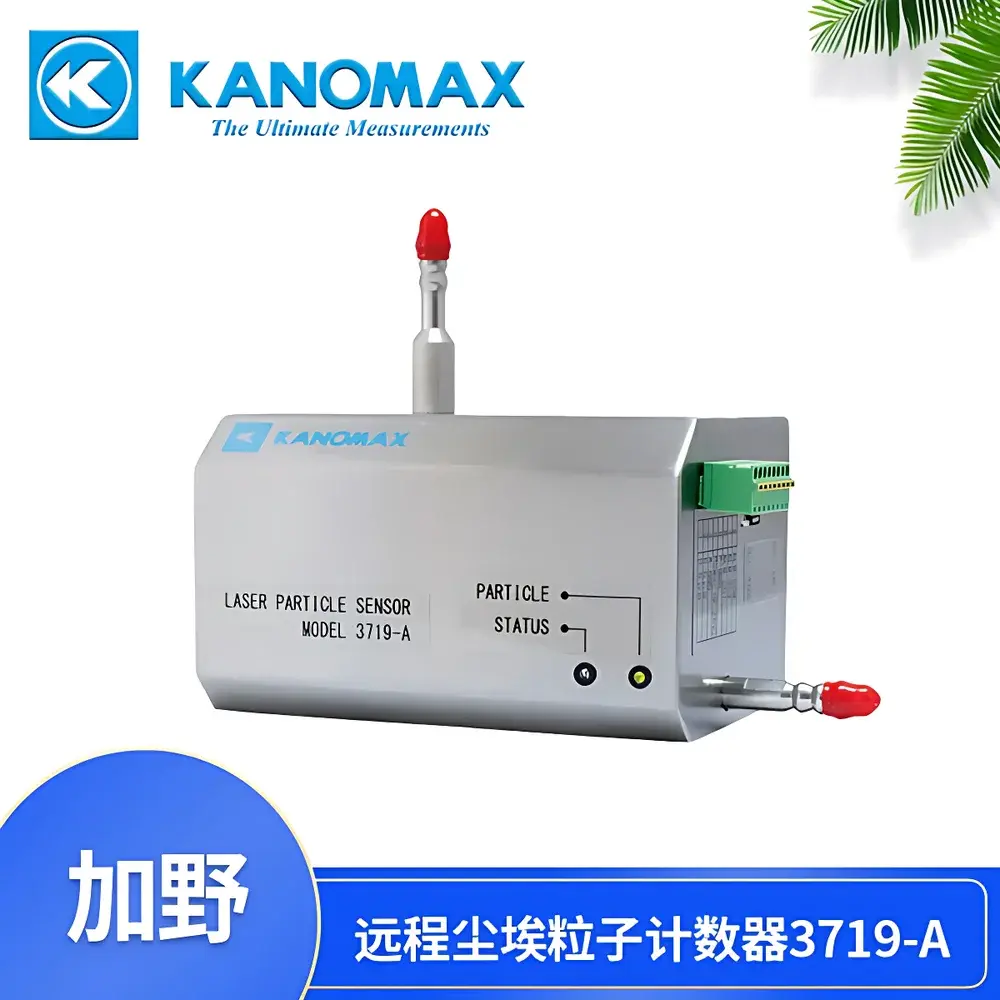
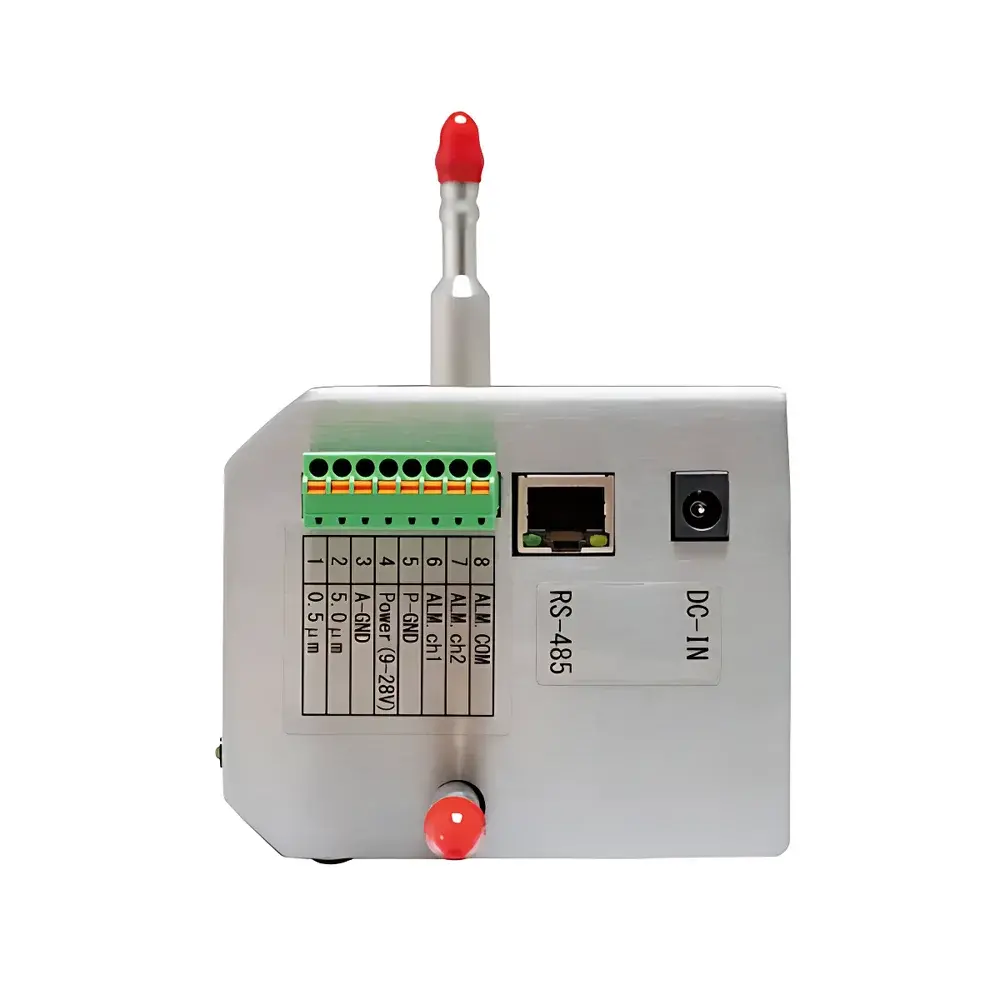
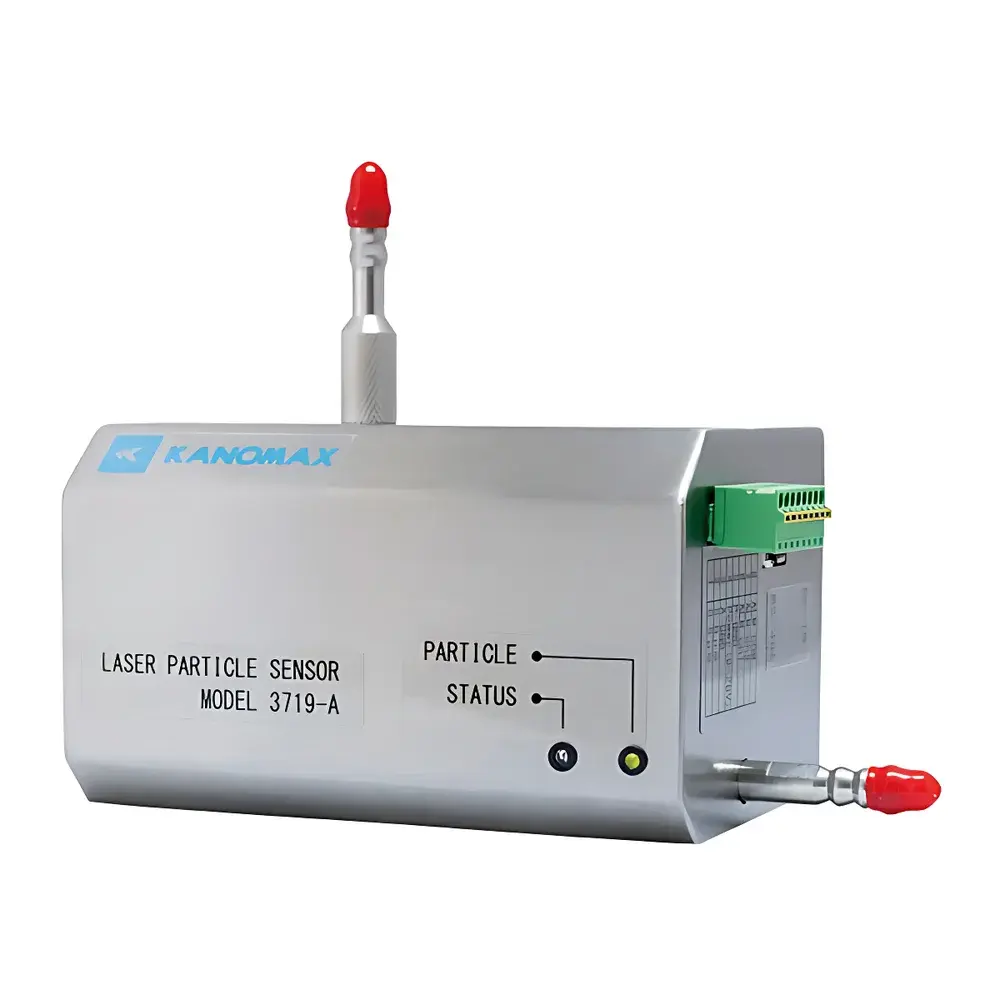
KANOMAX 3718-A / 3719-A Remote Optical Particle Counter for Pharmaceutical Cleanroom Monitoring
| Brand | KANOMAX |
|---|---|
| Origin | Liaoning, China |
| Manufacturer Type | Authorized Distributor |
| Product Type | Online Particle Counter |
| Flow Rate | 28.3 L/min (1 CFM) |
| Particle Size Channels | 3718-A: 0.3 & 0.5 µm |
| 3719-A | 0.5 & 5.0 µm |
| Light Source | Long-life Laser Diode |
| Compliance | ISO 21501-4, JIS B 9921, ISO 14644-1:2015 |
| Data Storage | 2,000 buffered records with redundancy backup |
| Output Interfaces | RS-485, Modbus RTU/TCP/IP, 4–20 mA analog |
| Power | DC 9–28 V, PoE, or AC 100–240 V |
| Housing | 316 Stainless Steel with VHP/ethanol vapor resistance |
| Operating Environment | 10–30 °C, 20–85% RH (non-condensing) |
| Dimensions | 133 × 95 × 80 mm |
| Weight | 1.0 kg |
Overview
The KANOMAX 3718-A and 3719-A are purpose-engineered remote optical particle counters designed specifically for continuous, unattended monitoring of airborne particulate contamination in regulated pharmaceutical and microelectronics cleanroom environments. These instruments operate on the principle of light scattering—where particles drawn through a precisely controlled laminar airflow intersect a collimated laser beam, generating scattered photons proportional to particle size and refractive index. Signal processing algorithms convert pulse height and frequency into real-time, traceable particle concentration data per cubic foot (ft³) or cubic meter (m³), fully aligned with ISO 14644-1:2015 classification requirements. Unlike portable or handheld units, the 3718-A/3719-A series is architected as an integrated component of facility-wide environmental monitoring systems (EMS), supporting 24/7 operation under GMP-compliant conditions.
Key Features
- Stable, externally sourced sampling flow at 28.3 L/min (1 CFM), actively regulated by an integrated pressure sensor to maintain ±2% volumetric accuracy across variable backpressure conditions.
- Dual-channel simultaneous detection: Model 3718-A measures 0.3 µm and 0.5 µm particles; Model 3719-A measures 0.5 µm and 5.0 µm particles—enabling concurrent monitoring of both viable and non-viable particulate threats per ISO 21501-4 calibration standards.
- Hermetically sealed 316 stainless steel enclosure with IP65-rated ingress protection and chemical resistance validated against vaporized hydrogen peroxide (VHP) and 70% isopropyl alcohol (IPA) exposure—critical for routine decontamination cycles in Grade A/B cleanrooms.
- Onboard data buffering of up to 2,000 measurement records with dual-layer redundancy: primary volatile memory and secondary non-volatile storage. In the event of power loss or network interruption, pre-failure data is preserved and automatically synchronized upon system recovery—ensuring full audit trail continuity.
- Flexible power architecture supporting Power over Ethernet (PoE, IEEE 802.3af), DC 9–28 V, or universal AC 100–240 V input—enabling hot-swap maintenance without facility shutdown.
- Comprehensive I/O suite including isolated RS-485 serial interface, Modbus RTU/TCP/IP protocol stack, and galvanically isolated 4–20 mA analog outputs for direct integration with SCADA, DCS, or MES platforms.
Sample Compatibility & Compliance
These instruments are validated for use in ISO Class 3–8 (FED-STD-209E Class 1–100,000) environments and support compliance with global regulatory frameworks including EU GMP Annex 1 (2022), US FDA Guidance for Industry on Sterile Drug Products, and PIC/S PI 007-6. The optical detection system meets counting efficiency specifications defined in ISO 21501-4 (≥50% at 0.3 µm, ≥100% at ≥0.5 µm) and JIS B 9921. All firmware and configuration parameters are stored in write-protected memory to prevent unauthorized modification—a prerequisite for 21 CFR Part 11-compliant electronic records. Calibration traceability is maintained to NIST-traceable reference aerosols (e.g., PSL spheres), with documented uncertainty budgets available upon request.
Software & Data Management
The 3718-A/3719-A operates autonomously but interfaces seamlessly with enterprise-level EMS software via standardized protocols. Modbus TCP/IP enables bidirectional communication for remote parameter adjustment (e.g., sampling duration: 1–60 s; alarm thresholds: 0–100% of limit), while 4–20 mA outputs provide real-time analog representation of particle counts or concentration for legacy PLCs. Each unit supports configurable output ranges—including linear or logarithmic scaling—for individual channels (e.g., 0–10,000 counts/ft³ or 0–35,300,000 counts/m³). Event-driven logging captures operational status (e.g., flow fault, laser degradation warning, communication timeout) alongside particle data, forming a complete GxP-aligned dataset suitable for trend analysis, CAPA initiation, and regulatory inspection readiness.
Applications
- Continuous monitoring of critical process zones (e.g., isolators, RABS, filling lines) during aseptic manufacturing of injectables and biologics.
- Validation and routine surveillance of HVAC filtration integrity in cleanroom suites per ISO 14644-3.
- Environmental qualification of lyophilization chambers, vial washers, and depyrogenation tunnels.
- Integration into automated contamination control strategies—triggering alarms, initiating purge cycles, or halting production upon exceedance of action levels.
- Supporting ISO 14644-2 surveillance testing plans with scheduled, location-tagged data capture and time-stamped export capabilities.
FAQ
What cleanroom standards does this instrument support?
It complies with ISO 14644-1:2015 (airborne particle concentration limits), ISO 21501-4 (instrument performance), and JIS B 9921 (Japanese national standard), making it suitable for EU GMP Annex 1 and FDA-regulated facilities.
Can the device operate during VHP decontamination cycles?
Yes—the 316 stainless steel housing and hermetic sealing are certified for repeated exposure to vaporized hydrogen peroxide at typical industrial concentrations (≤1000 ppm) without performance degradation.
How is data integrity ensured during power failure?
The dual-buffer architecture stores data redundantly; volatile RAM retains the latest readings, while non-volatile flash memory preserves historical records. Upon reboot, unsynchronized entries are prioritized for upload to the central database.
Is Modbus TCP/IP supported for IT network integration?
Yes—both Modbus RTU (over RS-485) and Modbus TCP/IP (Ethernet) are natively implemented, enabling secure, firewall-friendly communication with modern supervisory systems.
What is the expected lifetime of the laser source?
The high-stability laser diode is rated for ≥10 years of continuous operation under nominal conditions, with a manufacturer-backed 3-year warranty covering parts and labor.
Related Products







