
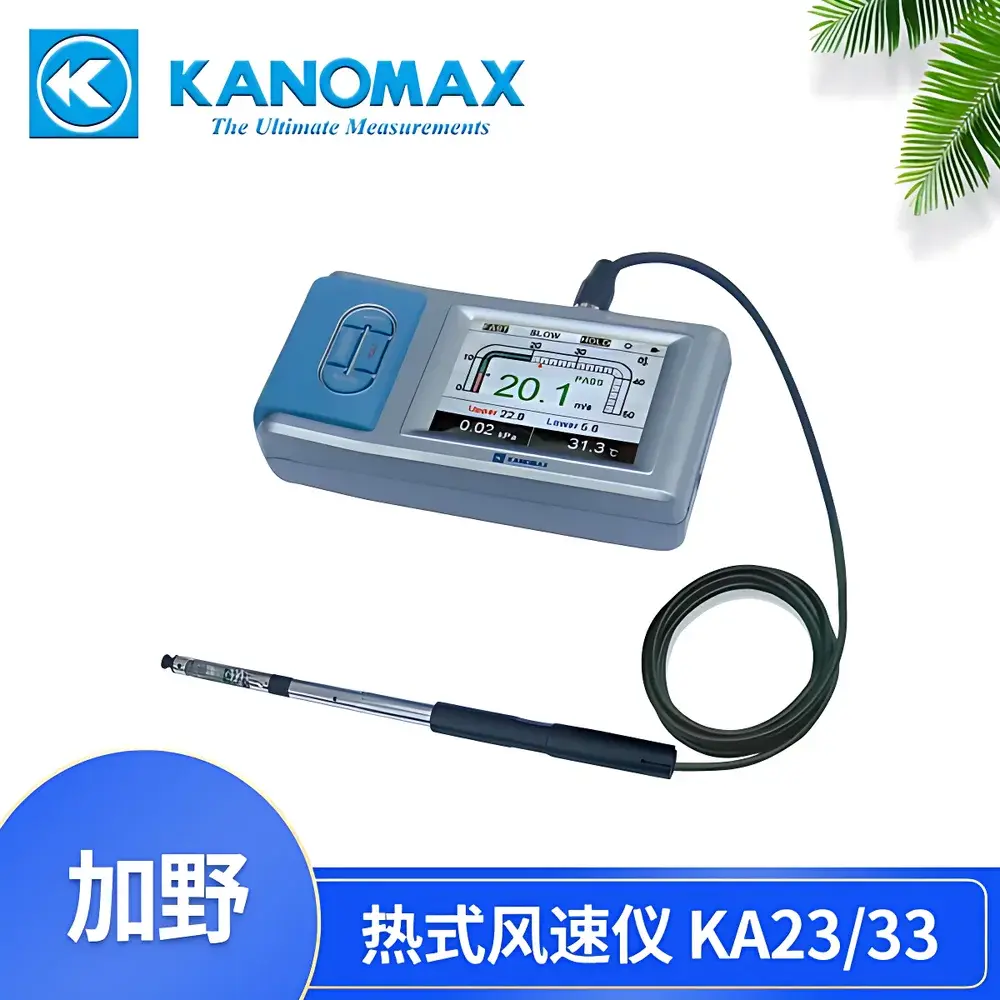
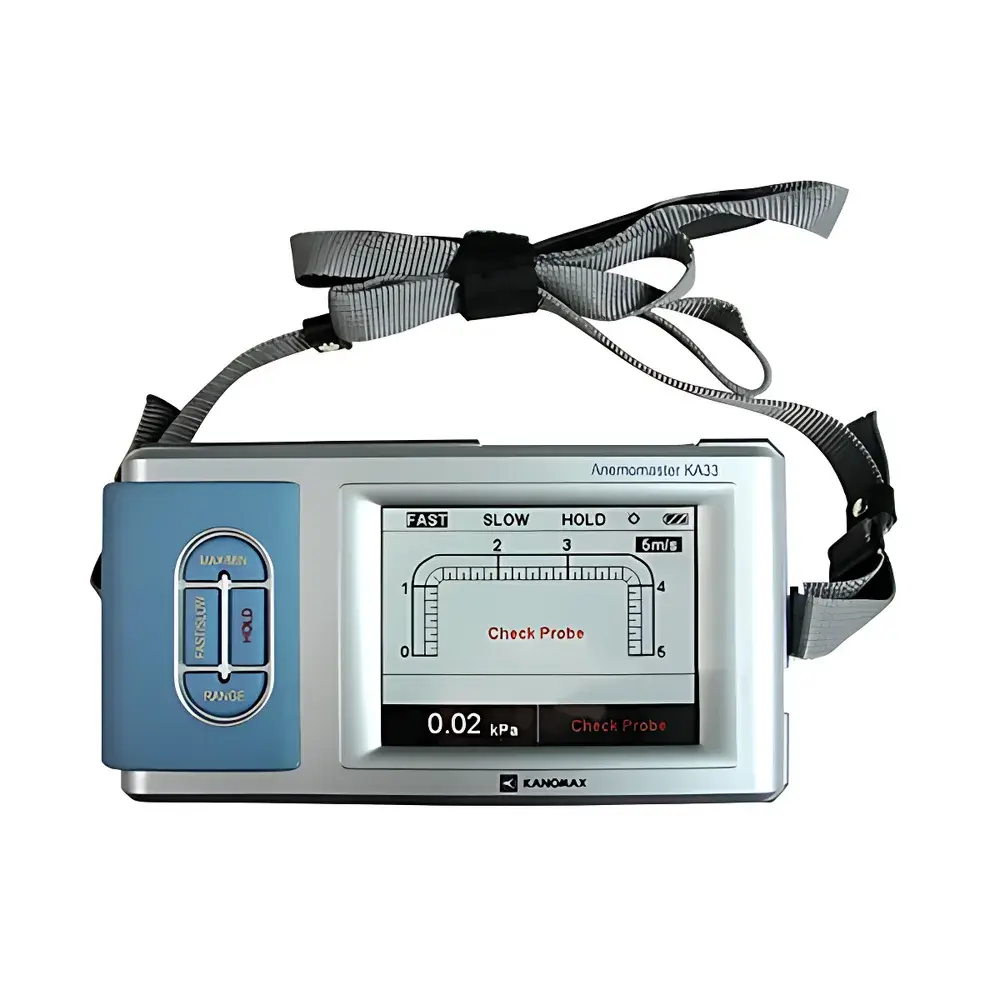
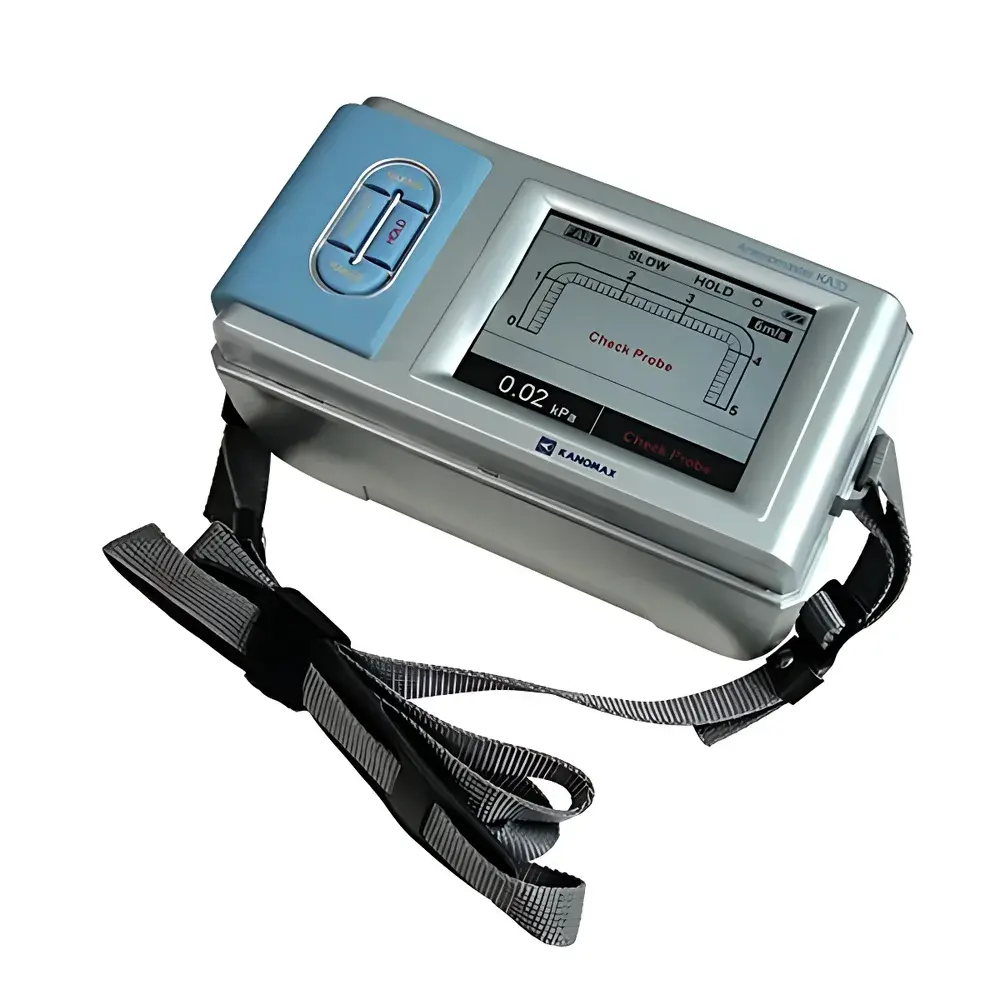
Kanomax KA23/KA33 Hot-Wire Anemometer with Temperature and Differential Pressure Measurement
| Brand | Kanomax |
|---|---|
| Origin | Japan |
| Instrument Type | Hot-Wire Anemometer |
| Velocity Range | 0.01–50.0 m/s |
| Velocity Resolution | 0.01 m/s (0.00–9.99 m/s), 0.1 m/s (10.0–50.0 m/s) |
| Accuracy | ±2% FS (full scale) for velocity |
| Temperature Range | −20 to +100 °C |
| Temperature Resolution | 0.1 °C |
| Temperature Accuracy | ±0.3 °C (−20 to 0 °C and 60 to 100 °C: ±0.5 °C) |
| Differential Pressure Range | 0.00 to ±5.00 kPa |
| Pressure Resolution | 0.01 kPa |
| Pressure Accuracy | ±0.1 kPa |
| Operating Humidity | 2.0–98.0% RH |
| Dimensions (main unit) | 157 × 42 × 80 mm (W×H×D) |
| Weight | ~450 g (incl. batteries) |
| Power | 4 × AA alkaline batteries or 5 V / 2 A AC adapter |
Overview
The Kanomax KA23/KA33 is a precision-engineered handheld hot-wire anemometer designed for simultaneous measurement of air velocity, temperature, and differential pressure in HVAC commissioning, cleanroom validation, industrial ventilation assessment, and environmental chamber monitoring. Based on constant-temperature anemometry (CTA), the instrument employs a fine platinum-coated thermistor sensor whose electrical resistance changes predictably with convective heat loss—directly correlating to local airflow velocity. This principle enables high-sensitivity, low-inertia response across a broad dynamic range (0.01–50.0 m/s), with built-in thermal compensation ensuring stable calibration performance from −20 °C to +100 °C ambient conditions. Unlike cup or vane anemometers, the KA23/KA33 delivers true point-velocity data without directional bias, making it suitable for laminar flow profiling, duct traverse studies, and low-velocity applications such as fume hood face velocity verification per ANSI/ASHRAE 110.
Key Features
- Triple-parameter acquisition: Real-time concurrent measurement of air velocity, ambient temperature, and differential pressure (±5.00 kPa range)
- Dual-display interface: Simultaneous digital readout and analog bar-graph visualization for rapid trend interpretation
- Adjustable backlight with three brightness levels—optimized for low-light environments including ceiling plenums and server room underfloor spaces
- Configurable pass/fail mode: User-defined upper/lower limits for velocity thresholds, enabling immediate go/no-go decisions during ISO 14644-3 cleanroom certification or GMP facility audits
- Statistical data logging: Onboard calculation of min/max/average values over user-selected time intervals—supports EN 12599-compliant duct testing protocols
- Interchangeable probe design: Modular sensor heads maintain traceable accuracy after replacement; standardized mounting ensures mechanical and thermal repeatability across KA23 and KA33 variants
- Ergonomic telescoping probe (140–235 mm extension) with ≤Φ15 mm maximum diameter—ideal for insertion into narrow grilles, perforated plates, and filter housings
Sample Compatibility & Compliance
The KA23/KA33 is validated for use with clean, dry, non-corrosive air at standard atmospheric pressure (±10% deviation). It is not rated for explosive atmospheres, saturated steam, or particulate-laden exhaust streams exceeding ISO 16890 coarse dust loading limits. The device conforms to IEC 61000-4-2 (ESD immunity) and IEC 61000-4-3 (radiated RF immunity) standards. Its measurement methodology aligns with ISO 7726 (ergonomics of thermal environments), ASTM D1078 (air velocity in ducts), and JIS B 7555 (hot-wire anemometer performance criteria). For regulated environments—including pharmaceutical cleanrooms (ISO 14644), hospital HVAC systems (ASHRAE 170), and laboratory fume hoods—the instrument supports documented calibration traceability to NIST or JCSS-accredited laboratories.
Software & Data Management
Data export is supported via USB interface to Kanomax’s proprietary PC software (Kanomax Data Logger Suite), which facilitates time-stamped CSV output, graphical trend analysis, and report generation compliant with GLP and FDA 21 CFR Part 11 requirements—including electronic signature capability, audit trail logging, and user-access controls. Internal memory retains up to 20,000 data points with timestamp, channel ID, and operator tag fields. No cloud dependency or subscription model is required—data sovereignty remains fully under end-user control. Firmware updates are delivered via signed binary packages with SHA-256 checksum verification.
Applications
- HVAC system balancing and TAB (Testing, Adjusting, Balancing) per ASHRAE Guideline 1
- Cleanroom airflow uniformity mapping and ISO Class verification
- Fume hood face velocity surveys (ANSI/ASHRAE 110, EN 14175)
- Filter integrity testing support (upstream/downstream velocity correlation)
- Industrial dryer and oven airflow profiling
- Environmental chamber validation (ICH Q5C, USP )
- Academic aerodynamics labs requiring portable, calibrated CTA instrumentation
FAQ
What calibration standards does the KA23/KA33 comply with?
The instrument is factory-calibrated against NIST-traceable wind tunnel references per ISO/IEC 17025 procedures. Certificate of Calibration includes uncertainty budgets at multiple points across the velocity range.
Can the KA23/KA33 measure velocity in humid or condensing environments?
It operates reliably within 2.0–98.0% RH; however, sustained exposure to condensation or dew point conditions may affect sensor longevity and requires post-use desiccation per Kanomax Technical Bulletin TB-ANEMO-07.
Is probe interchangeability supported between KA23 and KA33 models?
Yes—both models share identical probe interface mechanics and thermal compensation algorithms, enabling cross-model probe swaps without recalibration.
Does the device support real-time analog output for integration with building management systems (BMS)?
No analog output port is provided; however, USB data streaming enables third-party SCADA/BMS integration via Modbus RTU emulation through optional Kanomax USB-to-Modbus gateway module (K-GW-MB-USB).
How often should field verification be performed?
Kanomax recommends zero-check verification before each measurement session using the included zero-air cap; full recalibration is advised annually or after physical impact, sensor contamination, or exposure beyond specified environmental limits.
Related Products







