
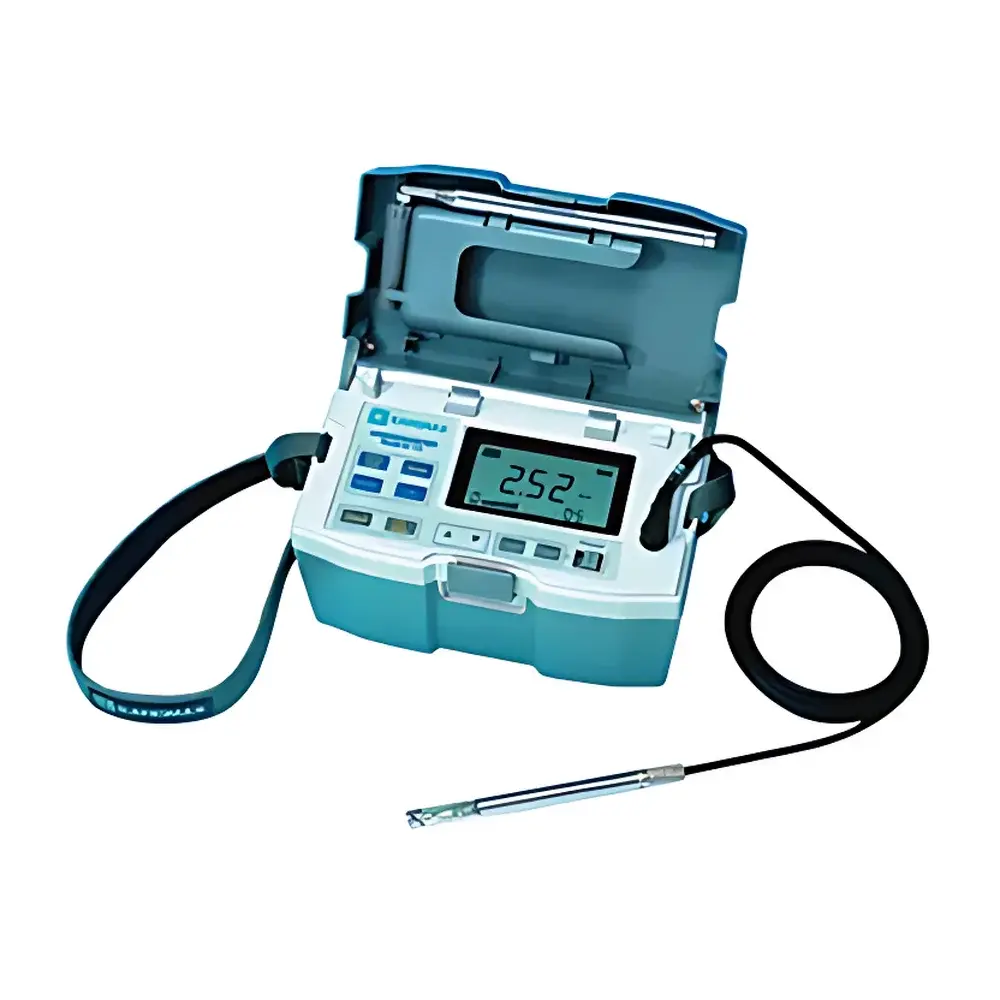
Kanomax 6113 Intelligent Thermal Anemometer
| Brand | Kanomax |
|---|---|
| Origin | Japan |
| Model | 6113 |
| Instrument Type | Thermal Anemometer |
| Resolution | 0.1 m/s |
| Measurement Range | 0.1–50.0 m/s |
| Accuracy | ±(3% of reading + 0.1) m/s |
| Operating Temperature | 0–100 °C |
| Operating Humidity | 5–80 %RH (accuracy degradation applies outside this range) |
| Temperature Measurement Range | 0–100 °C |
| Temperature Accuracy | ±1 °C |
| Pressure Measurement Range (optional probe) | –5 to +5 kPa |
| Pressure Accuracy | ±(3% of reading + 0.01) kPa |
| Data Storage Capacity | 100 sets |
| Communication Interface | RS-232C (standard), analog output 0–1 V (optional) |
| Built-in thermal printer | Yes |
| Power Supply | 6 × AA batteries |
| Dimensions | 210 × 120 × 133 mm |
| Weight | 1.0 kg |
Overview
The Kanomax 6113 Intelligent Thermal Anemometer is a precision-engineered environmental monitoring instrument designed for reliable, real-time measurement of air velocity, temperature, and differential pressure in HVAC systems, cleanrooms, industrial ducts, and laboratory ventilation applications. Utilizing constant-temperature anemometry (CTA) — a well-established thermal sensing principle — the device maintains a heated sensor element at a fixed temperature above ambient; airflow-induced cooling is quantified to derive velocity with high linearity and low drift. Its modular architecture separates the main unit from interchangeable hot-wire or hot-film probes, enabling field-replaceable components without recalibration downtime. Engineered for robustness, the 6113 features an IP54-rated enclosure suitable for use inside ductwork, fume hoods, and other semi-harsh environments where condensation, dust, or mechanical vibration may occur.
Key Features
- Modular design with fully interchangeable probes and main units — ensures operational continuity during maintenance or failure
- Simultaneous acquisition of air velocity, temperature, and (with optional pressure probe) differential pressure — all stored as synchronized data sets
- Large backlit LCD display with intuitive icon-based interface — supports rapid interpretation under variable lighting conditions
- Single-button operation for printout, data logging, and calculation functions — minimizes training requirements and operator error
- Integrated thermal printer — provides immediate hard-copy records compliant with GLP documentation practices
- Standard RS-232C serial interface — enables direct connection to PCs, PLCs, or data loggers for automated reporting and long-term trend analysis
- Built-in temperature compensation circuitry — maintains measurement stability across 0–100 °C operating range, with optimal accuracy (±1 °C) maintained between 10–40 °C
Sample Compatibility & Compliance
The Kanomax 6113 is validated for use with standard cylindrical and flat-plate thermal probes (e.g., 6113-01, 6113-02), compatible with laminar and turbulent airflow profiles typical of ducted and open-space environments. It meets IEC 61000-4 electromagnetic compatibility standards and conforms to JIS B 7554 (Japanese Industrial Standard for anemometers). While not certified for intrinsic safety, its battery-powered operation and non-sparking design make it suitable for non-hazardous classified areas per NEC Class I, Division 2 guidelines. The instrument supports audit-ready workflows: timestamped data storage, printer logs, and RS-232 traceability align with ISO/IEC 17025 documentation requirements for accredited calibration laboratories.
Software & Data Management
Data captured by the 6113 is stored locally in non-volatile memory (100 measurement sets maximum), each containing wind speed, temperature, pressure (if equipped), date/time stamp, and user-defined ID tags. The RS-232C port supports ASCII protocol for seamless integration with third-party software including LabVIEW, MATLAB, and custom SCADA platforms. Optional analog output (0–1 V) allows connection to chart recorders or building management systems (BMS) without digital interfacing. Firmware supports firmware-upgradable functionality via serial command set, ensuring long-term compatibility with evolving data governance frameworks such as FDA 21 CFR Part 11 (when paired with validated PC software and electronic signature controls).
Applications
- HVAC commissioning and balancing — verification of supply/return air velocities against ASHRAE 111 and ISO 16813 specifications
- Cleanroom certification — ISO 14644-3 airflow uniformity mapping and ISO 14644-1 classification support
- Industrial exhaust system validation — capture velocity profiles across stack cross-sections per EPA Method 2
- Pharmaceutical facility environmental monitoring — continuous airflow verification in Grade A/B critical zones
- Academic aerodynamics research — low-turbulence flow characterization in wind tunnels and boundary layer studies
- Energy audit assessments — duct leakage quantification using traverse-based velocity integration
FAQ
What probe types are compatible with the Kanomax 6113?
The 6113 accepts Kanomax’s standardized thermal probes, including the 6113-01 (cylindrical hot-wire) and 6113-02 (flat-plate hot-film), both calibrated traceably to NMIJ (National Metrology Institute of Japan).
Does the 6113 require periodic factory recalibration?
Yes — annual recalibration is recommended per ISO/IEC 17025 and manufacturer guidelines to maintain stated accuracy; field zero-checks can be performed using still-air reference.
Can the built-in printer generate ISO-compliant test reports?
The thermal printer outputs raw measurement values with timestamps and probe IDs; full ISO-compliant reports require post-processing in validated software that adds metadata, operator signatures, and uncertainty budgets.
Is the 6113 suitable for outdoor use?
It is rated IP54 — protected against dust ingress and water splashes — making it appropriate for covered outdoor applications but not for prolonged rain exposure or sub-zero temperatures below 0 °C.
How is measurement uncertainty calculated for velocity readings?
Combined standard uncertainty is derived from Type A (repeatability) and Type B (calibration certificate, resolution, temperature compensation drift) components, typically yielding an expanded uncertainty (k=2) of ±(4.5% of reading + 0.15) m/s under controlled lab conditions.







