
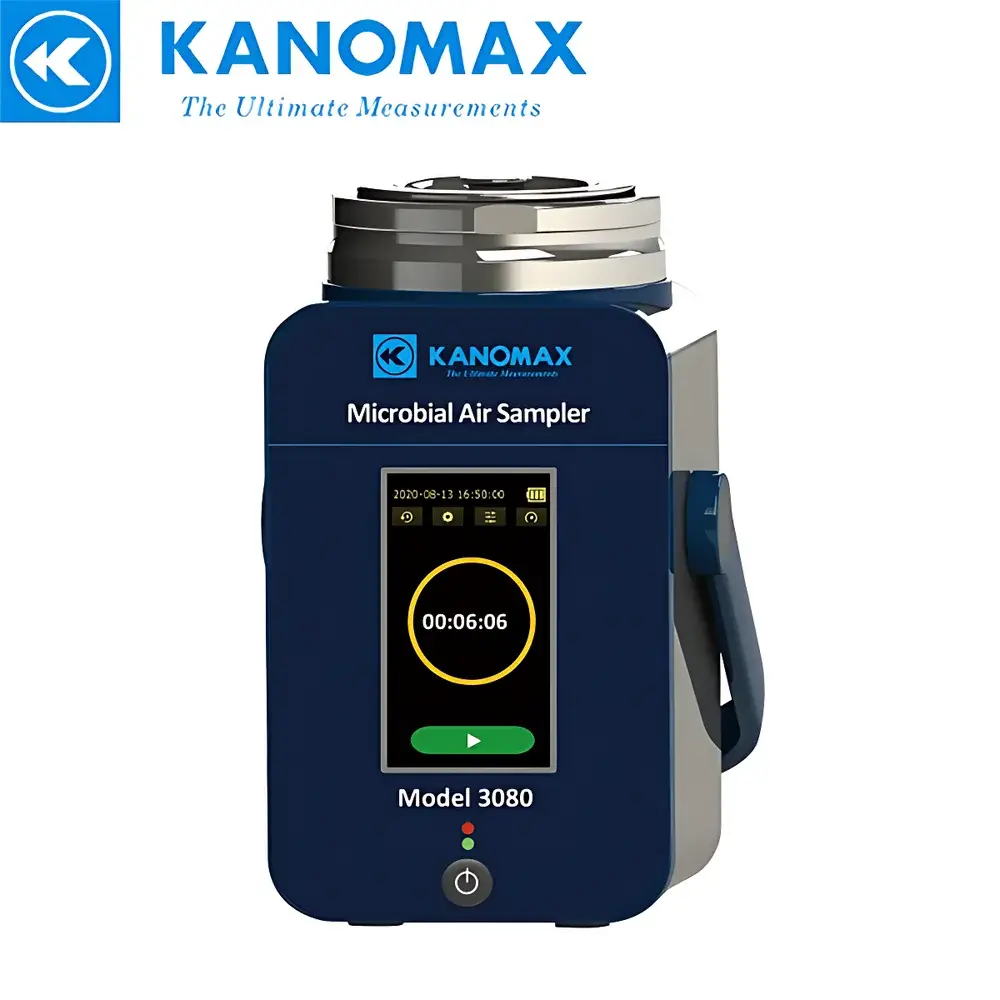
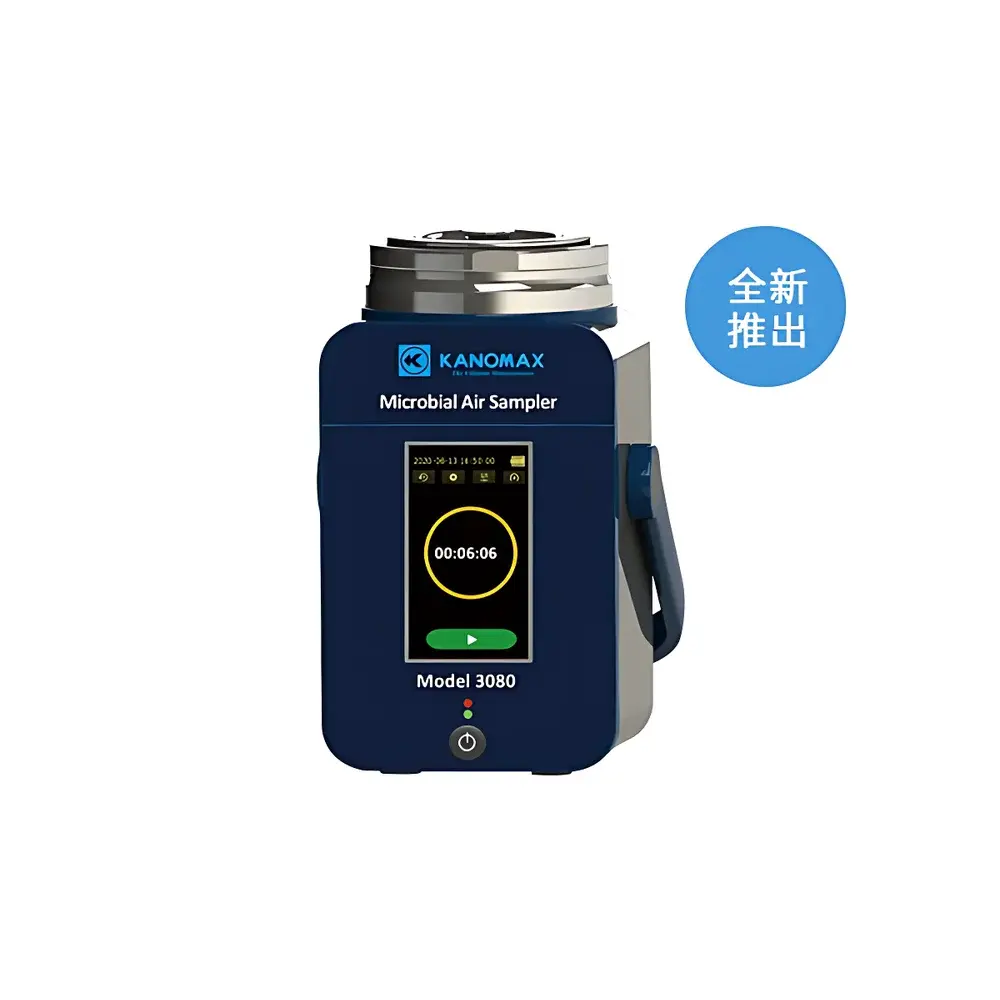
Kanomax Model 3080 Andersen-Principle Air Microbial Sampler
| Brand | Kanomax |
|---|---|
| Origin | Japan |
| Model | 3080 |
| Sampling Principle | Andersen Impaction |
| Flow Rate | 100 L/min |
| Flow Accuracy | ±2.5% |
| Operating Temperature | 0–40 °C |
| Operating Humidity | 0–90% RH (non-condensing) |
| Battery Runtime | 7 h |
| Sampling Volume Range | 20–6000 L |
| Sampling Interval | 10 s–1 h |
| Delay Time | 0 s–23 h 59 min 59 s |
| Cycle Count | 2–300 cycles or continuous |
| Data Storage | 10,000 internal records + USB export (CSV) |
| Display | 4.3-inch color touchscreen |
| Communication | USB, RS-485 (Modbus RTU) |
| User Management | 64 editable users with multi-level permission control and audit trail |
| Alarm | Visual & audible flow deviation alert |
| Exhaust Filtration | Integrated ISO Class 3 filter |
| Sampling Head Material | 316 stainless steel |
| Compatible Petri Dishes | 90–100 mm or 55–84 mm |
| Dimensions | 136 × 235 × 133 mm |
| Weight | 3.2 kg |
Overview
The Kanomax Model 3080 is a precision-engineered, portable air microbial sampler designed for quantitative monitoring of viable airborne microorganisms in controlled environments. It operates on the validated Andersen impactor principle—a standardized inertial impaction method widely accepted in pharmaceutical, biotechnology, and healthcare settings. Six-stage cascade impactors enable size-selective deposition of particles ≥0.65 µm onto agar-based culture media, supporting colony-forming unit (CFU) enumeration per ISO 14698-1, EU GMP Annex 1, and USP . With a fixed nominal flow rate of 100 L/min and an accuracy of ±2.5%, the instrument ensures high reproducibility across repeated sampling events. Its compact form factor (136 × 235 × 133 mm), lightweight construction (3.2 kg), and integrated Li-ion battery (7-hour runtime) support flexible deployment in cleanrooms, isolators, biosafety cabinets, and dynamic environmental monitoring (EM) networks.
Key Features
- Andersen six-stage impactor design with calibrated jet velocities 10 µm
- 316 stainless steel sampling head—resistant to corrosion, autoclavable, and compatible with standard sterilization protocols (e.g., steam, hydrogen peroxide vapor)
- Integrated ISO Class 3 exhaust filter—retains >99.97% of particles ≥0.3 µm, preventing operator exposure and cross-contamination during sampling
- Real-time volumetric flow monitoring with visual/audible alarm triggered upon deviation exceeding ±5% of setpoint
- Multi-language interface (English, Japanese, Chinese) on a 4.3-inch capacitive touchscreen—supporting intuitive navigation, parameter editing, and status visualization
- Configurable sampling logic: single-shot, repeat cycles (2–300), delayed start (up to 23 h 59 min), and programmable interval timing (10 s–1 h)
- Remote operation via infrared controller—capable of synchronizing up to five units within line-of-sight range
Sample Compatibility & Compliance
The Model 3080 accommodates standard Petri dishes (90–100 mm and 55–84 mm diameters), ensuring compatibility with common microbiological culture media including Tryptic Soy Agar (TSA), Sabouraud Dextrose Agar (SDA), and malt extract agar. Its mechanical architecture and firmware comply with regulatory expectations for data integrity under FDA 21 CFR Part 11 (when paired with validated software and audit-trail-enabled configurations). The built-in audit trail logs user identity, timestamp, location annotation, sampling volume, duration, and system status changes—supporting GLP/GMP-aligned documentation requirements. Exhaust filtration meets ISO 14644-1 Class 3 particulate retention standards, and operational performance aligns with ISO 8573-1 (compressed air purity) when used with optional high-pressure gas modules.
Software & Data Management
Data acquisition and reporting are managed through embedded firmware with dual storage pathways: internal memory (10,000 sample records) and external USB mass storage (CSV format export). Communication interfaces include USB host/device mode and RS-485 Modbus RTU protocol—enabling seamless integration into facility-wide EM systems or SCADA platforms. Optional thermal printer connectivity allows on-site hardcopy generation of sampling reports containing date/time, operator ID, location tag, total sampled volume, cycle count, and pass/fail status relative to pre-defined thresholds. All user actions—including parameter modification, login/logout, and alarm acknowledgment—are time-stamped and attributed to individual accounts within the 64-user permission matrix, satisfying ALCOA+ principles for attributable, legible, contemporaneous, original, accurate, complete, consistent, enduring, and available records.
Applications
The Model 3080 is deployed across regulated and research-intensive environments requiring reliable, traceable airborne bioburden assessment. Primary use cases include routine environmental monitoring in Grade A/B/C/D cleanrooms per EU GMP Annex 1; qualification and routine surveillance of isolators and restricted access barrier systems (RABS); validation of HVAC filtration efficiency; assessment of indoor air quality in hospitals, museums, and libraries; and microbial challenge testing during process simulation (media fill) studies. It is also utilized in food & beverage production facilities for pathogen screening, in cosmetics manufacturing for preservative efficacy testing, and in agricultural biocontainment labs for aerosolized fungal spore quantification.
FAQ
What sampling principle does the Model 3080 employ?
It uses the Andersen six-stage cascade impactor method, based on inertial impaction physics, to separate and deposit viable airborne particles onto agar surfaces by aerodynamic size.
Is the device compliant with FDA 21 CFR Part 11 requirements?
When configured with enabled audit trail, user authentication, and electronic signature workflows—and operated within a validated IT environment—the Model 3080 supports Part 11 compliance for electronic records and signatures.
Can sampling parameters be edited during active operation?
No—sampling volume, interval, and cycle settings must be defined prior to initiation; runtime parameter modification is intentionally disabled to preserve data integrity and regulatory defensibility.
Does the instrument support integration with centralized EM software platforms?
Yes—via Modbus RTU over RS-485, it enables bidirectional communication with industrial automation systems, LIMS, and dedicated environmental monitoring suites.
What is the maximum allowable ambient humidity for operation?
The device is rated for continuous use at 0–90% RH non-condensing; operation in condensing conditions may impair sensor accuracy and compromise sterile integrity of the sampling head.
Related Products







