
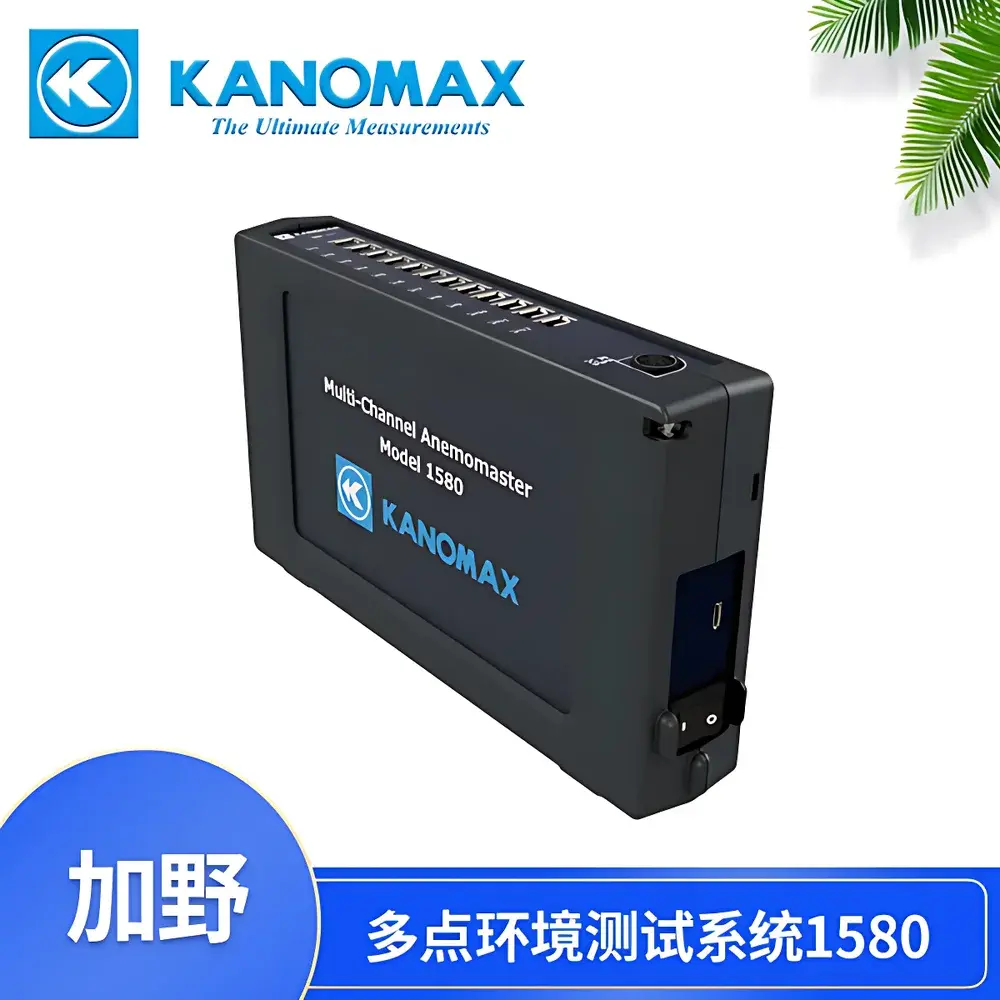
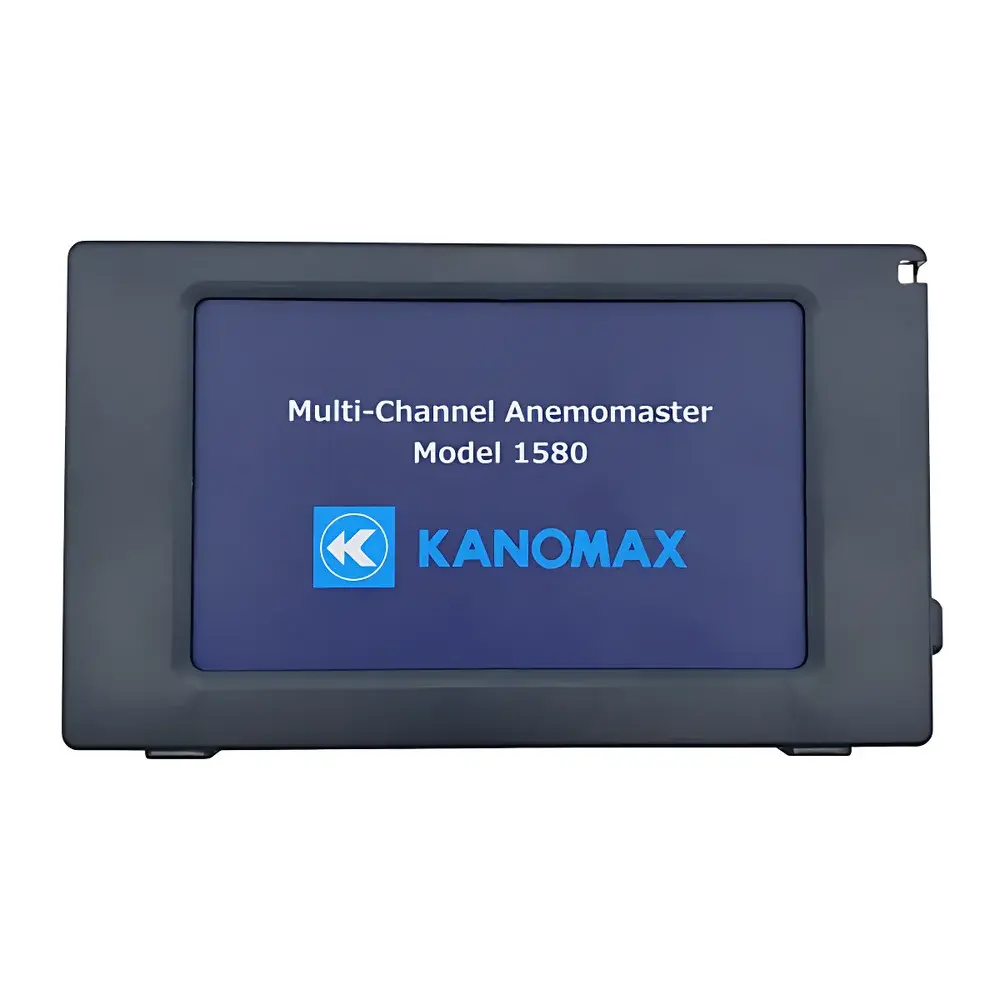
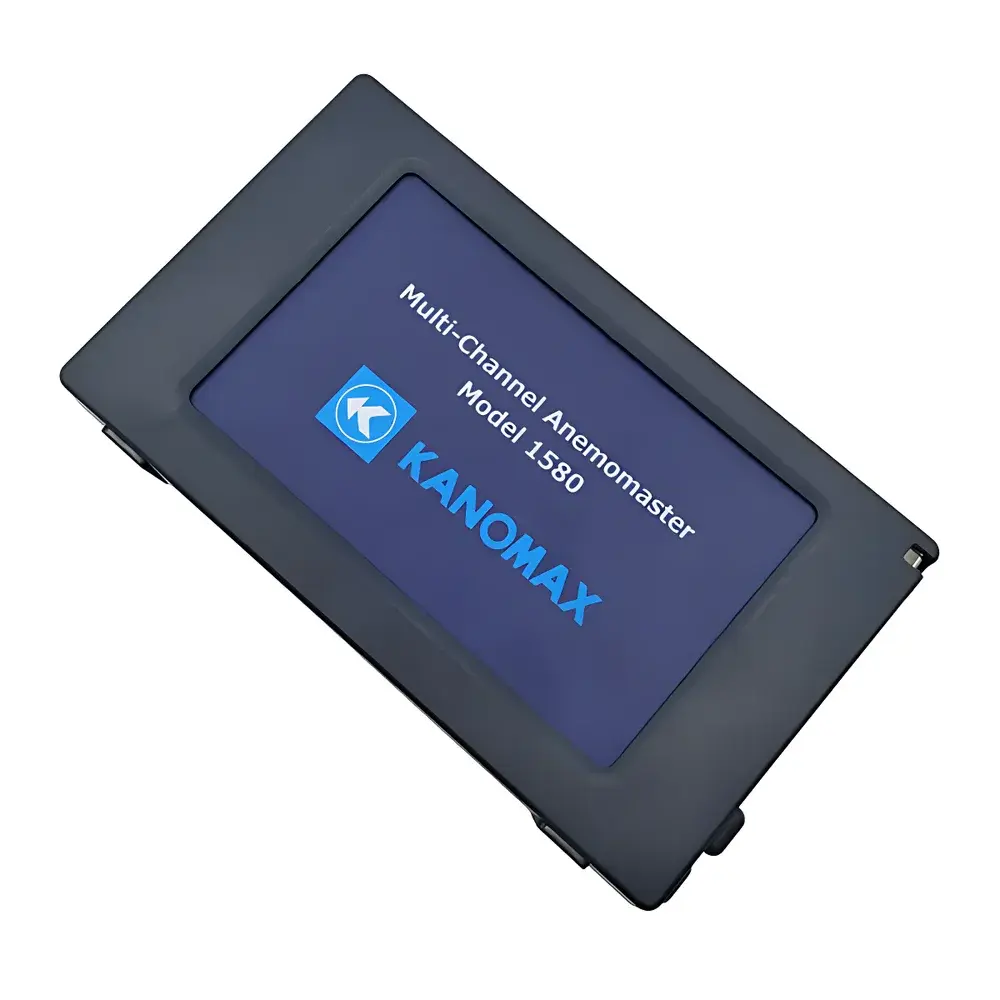
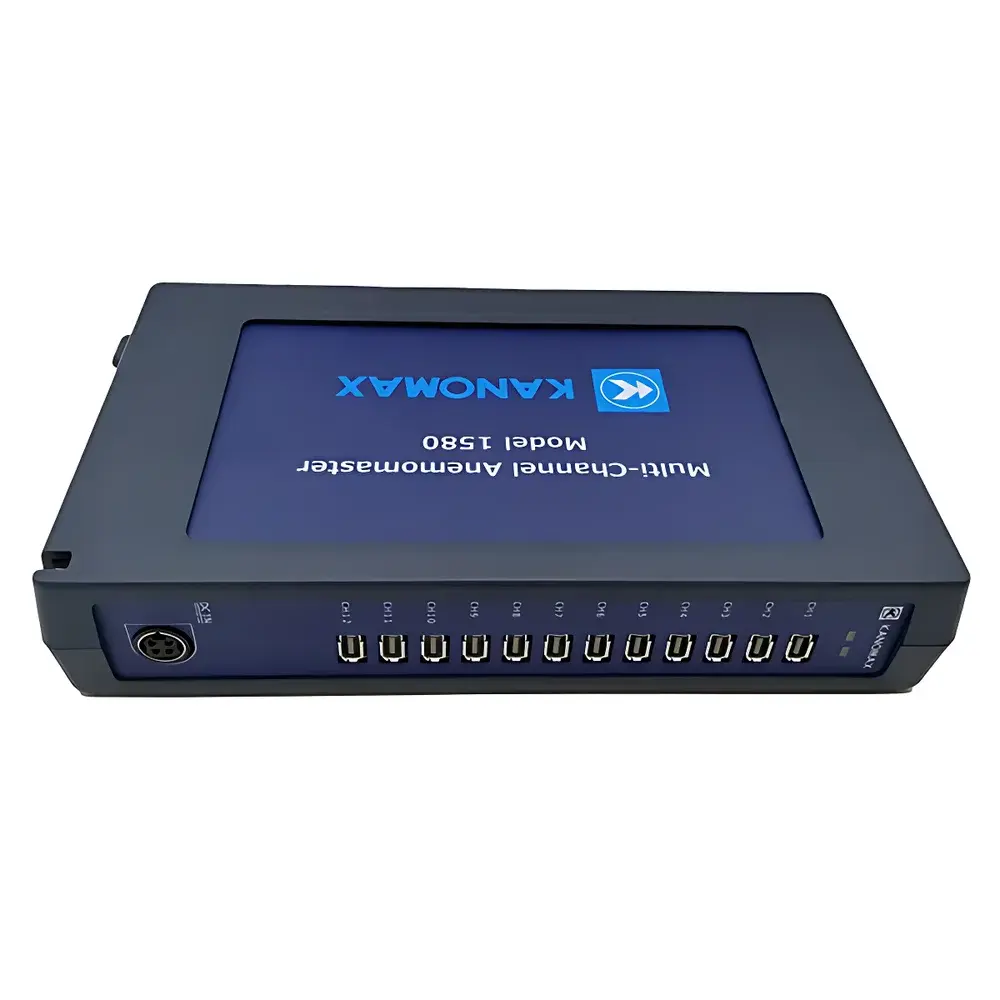
KANOMAX Model 1580-0C Intelligent Multi-Point Environmental Monitoring System
| Brand | KANOMAX |
|---|---|
| Origin | Japan |
| Instrument Type | Thermal Anemometer |
| Resolution | 0.01 m/s |
| Measurement Range | 0.01–50.0 m/s |
| Accuracy | ±2% of reading or ±0.02 m/s (whichever is greater) |
| Operating Temperature | 5–40 °C |
| Operating Humidity | 0–85% RH (non-condensing) |
| Channels | 12-channel simultaneous acquisition |
| Probe Compatibility | 15 interchangeable probe models |
| Power Supply | AC 100–240 V / DC 12–24 V |
| Dimensions (Main Unit) | 220 × 130 × 40 mm |
| Weight (Main Unit) | 0.6 kg |
| Communication | USB Micro-B, RS-485 serial interface |
| Software | Windows 10-compatible, tri-lingual (English/Chinese/Japanese), real-time data logging and visualization |
Overview
The KANOMAX Model 1580-0C Intelligent Multi-Point Environmental Monitoring System is a compact, high-fidelity 12-channel platform engineered for simultaneous, synchronized measurement of air velocity, temperature, and relative humidity across distributed locations. Built upon thermal anemometry principles—where convective heat transfer from a heated sensor element correlates directly with local airflow velocity—the system delivers traceable, repeatable data under controlled and field-deployable conditions. Its modular architecture supports up to 144 total channels when expanded with optional MODEL 1592-0C analog output modules (12 per unit), enabling integration into building management systems (BMS), HVAC validation protocols, cleanroom monitoring networks, and industrial process control loops. Designed for laboratory-grade accuracy in non-laboratory environments, the 1580-0C meets functional requirements aligned with ISO 14644-3 (cleanroom testing), ASTM D1072 (air velocity measurement standards), and ASHRAE Guideline 12-2020 (infection control in healthcare ventilation). The main unit operates without internal fans or moving parts, ensuring long-term stability and minimal drift over time.
Key Features
- 12-channel synchronous acquisition with plug-and-play probe connectivity via standardized serial interface
- 15 interchangeable probe models—including directional and omnidirectional variants—with thermal compensation algorithms embedded in each sensor head for real-time offset correction
- Ultra-low-velocity detection capability down to 0.01 m/s, validated per ISO 7726 Annex B for low-airflow environments such as laminar flow hoods and pharmaceutical isolators
- Compact main unit (220 × 130 × 40 mm; 0.6 kg) with dual power input options: universal AC adapter (100–240 V) or regulated DC supply (12–24 V), supporting mobile deployment including vehicle-mounted installations
- High-temperature probe variants rated up to 120 °C, compliant with IEC 60529 IP54 ingress protection when used with appropriate sealing accessories
- Integrated analog output expansion support via MODEL 1592-0C modules—each providing 12 independent voltage (0–5 V) or current (4–20 mA) outputs with user-configurable scaling per channel
- No internal battery; continuous operation enabled by external power sources, eliminating maintenance intervals associated with rechargeable systems
Sample Compatibility & Compliance
The system accommodates heterogeneous sampling configurations through its universal probe interface. Probes are mechanically and electrically compatible across all 15 models, allowing seamless substitution without recalibration or firmware updates. Directional probes (e.g., MODEL 0972-00) feature aerodynamically optimized shrouds for unidirectional duct or grille measurements, while isotropic variants (e.g., MODEL 0975-00) provide spatially averaged readings suitable for open-space environmental qualification. All probes undergo individual factory calibration against NIST-traceable reference standards, with calibration certificates available upon request. The system conforms to electromagnetic compatibility (EMC) requirements per EN 61326-1:2013 and safety standards per IEC 61010-1:2010. For regulated industries, audit trails, user access levels, and data export logs generated by the included software comply with ALCOA+ principles and support 21 CFR Part 11 readiness when deployed with validated IT infrastructure.
Software & Data Management
The bundled Windows 10 application provides full configuration, acquisition, visualization, and export functionality. It supports simultaneous display of up to 144 channels with real-time graphical overlays, statistical summaries (min/max/mean), and dynamic charting with adjustable time bases (1 s to 24 h). Each probe’s metadata—including serial number, calibration date, sensitivity factor, and physical orientation—is stored and displayed within the software interface. Users may define custom alarm thresholds per channel, trigger timestamped event logs, and export raw datasets directly to CSV or Excel-compatible XLSX formats with embedded metadata headers. The software implements role-based access control (operator/administrator modes), encrypted local storage, and configurable auto-backup intervals. No cloud dependency or mandatory online activation is required—ensuring full data sovereignty and offline operability in secure facilities.
Applications
- HVAC system commissioning and periodic performance verification in pharmaceutical manufacturing suites and hospital operating theaters
- Cleanroom airflow uniformity mapping per ISO 14644-3 Annex C, including velocity profiles at supply diffusers and return grilles
- Validation of fume hood face velocities and containment integrity testing per ANSI/AIHA Z9.5
- Environmental monitoring during sterile product filling line qualification (e.g., Grade A/B zones)
- Thermal comfort assessment in office buildings and educational facilities using PMV/PPD indices derived from concurrent air velocity, dry-bulb temperature, and RH inputs
- Mobile air quality surveys in transportation tunnels, subway stations, and underground parking structures
- Research-grade boundary layer studies in wind engineering laboratories where multi-point temporal correlation is critical
FAQ
Can the 1580-0C operate continuously for extended periods without interruption?
Yes—the system is designed for unattended, 24/7 operation when powered by a stable AC or DC source. Its fanless thermal design and solid-state electronics ensure operational reliability beyond 10,000 hours MTBF.
Is probe calibration traceable to international standards?
All probes are calibrated individually against NIST-traceable hot-wire anemometers in KANOMAX’s ISO/IEC 17025-accredited calibration laboratory. Calibration reports include uncertainty budgets and environmental condition records.
Does the software support automated report generation for regulatory submissions?
While the base software does not generate pre-formatted GMP reports, it exports fully structured datasets with timestamps, probe IDs, and units—enabling direct import into validated third-party reporting tools compliant with FDA, EMA, or PMDA requirements.
What is the maximum cable length between the main unit and remote probes?
Standard shielded serial cables support distances up to 30 meters. For longer runs, active repeaters or RS-485 signal conditioners meeting TIA/EIA-485-A specifications are recommended.
Are firmware updates provided, and how are they applied?
Firmware updates are released periodically for enhanced stability and feature support. Updates are delivered as signed binaries and installed locally via USB connection using the same software interface—no internet connection required.
Related Products







