
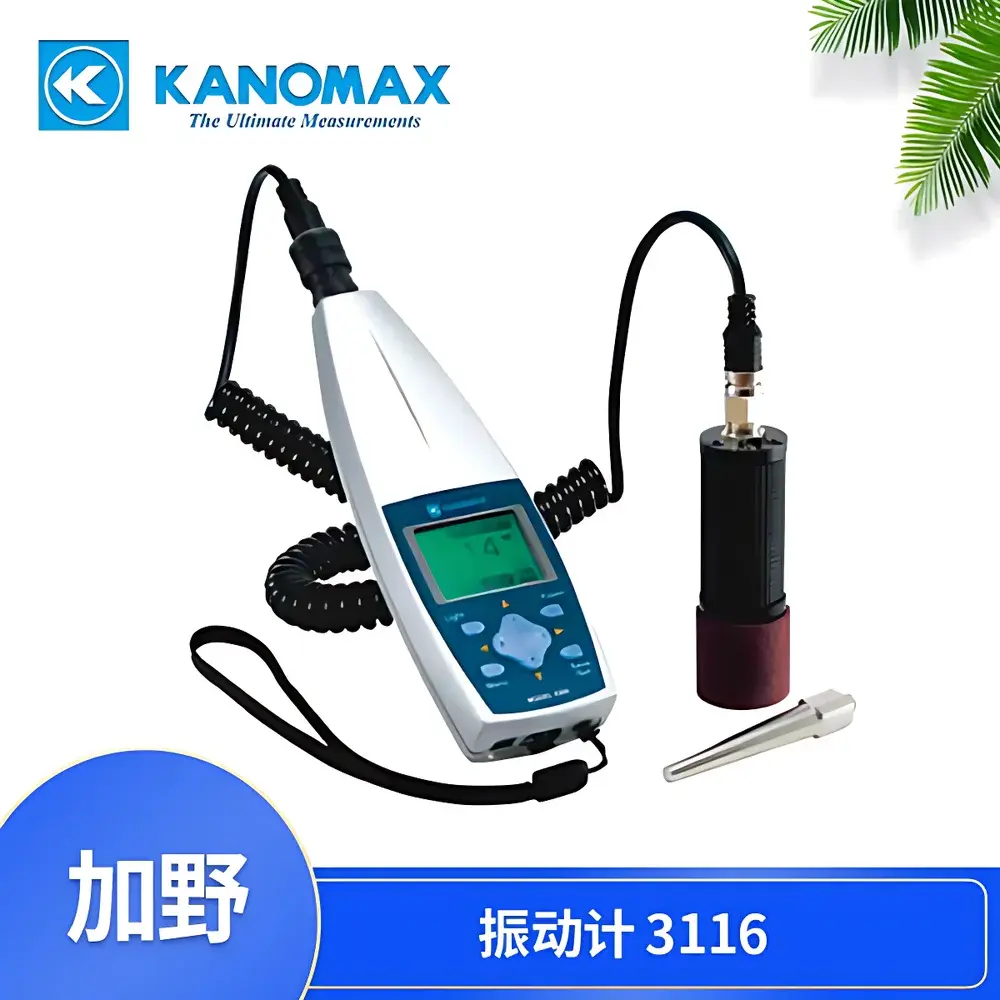
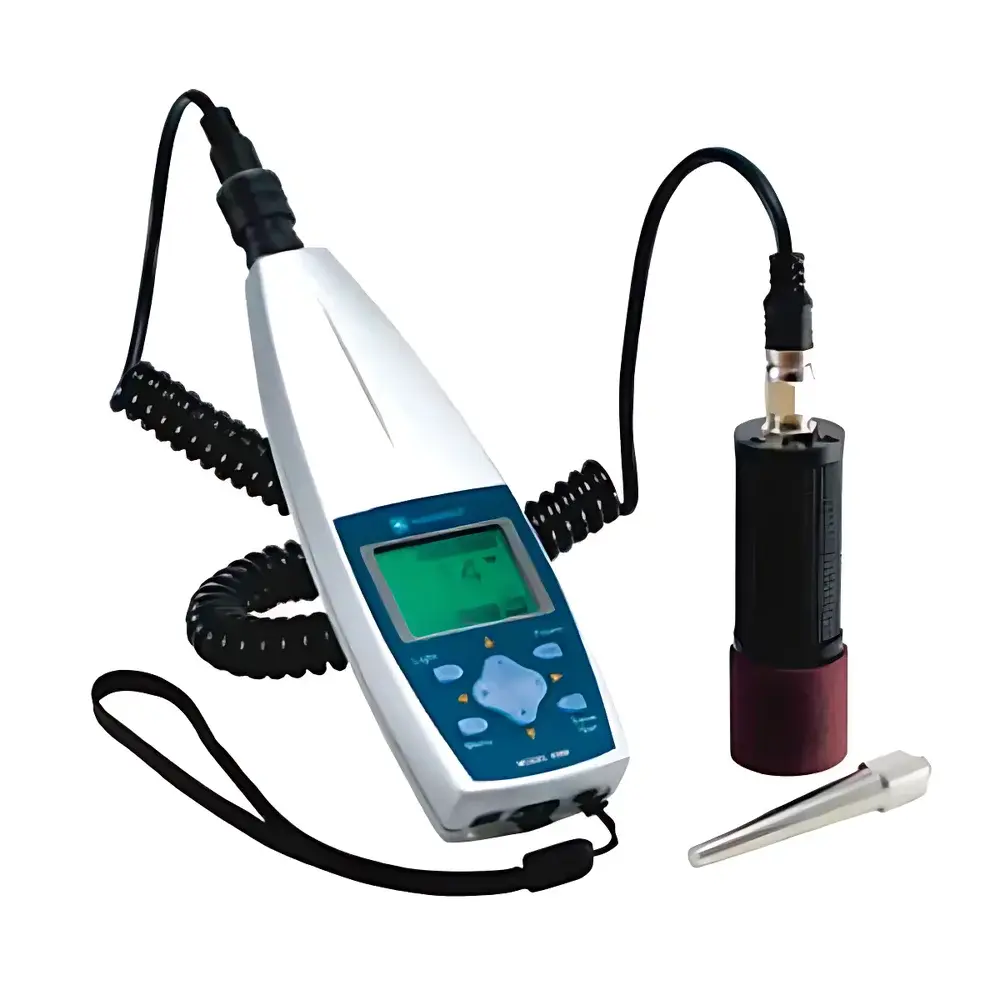
Kanomax Model 3116 Portable Digital Vibration Meter
| Brand | Kanomax |
|---|---|
| Origin | Japan |
| Model | 3116 |
| Acceleration Range | 0.02–200 m/s² RMS |
| Velocity Range | 0.02–200 mm/s RMS |
| Displacement Range | 2–2000 µm EQp-p |
| Accuracy | ±5% |
| Frequency Range (Acceleration) | 3 Hz–10 kHz |
| Frequency Range (Velocity) | 10 Hz–1 kHz (compliant with JIS B 0907-1989) |
| Frequency Weighting | 10–400 Hz band-limited for displacement evaluation |
| Output | AC output 1 Vrms (full scale), headphone output with volume control |
| Interface | RS-232C |
| Power | Two AAA batteries or AC adapter |
| Dimensions | 145 mm (H) × 48 mm (W) × 23 mm (D) |
| Weight | Approx. 130 g |
Overview
The Kanomax Model 3116 Portable Digital Vibration Meter is a compact, hand-held instrument engineered for field and laboratory-based vibration analysis of rotating machinery, structural components, and industrial equipment. It operates on the principle of piezoelectric acceleration sensing, converting mechanical vibration into proportional electrical signals for real-time quantification of acceleration, velocity, and displacement (equivalent peak-to-peak). Designed in strict accordance with JIS B 0907-1989 for vibration measurement instrumentation, the device delivers traceable, repeatable metrics across three fundamental vibration parameters—enabling users to assess machine health, detect early-stage bearing degradation, verify balancing efficacy, and validate compliance with ISO 10816 and ISO 20816 machinery vibration severity standards.
Key Features
- Integrated tri-parameter measurement: simultaneous digital display of acceleration (m/s² RMS), velocity (mm/s RMS), and displacement (µm EQp-p) without manual range switching.
- High-fidelity piezoelectric accelerometer with built-in magnetic base for stable, low-noise coupling to ferromagnetic surfaces—minimizing signal attenuation and mounting-induced resonance artifacts.
- Optimized frequency response: 3 Hz–10 kHz for acceleration analysis supports high-frequency fault detection (e.g., gear mesh frequencies, bearing cage defects); 10 Hz–1 kHz velocity band aligns with ISO 10816-3 diagnostic thresholds for medium-speed machinery.
- Dual-output architecture: 1 Vrms AC analog output enables connection to oscilloscopes or data loggers; RS-232C serial interface permits direct PC communication for time-synchronized waveform capture and archival.
- Low-power design: Operates continuously for >15 hours on two standard AAA alkaline cells; optional AC adapter ensures uninterrupted operation during extended calibration or commissioning tasks.
- Ergonomic form factor: 130 g mass and 145 × 48 × 23 mm footprint facilitate single-hand operation in confined spaces—ideal for HVAC fan assemblies, pump casings, motor end-bells, and compressor housings.
Sample Compatibility & Compliance
The Model 3116 is compatible with rigid metallic surfaces (steel, cast iron, aluminum alloys) via its integrated neodymium magnetic base. For non-magnetic substrates (stainless steel, plastic, composites), optional threaded stud mounts or adhesive-backed sensor adapters are available. The instrument conforms to JIS B 0907-1989 for vibration meter performance specifications—including linearity, temperature drift (<±0.05%/°C), and amplitude-dependent error limits. While not certified for intrinsic safety or ATEX/IECEx environments, it meets general-purpose industrial EMC requirements per IEC 61326-1 (industrial immunity) and is suitable for use in ISO/IEC 17025-accredited laboratories when operated within specified environmental conditions (10–40°C, <80% RH non-condensing).
Software & Data Management
Raw analog outputs and RS-232C digital streams support integration with third-party acquisition platforms (e.g., LabVIEW, MATLAB, or custom Python-based FFT analyzers). Kanomax provides basic terminal emulation utilities for ASCII-formatted data export (timestamped CSV), enabling post-processing for spectral analysis, trend logging, and report generation. Although the device lacks onboard memory or embedded firmware-upgrade capability, its RS-232 protocol is fully documented—facilitating automated data ingestion into CMMS or predictive maintenance databases compliant with ISO 55000 asset management frameworks. Audit trails and electronic signatures are managed externally via host-system validation protocols aligned with FDA 21 CFR Part 11 requirements where applicable.
Applications
- Routine condition monitoring of electric motors, centrifugal pumps, and gearboxes in manufacturing and power generation facilities.
- Vibration screening during commissioning of HVAC systems, including fan coil units and air handling units.
- Verification of vibration isolation effectiveness for sensitive laboratory equipment (e.g., electron microscopes, optical tables).
- Field validation of structural resonance characteristics in building retrofit projects and civil infrastructure assessments.
- Educational use in mechanical engineering labs for hands-on instruction in modal analysis fundamentals and sensor calibration principles.
FAQ
Does the Model 3116 support FFT spectral analysis?
No—the instrument provides only time-domain RMS and EQp-p values. Spectral decomposition requires external digitization and software processing.
Can the magnetic base be used on stainless steel surfaces?
Only on ferritic or martensitic grades (e.g., SUS430, SUS410); austenitic stainless steels (e.g., SUS304, SUS316) are non-magnetic and require alternative mounting solutions.
Is calibration certification included with purchase?
A factory calibration report (traceable to JCSS standards) is provided; NIST-traceable recalibration services are available through authorized Kanomax service centers.
What is the maximum cable length supported for RS-232 communication?
Up to 15 meters using shielded twisted-pair cabling compliant with EIA/TIA-232-F specifications.
Does the device meet ISO 20816-1 vibration severity criteria for industrial machines?
Yes—the velocity measurement channel (10–1 kHz, ±5% accuracy) satisfies the frequency weighting and uncertainty requirements for Category A (small machines) and Category B (medium machines) assessment per ISO 20816-1:2016.







