
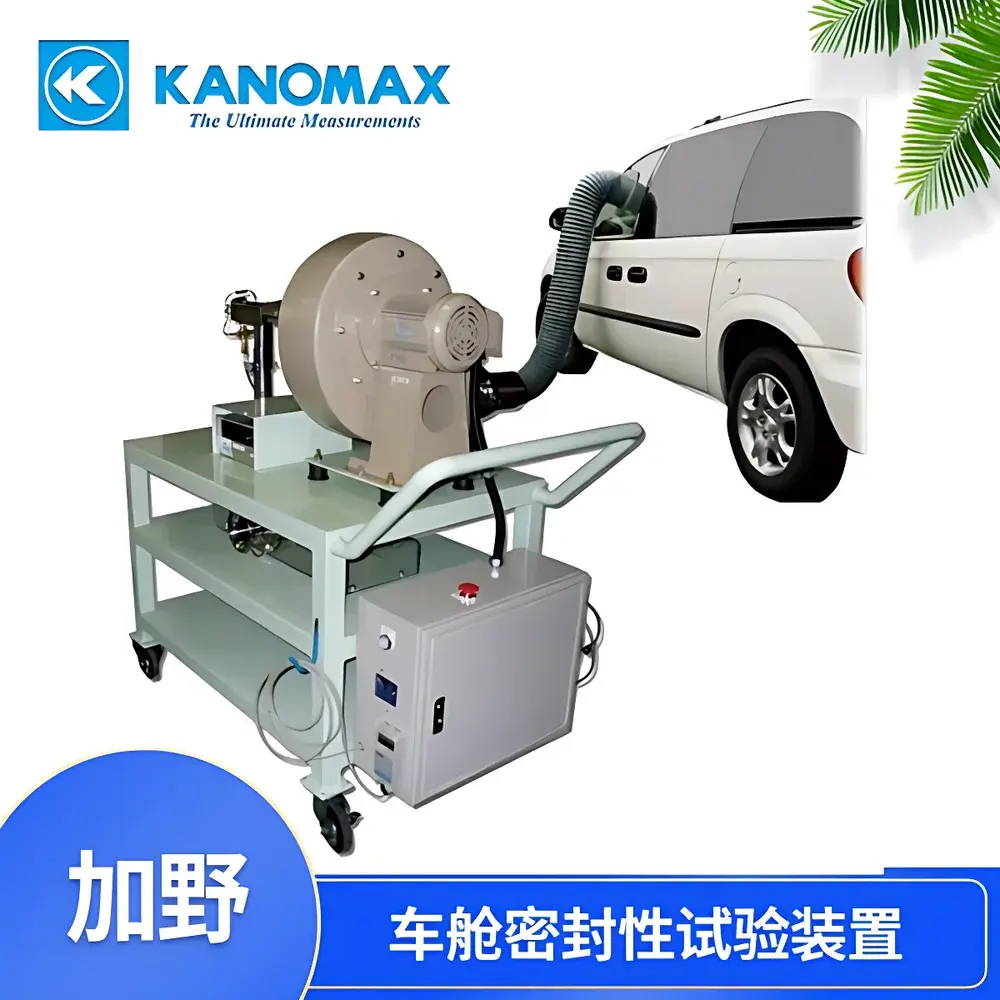
Kanomax KAN-7600 Vehicle Cabin Air Tightness Test System
| Brand | Kanomax |
|---|---|
| Origin | Japan |
| Manufacturer Type | Authorized Distributor |
| Origin Category | Imported |
| Model | KAN-7600 |
| Quotation | Upon Request |
| Airflow Range | 100–500 m³/h |
| Max. Cabin Static Pressure | ±2500 Pa (adjustable) |
| Standard Nozzle Diameters | Φ41 mm & Φ39 mm |
| Pressure Measurement Port | Integrated static pressure tap on flange |
| Control Method | Inverter-driven variable-speed blower with real-time feedback loop |
| Compliance | JIS D 1622 (Automotive Ventilation Performance Test), JIS B 8330 (Blower Testing and Inspection) |
Overview
The Kanomax KAN-7600 Vehicle Cabin Air Tightness Test System is an engineered solution for quantitative, repeatable measurement of air leakage characteristics across automotive passenger compartments. Based on the principle of controlled pressurization/depressurization using calibrated airflow delivery and high-fidelity static pressure monitoring, the system determines volumetric air exchange rates under defined pressure differentials—enabling objective evaluation of cabin integrity in accordance with JIS D 1622. Unlike qualitative smoke or ultrasonic detection methods, the KAN-7600 delivers traceable, metrologically sound data suitable for engineering validation, production line QA, and regulatory documentation. Its modular design supports both whole-cabin assessment and component-level isolation (e.g., individual door, sunroof, or trunk seal evaluation) via selective sealing and differential pressure mapping.
Key Features
- Inverter-controlled centrifugal blower providing continuous, stepless airflow regulation from 100 to 500 m³/h, ensuring stable operation across low- and high-leakage vehicle architectures.
- Dual-standard orifice nozzles (Φ39 mm and Φ41 mm) installed inline for flow calibration traceability; nozzle selection optimized per test pressure range and expected leakage magnitude.
- Integrated flanged flexible duct interface with dedicated static pressure port—designed for rapid, non-invasive mounting to vehicle window apertures without structural modification.
- Real-time closed-loop pressure control architecture: maintains setpoint cabin static pressure (±2500 Pa range) or target leakage rate via dynamic fan speed adjustment, compensating for thermal drift, ambient barometric shifts, or seal relaxation during extended tests.
- Robust mechanical construction compliant with JIS B 8330 requirements for blower performance verification, including vibration isolation, aerodynamic efficiency certification, and acoustic emission limits.
Sample Compatibility & Compliance
The KAN-7600 accommodates passenger cars, light commercial vehicles, and electric vehicle platforms with standard side-window openings (minimum 400 × 300 mm clear aperture). It supports testing under both positive and negative pressure conditions, enabling bidirectional leak path analysis critical for HVAC integration and battery compartment ingress protection. All operational procedures and data acquisition protocols align with JIS D 1622 Annex B (Quantitative Air Leakage Rate Determination) and are compatible with internal OEM test standards referencing ISO 9001:2015 and IATF 16949 audit requirements. The system’s pressure transducer and airflow sensor are factory-calibrated against NMIJ-traceable standards, and calibration certificates include uncertainty budgets per ISO/IEC 17025.
Software & Data Management
Data acquisition is managed via Kanomax’s proprietary PC-based software suite, supporting real-time visualization of cabin pressure, mass airflow, and calculated leakage rate (L/s or m³/h at specified ΔP). Raw time-series datasets are exported in CSV and XML formats for integration into PLM systems (e.g., Siemens Teamcenter) or statistical process control (SPC) platforms. Audit trails record operator ID, test timestamp, environmental conditions (ambient T/P/RH), and all parameter changes—meeting GLP/GMP documentation expectations and FDA 21 CFR Part 11 electronic record requirements when configured with user authentication and digital signature modules.
Applications
- Pre-production validation of door, window, sunroof, and rear hatch sealing systems under simulated road-load pressure gradients.
- Root-cause analysis of HVAC air-handling inefficiencies linked to uncontrolled cabin infiltration.
- Comparative benchmarking of prototype vs. production vehicle airtightness for lightweight material adoption (e.g., aluminum-intensive bodies or composite panels).
- Supporting ISO 16750-4 (Environmental Conditions – Climatic Loads) compliance testing for electronic control unit housing integrity.
- Quantifying cabin air change rates (ACH) used in cabin air quality (CAQ) modeling and CO₂ dilution studies.
FAQ
What pressure range can the KAN-7600 maintain inside the vehicle cabin?
The system achieves and sustains static pressure differentials from –2500 Pa to +2500 Pa relative to ambient, with typical cabin integrity testing conducted between ±50 Pa and ±500 Pa per JIS D 1622.
Is the system capable of measuring leakage through individual components only?
Yes—by selectively sealing all openings except one (e.g., driver’s door), the KAN-7600 isolates and quantifies component-specific leakage rates while maintaining full system metrological traceability.
Does the KAN-7600 require external calibration services after installation?
Initial commissioning includes on-site verification using NMIJ-traceable reference instruments; subsequent annual recalibration is recommended and supported by Kanomax-certified service centers in APAC and EMEA regions.
Can test data be integrated into automated manufacturing reporting systems?
Yes—the software provides OPC UA and Modbus TCP interfaces for direct connectivity to MES and SCADA platforms, enabling real-time SPC charting and auto-flagging of out-of-specification units.
What environmental conditions must be controlled during testing?
Ambient temperature should remain within 15–30 °C, and relative humidity below 80% RH to minimize condensation effects on pressure sensor stability and seal adhesion behavior.



