
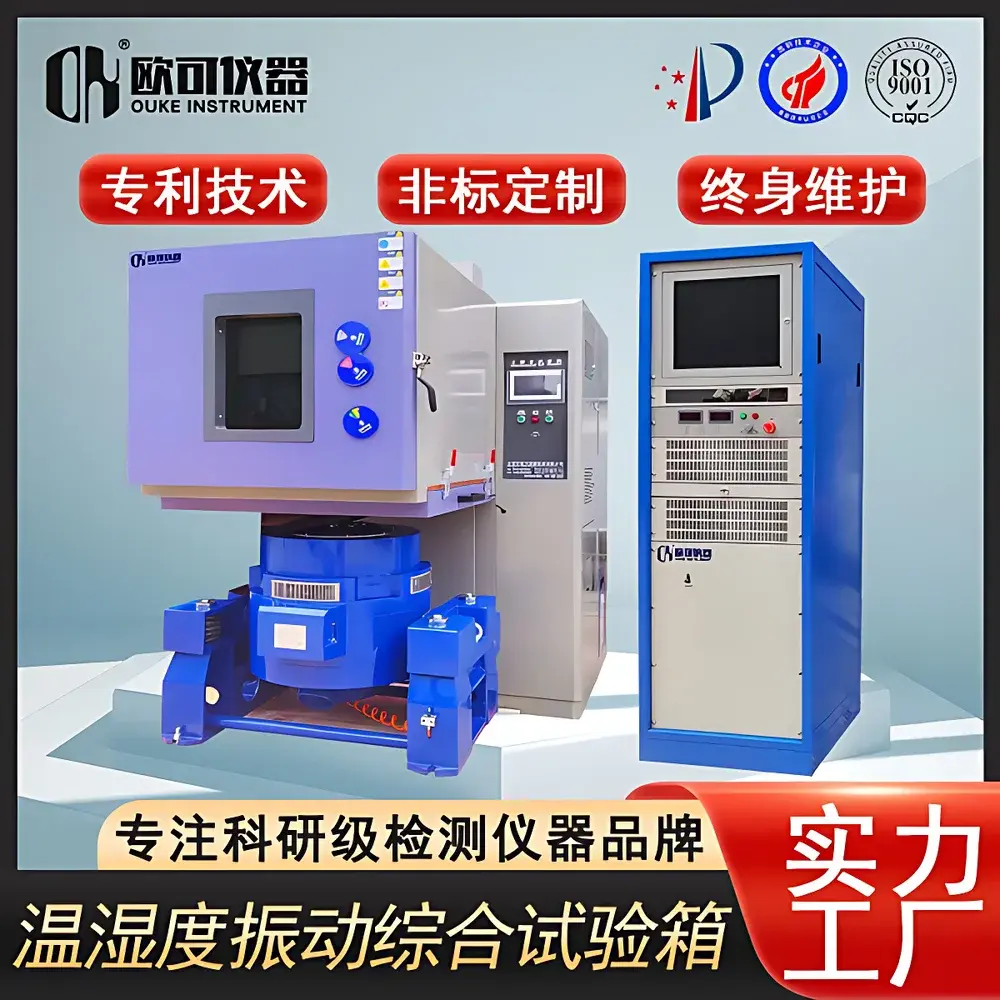
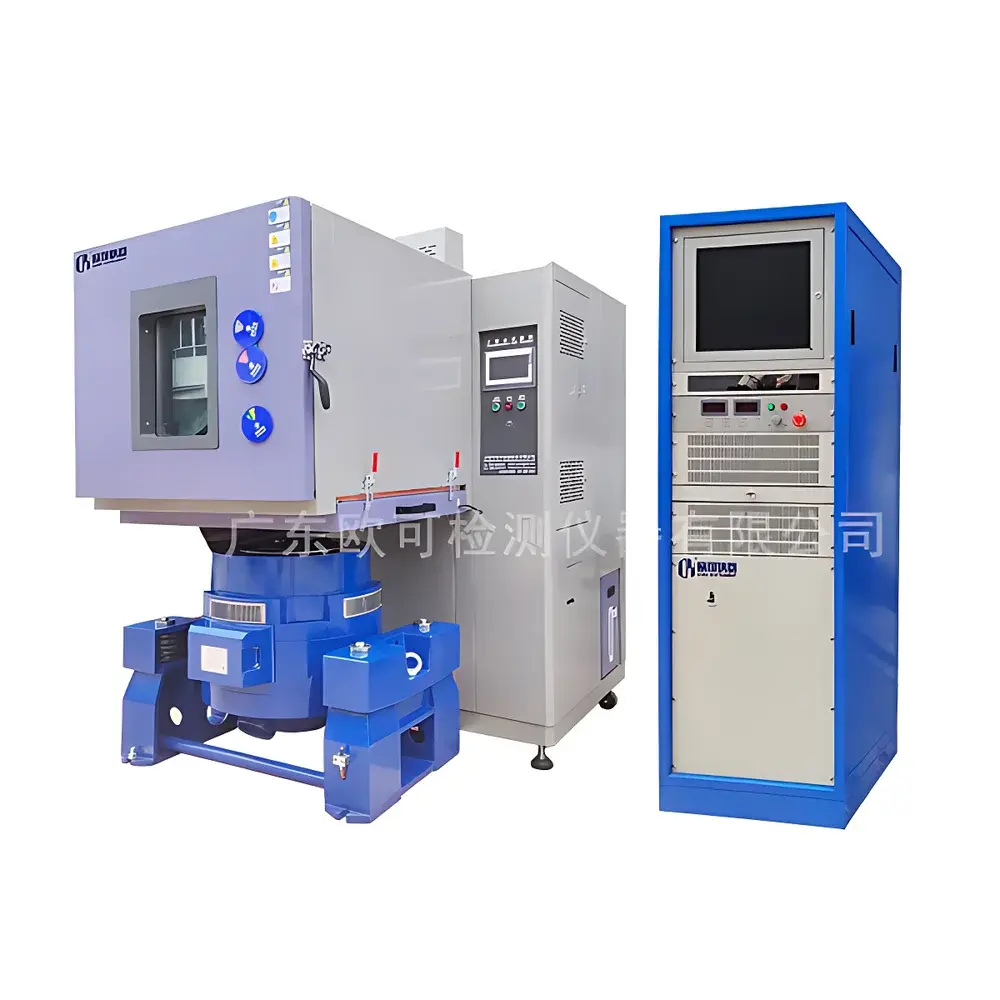
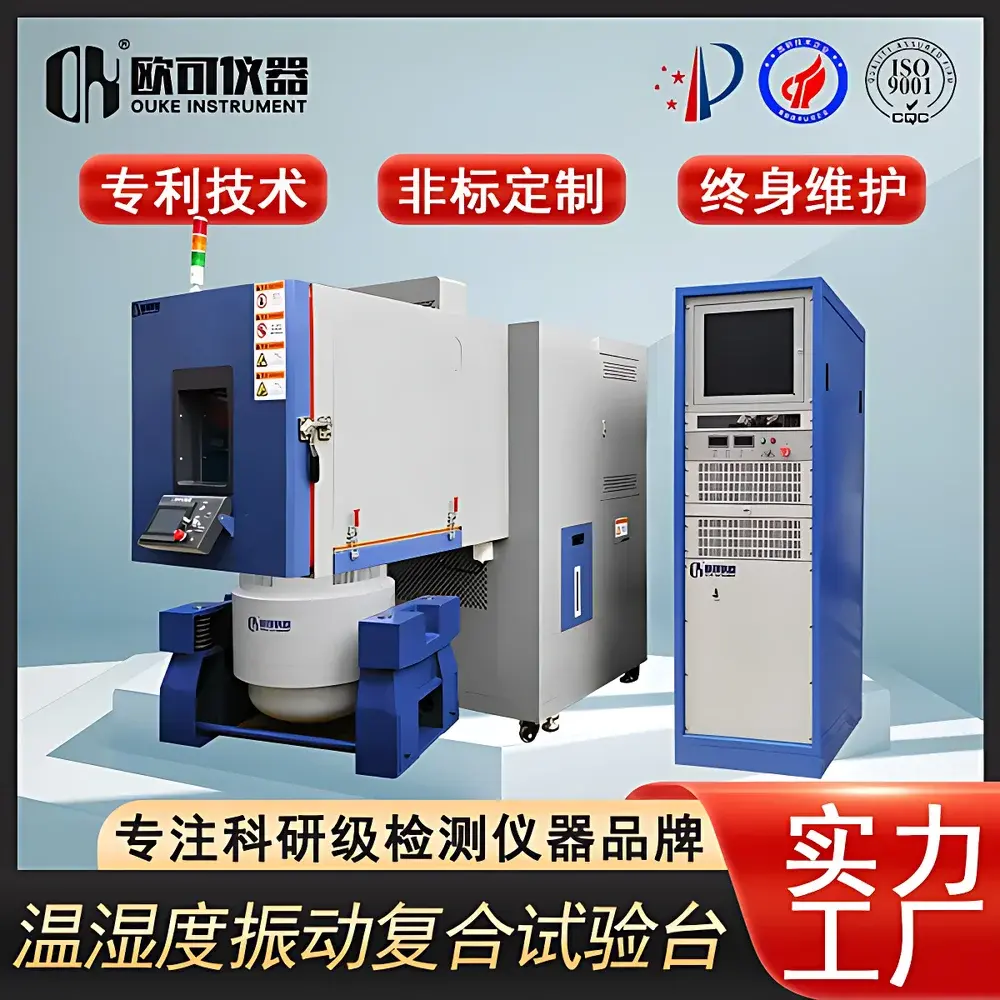
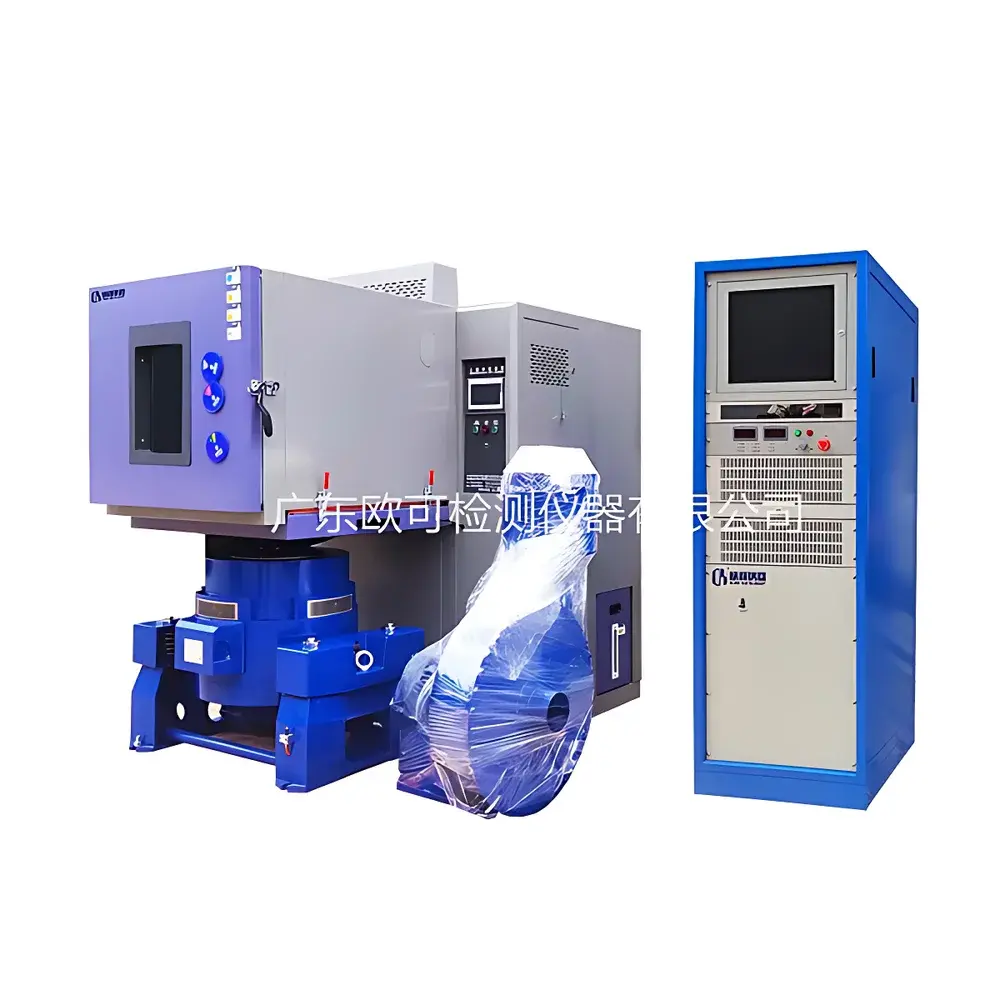
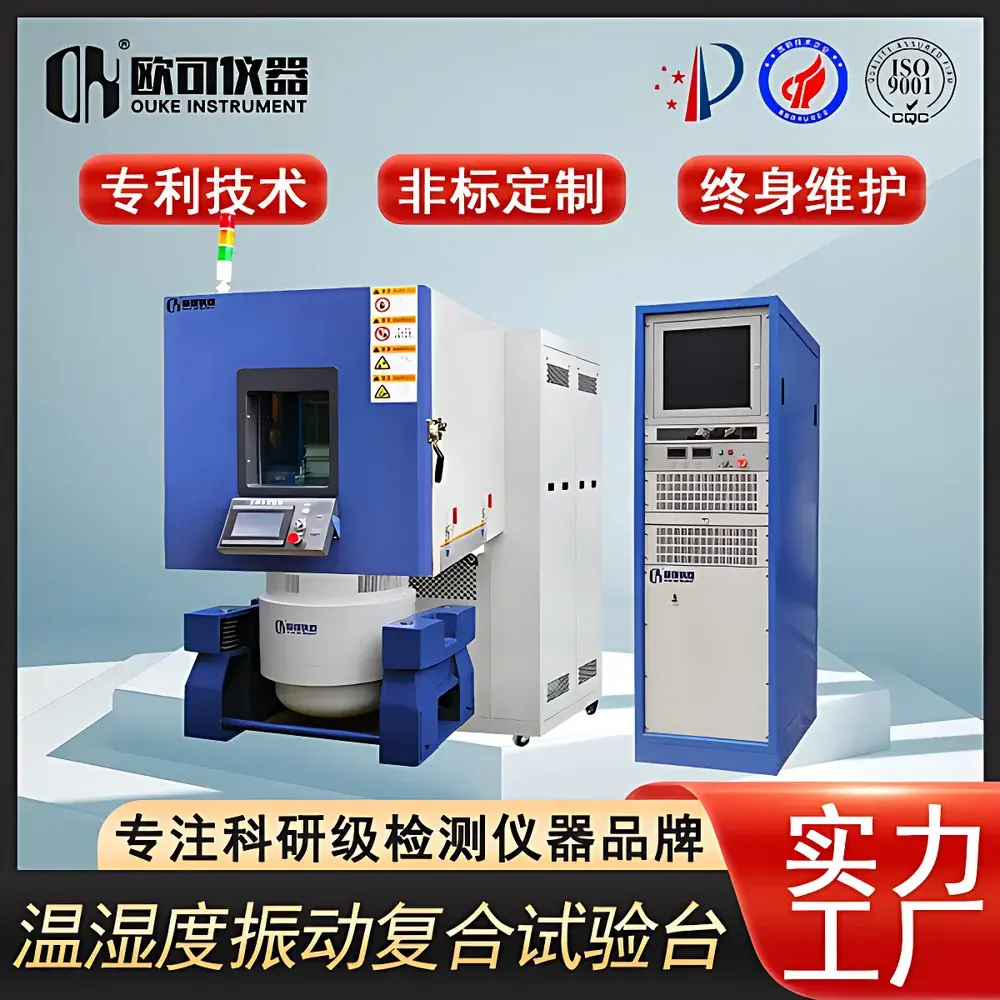
OK Instruments OK-ZTH-1000.00100 Combined Temperature-Humidity-Vibration Environmental Test Chamber
| Brand | OK Instruments |
|---|---|
| Origin | Guangdong, China |
| Manufacturer Type | Direct Manufacturer |
| Country of Origin | China |
| Model | OK-ZTH-1000.00100 |
| Temperature Range | −70 °C to +150 °C |
| Humidity Range | 20–98 %RH at 20–85 °C |
| Temperature Ramp Rate | 5 / 10 / 15 °C/min |
| Temperature Uniformity | ≤ ±0.5 °C |
| Standard Load Capacity | 15 kg aluminum mass with 350 W internal heat dissipation |
Overview
The OK Instruments OK-ZTH-1000.00100 Combined Temperature-Humidity-Vibration Environmental Test Chamber is an integrated reliability validation system engineered for accelerated stress testing of household appliances and their critical subassemblies under simultaneous thermal, hygrothermal, and mechanical dynamic loading conditions. It operates on the principle of multi-stress synergistic acceleration—applying controlled temperature cycling, humidity modulation, and broadband electrodynamic vibration in a single, tightly coupled test environment. This approach replicates real-world operational and logistical stress profiles far more rigorously than sequential or single-stress testing methods. The chamber is designed to meet the functional and structural validation requirements defined in IEC 60068-2 series, GB/T 2423 (China National Standards), and ISO 16750-4 for automotive-grade environmental robustness—making it suitable not only for white goods but also for cross-industry applications in industrial electronics and consumer IoT devices.
Key Features
- Triple-stress integration: Simultaneous control of temperature (−70 °C to +150 °C), relative humidity (20–98 %RH within 20–85 °C), and vibration (via integrated electrodynamic shaker with programmable sine/random waveforms).
- High-fidelity thermal management: Dual-stage mechanical refrigeration system with cascade configuration ensures stable ultra-low temperature operation; precision resistive heating elements enable rapid, linear ramp rates up to 15 °C/min.
- Robust mechanical architecture: Rigid internal mounting platform with kinematic isolation from chamber structure minimizes parasitic vibration transmission; reinforced floor coupling supports dynamic loads without resonant amplification.
- Intelligent profile-based controller: Embedded real-time OS enables complex multi-segment test sequences—including dwell, ramp, hold, and loop functions—with synchronized timestamped logging of all environmental and vibrational parameters.
- Comprehensive safety infrastructure: Triple-redundant over-temperature cutoffs, vibration fault detection (acceleration/velocity/position limit monitoring), emergency power-off interlock, and leak-tight feedthrough ports rated for Class I Division 2 environments.
- Modular scalability: Pre-engineered interfaces for optional humidity extension kits, data acquisition modules (e.g., 16-channel analog input for in-situ voltage/current/temperature telemetry), and remote diagnostics via Ethernet/IP or Modbus TCP.
Sample Compatibility & Compliance
The OK-ZTH-1000.00100 accommodates full-system and subsystem-level testing of domestic appliances—including refrigerators, HVAC indoor/outdoor units, washing machines, dishwashers, robotic vacuum cleaners, air purifiers, microwave ovens, and embedded PCB assemblies. Its standard load specification (15 kg aluminum mass, 350 W thermal dissipation) reflects typical thermal inertia and power draw of mid-sized electronic enclosures. The chamber complies with key regulatory frameworks including ISO/IEC 17025 calibration traceability requirements, GLP-compliant audit trails (with user-accessible event logs and digital signature support), and design conformity to IEC 61000-4-27 for immunity testing infrastructure. All control firmware and data handling routines adhere to FDA 21 CFR Part 11 principles where electronic records are used for quality documentation.
Software & Data Management
Equipped with OK-TestSuite™ v4.2 control and analysis software, the system provides deterministic real-time waveform generation, closed-loop feedback control, and synchronized parameter logging at configurable sampling intervals (down to 10 ms). Raw sensor data—including chamber air temperature/humidity, shaker armature acceleration (±200 g range), displacement (±25 mm peak-to-peak), and drive current—is stored in HDF5 format with embedded metadata (test ID, operator, timestamp, calibration certificate ID). Export options include CSV, MATLAB .mat, and PDF summary reports compliant with ISO/IEC 17025 reporting clauses. Audit trail functionality records all user actions—including profile edits, manual overrides, and calibration events—with immutable timestamps and operator authentication.
Applications
- Design verification of thermal-mechanical interface integrity (e.g., solder joint fatigue under cyclic thermal expansion mismatch).
- Validation of enclosure sealing performance during combined thermal shock and vibration-induced gasket deformation.
- Functional endurance testing of motor-driven components (compressors, drum suspensions, fan assemblies) under realistic ambient extremes.
- Qualification of display modules and touch interfaces for condensation resistance and micro-fracture propagation under random vibration spectra.
- Supplier component screening per AEC-Q200 or JEDEC JESD22-A108 protocols adapted for appliance-grade use cases.
- Root cause analysis of field return failures through accelerated reproduction of suspected transport- or usage-related stress combinations.
FAQ
What standards does this chamber support for appliance qualification?
It supports test execution per GB/T 2423.10 (vibration), GB/T 2423.22 (temperature shock), IEC 60068-2-14 (change of temperature), and IEC 60068-2-64 (random vibration), with optional configuration for MIL-STD-810H Method 514.8 Annex G (combined environments).
Can the vibration system be calibrated independently of the thermal chamber?
Yes—the electrodynamic shaker includes traceable transducer mounting points and supports third-party calibration per ISO 16063-21 using reference accelerometers; thermal chamber sensors are separately certified per ISO/IEC 17025.
Is remote monitoring and control supported?
The system features dual Ethernet ports with VLAN segregation: one for local HMI access, the other for secure TLS-encrypted remote supervision via OK-CloudLink™ gateway (optional), enabling real-time status dashboards and alarm notifications.
What electrical infrastructure is required for installation?
A dedicated 3-phase 380 V ±10 %, 50 Hz supply with minimum 63 A circuit breaker is recommended; water-cooled variants require chilled water at 7–12 °C with 2 bar inlet pressure and flow rate ≥3 L/min.
How is data integrity ensured during long-duration tests (e.g., 500+ hours)?
The controller implements cyclic ring-buffer logging with automatic failover to redundant SD card storage; all critical state transitions (e.g., ramp start/stop, fault triggers) generate SHA-256 hashed entries in a write-once audit log file.



