
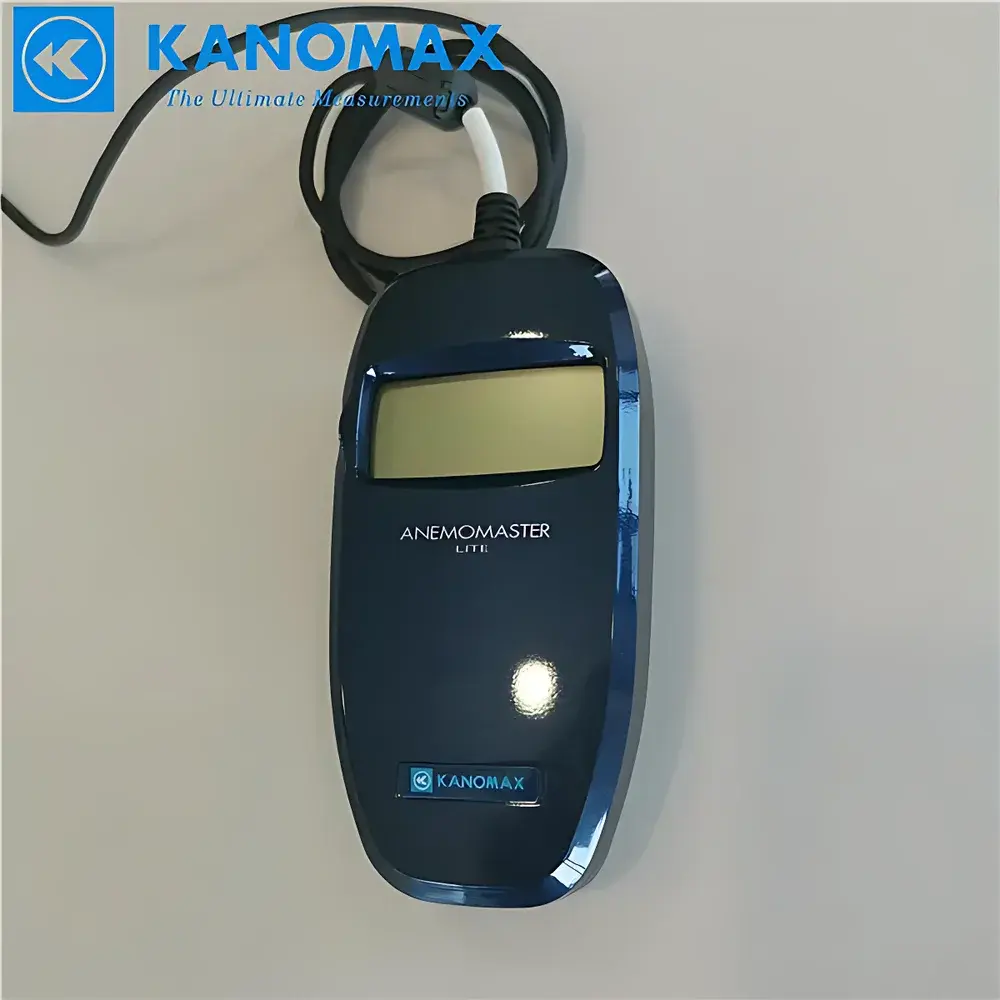
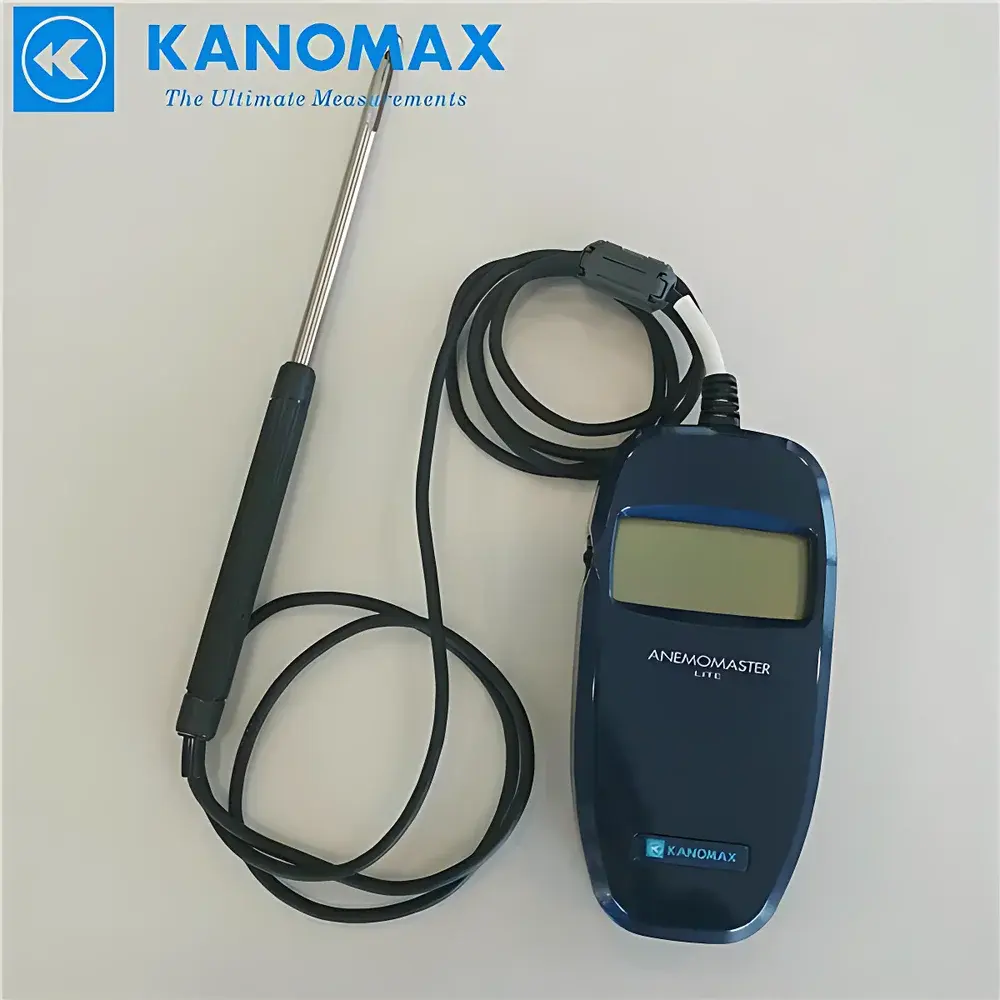
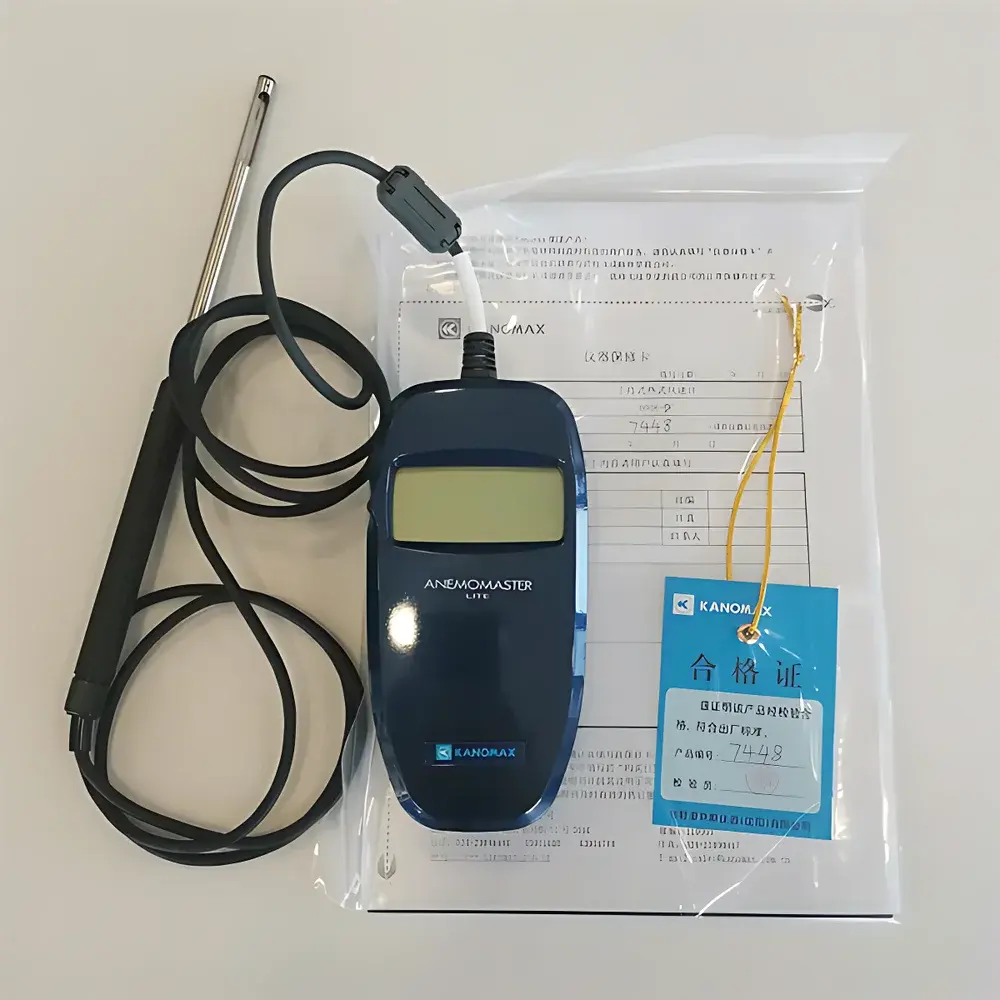
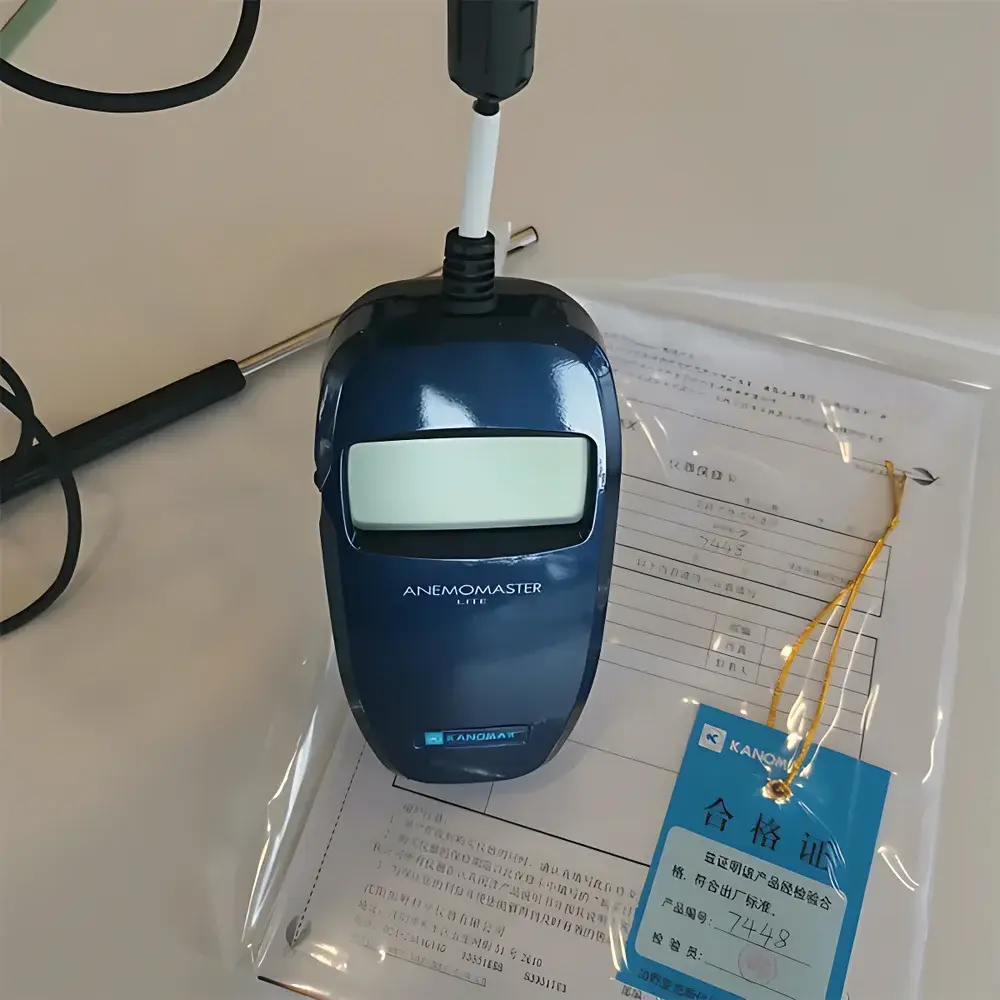
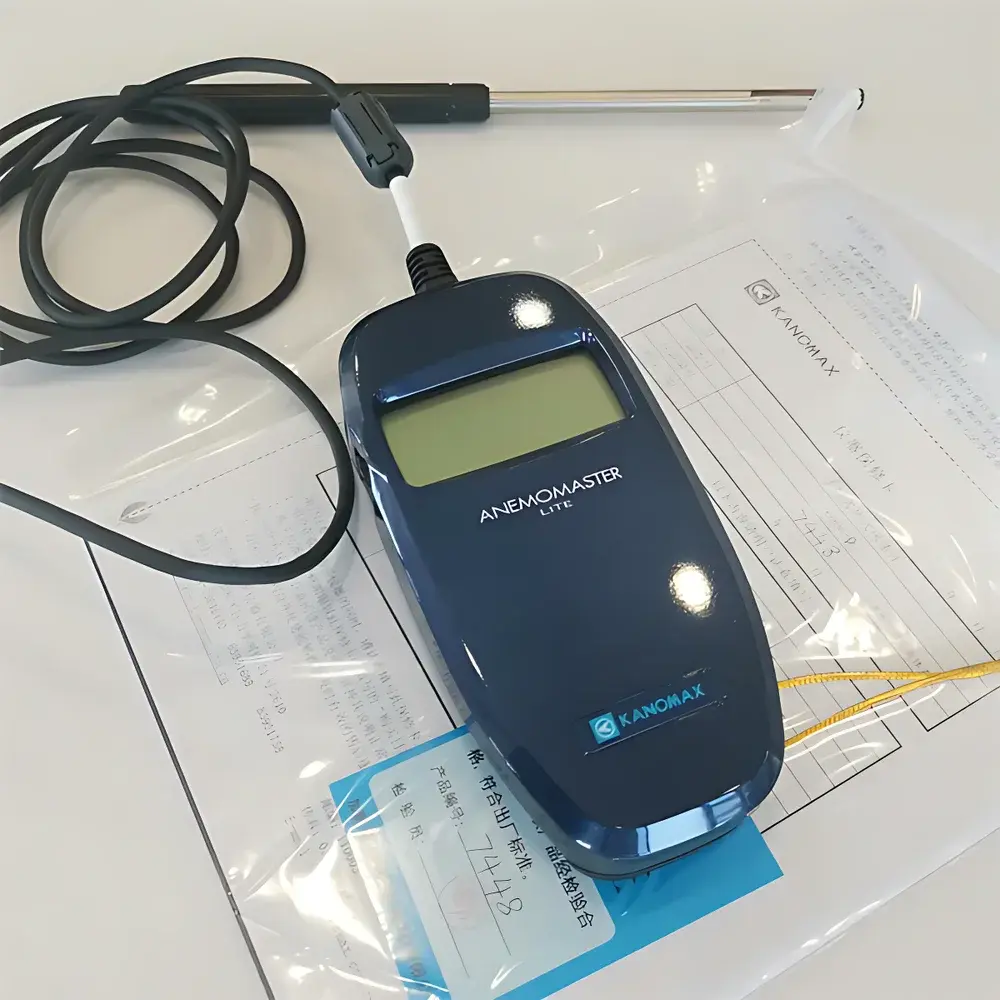
KANOMAX Model 6006 Smart Thermal Anemometer
| Brand | KANOMAX |
|---|---|
| Origin | Japan |
| Model | 6006 |
| Instrument Type | Thermal Anemometer |
| Measurement Range | 0.01–20.0 m/s |
| Resolution | 0.01 m/s (0–9.99 m/s), 0.1 m/s (10.0–20.0 m/s) |
| Accuracy | ±5% of reading (wind speed), ±1°C (temperature) |
| Operating Temperature | −20–70°C (probe), 5–40°C (main unit) |
| Operating Humidity | 20–85% RH |
| Response Time | <1 s (90% for wind speed at 1 m/s), <30 s (90% for temperature) |
| Display | Dual-parameter (wind speed + temperature), unit switchable (m/s/°C ↔ fpm/°F), FAST/SLOW averaging, battery level indicator (4-level), hold function |
| Probe Dimensions | Ø6.1 mm (Ø10.6 mm tip) × 205 mm |
| Cable | Ø3.3 mm × ~1.5 m |
| Main Unit Dimensions | 60 × 120 × 30 mm |
| Weight | ~180 g (including batteries) |
| Accessories | Instruction manual, carrying case |
| Optional Accessories | Extension rod, spare probe |
Overview
The KANOMAX Model 6006 Smart Thermal Anemometer is a precision handheld instrument engineered for reliable, real-time measurement of air velocity and ambient temperature in HVAC commissioning, indoor air quality (IAQ) assessment, cleanroom validation, laboratory ventilation verification, and industrial process airflow monitoring. Based on constant-temperature anemometry (CTA), the device employs a thermally sensitive platinum resistance sensor housed in a low-inertia probe tip. As air flows across the heated sensing element, convective heat transfer alters its resistance proportionally to local flow velocity—enabling direct, linearized output calibrated per ISO 16813 and ASTM D1212 standards for thermal anemometer performance. Unlike cup or vane anemometers, the Model 6006 delivers high sensitivity at low velocities (down to 0.01 m/s), making it suitable for laminar flow characterization, duct traverse surveys, and exhaust hood face velocity verification per ASHRAE 110 and ANSI Z9.5. Its integrated temperature compensation circuit ensures stable calibration across the full operational range (−20 to 70°C probe environment), with optimal accuracy maintained between 10–40°C as verified per manufacturer’s traceable calibration protocol.
Key Features
- Single-button operation interface optimized for field technicians—no menu navigation required for start/stop, unit switching, or data hold.
- Interchangeable probe design with factory-matched calibration coefficients stored in probe memory, ensuring consistent accuracy when swapping sensors without recalibration.
- Dual-parameter simultaneous display: real-time wind speed and temperature, with selectable averaging modes (FAST: 1-second moving average; SLOW: 5-second moving average) to accommodate turbulent or transient airflow conditions.
- Multi-unit support via DIP-switch configuration: m/s and °C default; configurable to ft/min (fpm) and °F for compliance with North American HVAC documentation requirements.
- Integrated battery status indicator (4-segment LED) and auto-power-off after 10 minutes of inactivity to extend alkaline AA battery life (>20 hours continuous use).
- Rugged, pocket-sized main unit (60 × 120 × 30 mm) with IP54-rated ingress protection against dust and water splashes during portable deployment.
Sample Compatibility & Compliance
The Model 6006 is validated for use in ambient air under standard atmospheric pressure (86–106 kPa). It is not intended for corrosive, explosive, or particulate-laden gas streams without optional filtration or probe shielding. Probe materials (stainless steel tip, PTFE-insulated cable) comply with RoHS Directive 2011/65/EU and are compatible with ISO 14644-3 cleanroom classification protocols. The instrument meets CE marking requirements per EMC Directive 2014/30/EU and Low Voltage Directive 2014/35/EU. While not inherently 21 CFR Part 11 compliant, audit-ready usage is supported through external documentation of calibration certificates (NIST-traceable), operator logs, and controlled procedural records per GLP/GMP Annex 11 guidelines.
Software & Data Management
The Model 6006 operates as a standalone field instrument with no embedded Bluetooth or USB connectivity. All measurements are displayed in real time only; no onboard data logging or PC interface is provided. For regulatory-compliant recordkeeping, users are advised to pair the device with validated external recording systems (e.g., certified digital loggers or validated spreadsheet templates) that include operator ID, timestamp, location tag, and environmental context. Calibration certificates—issued annually or per ISO/IEC 17025-accredited laboratories—must be retained for audit trails. The instrument supports manual transcription into LIMS or QA databases aligned with ISO 9001:2015 clause 7.1.5.2 (monitoring and measuring resources).
Applications
- HVAC system balancing and TAB (Testing, Adjusting, Balancing) per SMACNA and NEBB standards.
- Cleanroom airflow uniformity mapping (ISO 14644-3 Class 5–8), including supply diffuser and return grille velocity profiling.
- Fume hood face velocity verification (ANSI/AIHA Z9.5, OSHA 1910.1200) and local exhaust ventilation (LEV) performance audits.
- Indoor air quality (IAQ) assessments per ASHRAE Standard 62.1, including thermal comfort (PMV/PPD) input parameter acquisition.
- Industrial drying tunnel, oven, and cooling line airflow verification where low-velocity sensitivity and thermal stability are critical.
- Academic and research lab ventilation safety checks, particularly in biosafety cabinets (BSCs) and chemical handling enclosures.
FAQ
Is the Model 6006 suitable for outdoor use in rain or high humidity?
The probe is rated IP54; however, prolonged exposure to precipitation or condensation is not recommended. Use only under sheltered conditions with relative humidity ≤85% RH.
Can I replace the probe with third-party sensors?
No. Only KANOMAX-certified replacement probes (e.g., optional spare probe P/N 6006-PROBE) maintain traceable calibration integrity. Non-OEM probes invalidate accuracy specifications and void warranty.
What is the recommended calibration interval?
Annual calibration is advised per ISO/IEC 17025 requirements. More frequent calibration may be necessary in high-use environments or after mechanical shock.
Does the unit meet FDA requirements for pharmaceutical facility monitoring?
While not intrinsically compliant, the Model 6006 supports GMP-aligned workflows when used with documented SOPs, calibration records, and operator training—consistent with FDA guidance on “adequate controls for measurement equipment” (21 CFR Part 211.68).
How does the temperature compensation circuit affect low-velocity accuracy?
The internal compensation algorithm corrects for ambient thermal drift across −20–70°C, preserving ±5% reading accuracy within the 0.01–20.0 m/s range—verified per probe-specific calibration reports issued at time of manufacture.
Related Products







