
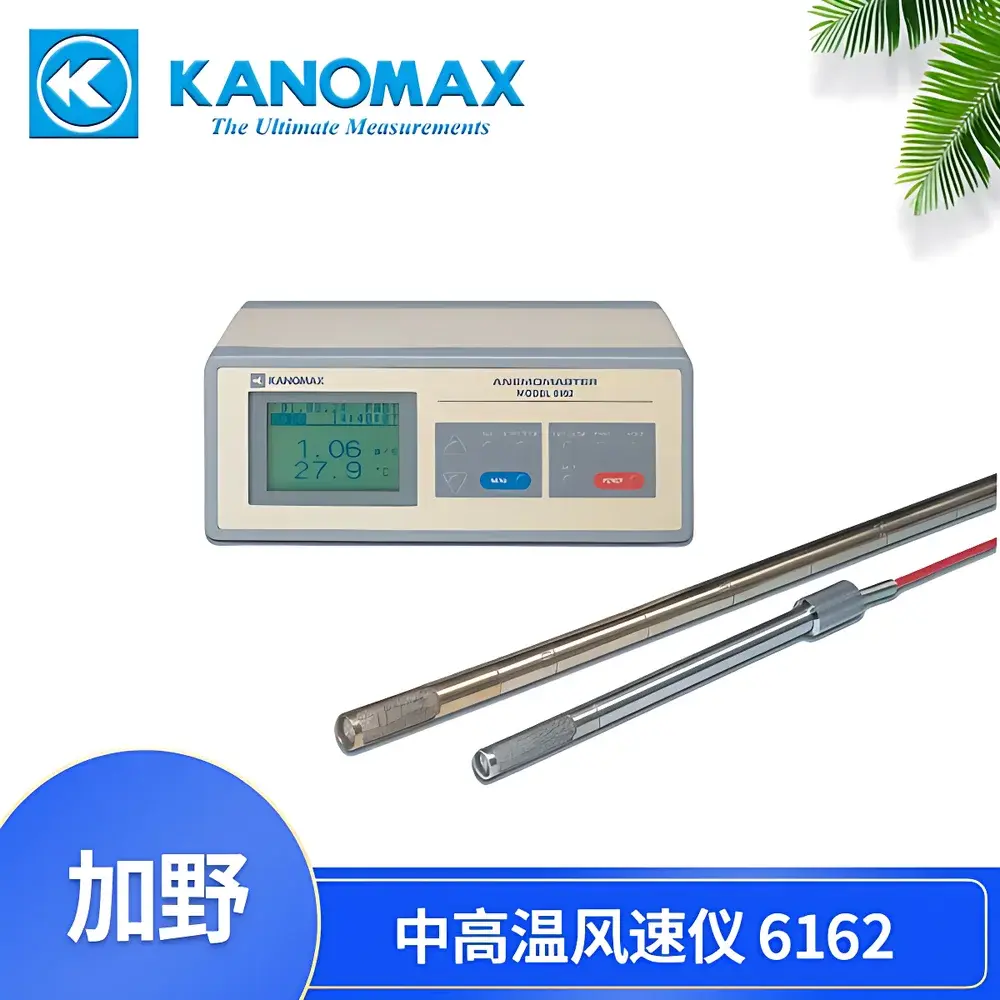
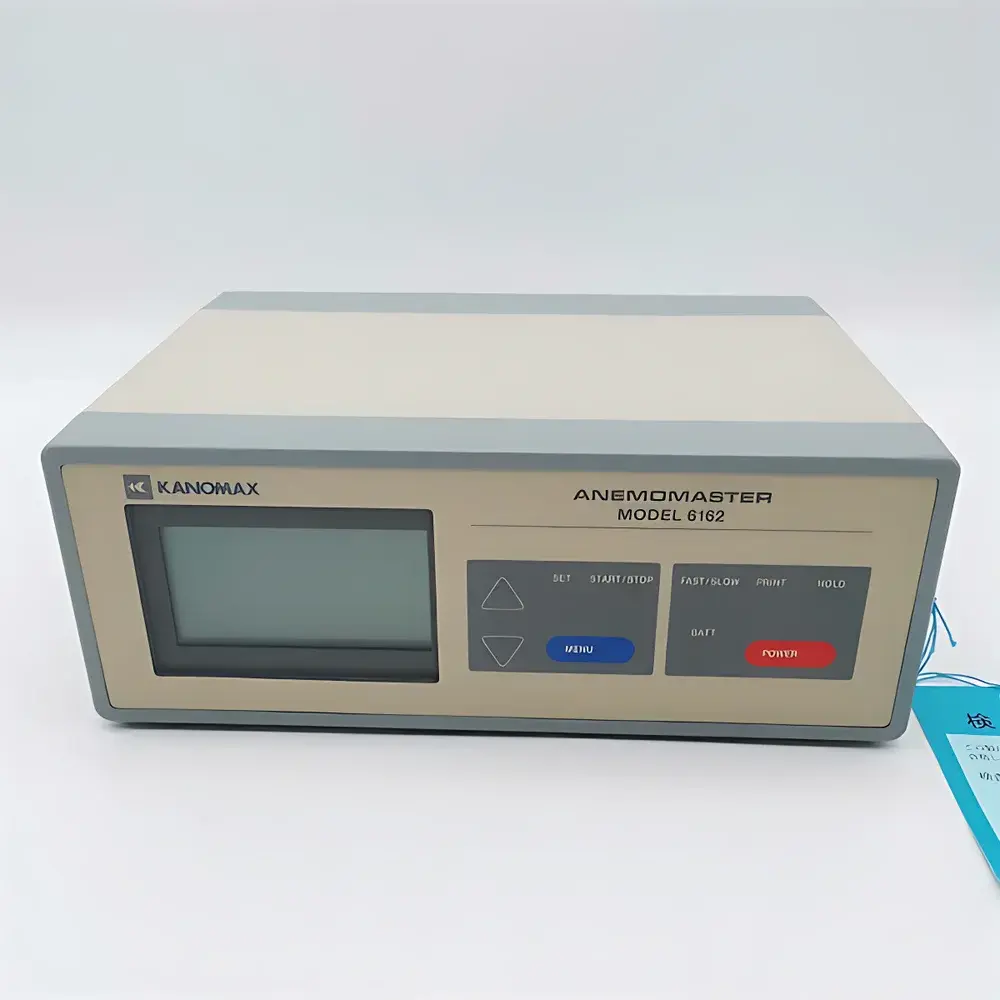
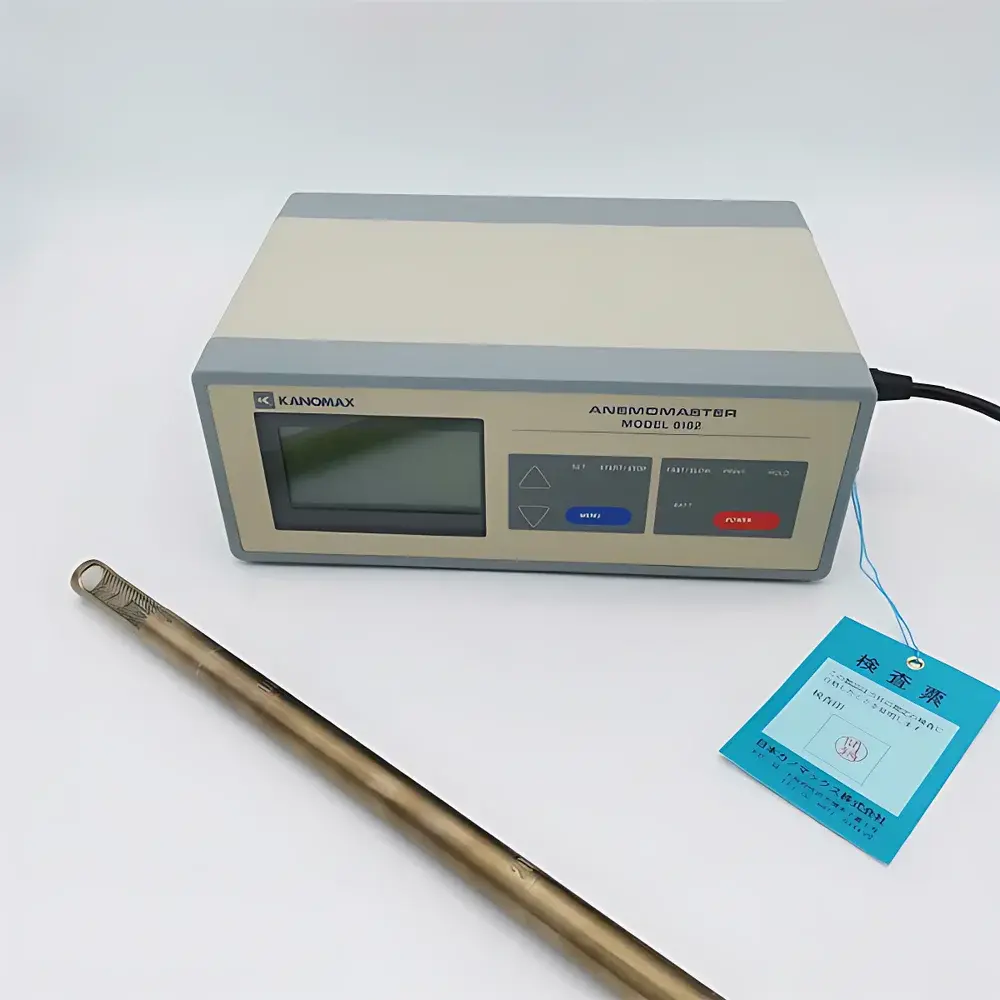
KANOMAX 6162 Intelligent High-Temperature Thermal Anemometer
| Brand | KANOMAX |
|---|---|
| Origin | Liaoning, China |
| Manufacturer Type | Authorized Distributor |
| Product Category | Domestic |
| Model | 6162 |
| Instrument Type | Thermal Anemometer |
| Resolution | 0.01 m/s |
| Velocity Range | 0–50.0 m/s |
| Accuracy | ±3% of reading (velocity) |
| Operating Ambient Temperature | 0–500 °C (probe-dependent) |
| Operating Ambient Humidity | 0–100% RH |
| Temperature Measurement Range | 0–200 °C / 0–400 °C / 0–500 °C (by probe variant) |
| Probe Cable Material | PTFE-insulated |
| Extension Cable Material | PVC-insulated |
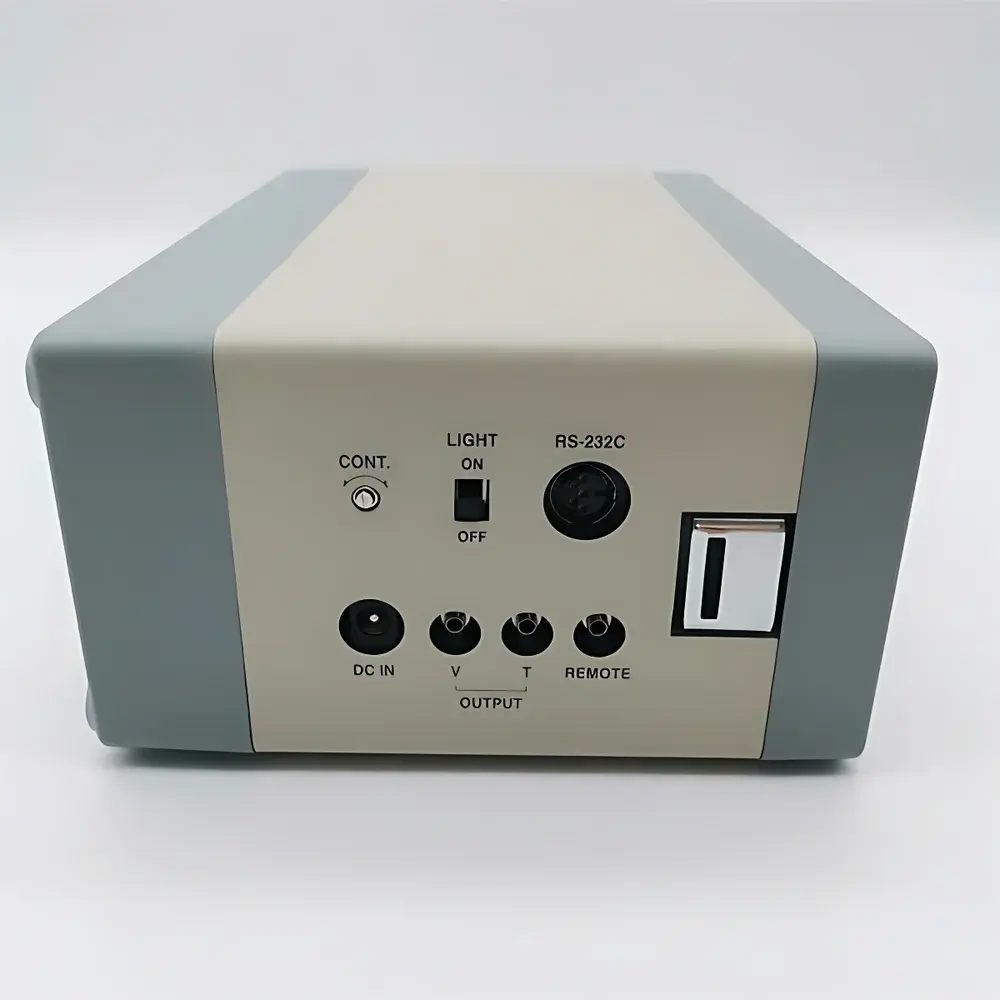
| Communication Interface | RS-232C |
| Data Storage Capacity | 999 records |
| Analog Output | 0–1 V DC |
| Power Supply | 6 × 1.5 V AA batteries or 12.5 V DC / 450 mA AC adapter |
| Dimensions (main unit) | 220 × 150 × 85 mm |
| Weight (main unit) | 1.8 kg |
| Probe Options | 0203 (Φ11 × 208 mm), 0204 (Φ14 × 500 mm), 0205 (Φ14 × 1000 mm) |
| Probe Weights | 200 g / 200 g / 500 g |
Overview
The KANOMAX 6162 Intelligent High-Temperature Thermal Anemometer is a precision-engineered instrument designed for simultaneous measurement of air velocity and temperature in demanding industrial environments—particularly where elevated thermal conditions preclude conventional anemometric solutions. Based on constant-temperature anemometry (CTA), the device maintains a heated sensing element at a fixed differential above ambient, with convective heat loss directly correlated to local gas velocity. This principle enables stable, low-inertia response across wide dynamic ranges while retaining high sensitivity at low flow velocities (down to 0.2 m/s). Unlike hot-wire systems vulnerable to contamination or thermal shock, the 6162 employs robust ceramic-sheathed platinum resistance sensors embedded in thermally graded stainless-steel probes, enabling continuous operation up to 500 °C. Its modular architecture supports interchangeable probe configurations optimized for ductwork, furnace flues, kiln exhausts, and HVAC commissioning—making it suitable for both R&D validation and routine process monitoring under ASME PTC-19.5, ISO 16813, and EN 15242-compliant workflows.
Key Features
- Triple-range high-temperature probe compatibility: 0–200 °C (Probe 0203), 0–400 °C (Probe 0204), and 0–500 °C (Probe 0205), each with PTFE-insulated lead cables rated to 200 °C
- Velocity accuracy calibrated per ISO 13347-2: ±0.15 m/s (0–4.99 m/s), ±0.3 m/s (5.00–9.99 m/s), ±0.75 m/s (10.0–24.9 m/s), ±1.5 m/s (25.0–50.0 m/s)
- Integrated temperature compensation algorithm ensures velocity readings remain traceable across full operating temperature span
- Real-time wind volume calculation: user-input cross-sectional area triggers automatic volumetric flow derivation (m³/h or CFM) with SI/imperial unit toggle
- Onboard statistical engine computes min/max/mean over stored datasets; timestamped records include velocity, temperature, and derived flow values
- RS-232C serial interface supports bidirectional communication with PC-based data acquisition software for GLP-compliant audit trails
- 0–1 V analog output enables integration into PLC-controlled ventilation systems or SCADA architectures without signal conditioning
Sample Compatibility & Compliance
The KANOMAX 6162 is validated for use in clean, dry, non-corrosive gas streams—including air, nitrogen, and combustion exhaust with particulate loading <5 mg/m³. Probe variants are rated for static pressure ≤10 kPa and flow turbulence intensity <15%. It complies with IEC 61000-4 electromagnetic immunity standards and meets CE marking requirements for industrial instrumentation. While not intrinsically safe, its design conforms to IP54 ingress protection when used with standard probe housings. For regulated environments, the instrument supports 21 CFR Part 11-compliant data export protocols when paired with validated KANOMAX LogViewer software (v3.2+), including electronic signature capture, user access control, and immutable record archiving.
Software & Data Management
Data transfer and configuration are managed via KANOMAX’s proprietary LogViewer application (Windows 10/11 compatible), which provides real-time graphing, batch export to CSV/Excel, and customizable report templates aligned with ISO/IEC 17025 documentation frameworks. All 999 onboard measurements retain full metadata—including date/time stamp, probe ID, ambient temperature, and calibration status flag. The RS-232 interface supports command-line scripting for automated scheduled logging, enabling unattended long-term monitoring deployments. Audit logs record all parameter changes, firmware updates, and memory clear events—critical for GMP-aligned facility qualification (IQ/OQ/PQ) documentation.
Applications
- Industrial furnace and boiler flue gas velocity profiling for combustion efficiency optimization
- Validation of laminar flow hoods and cleanroom air distribution per ISO 14644-3
- Exhaust stack characterization in cement, glass, and metal processing plants
- Thermal drying tunnel airflow uniformity mapping during pharmaceutical dryer qualification
- HVAC system balancing in high-temperature manufacturing facilities (e.g., semiconductor fab tool exhaust networks)
- Research-grade boundary layer studies in wind tunnels with heated test sections
FAQ
What probe should I select for continuous 450 °C duct measurement?
Probe 0205 (Φ14 × 1000 mm) is required—its extended length minimizes conductive heat transfer to the main unit, and its ceramic sensor housing is certified for 500 °C continuous duty.
Does the 6162 support NIST-traceable calibration certificates?
Yes—KANOMAX offers factory calibration with optional NIST-traceable certification (ISO/IEC 17025 accredited lab), including as-found/as-left data and uncertainty budgets per ANSI/NCSL Z540.
Can the analog output be scaled to represent volumetric flow instead of velocity?
No—the 0–1 V output is fixed to velocity range (0–50 m/s); volumetric flow must be calculated externally using cross-sectional area and logged velocity data.
Is battery life affected by high-temperature probe operation?
Battery consumption remains stable below 40 °C ambient; above this, internal thermal management reduces display backlight intensity to preserve alkaline cell longevity—typical runtime exceeds 12 hours at 25 °C.
How is probe interchangeability maintained across calibration validity?
Each probe carries a unique ID chip storing individual calibration coefficients; the main unit auto-detects and applies corresponding correction tables upon insertion, preserving measurement integrity without manual recalibration.







