
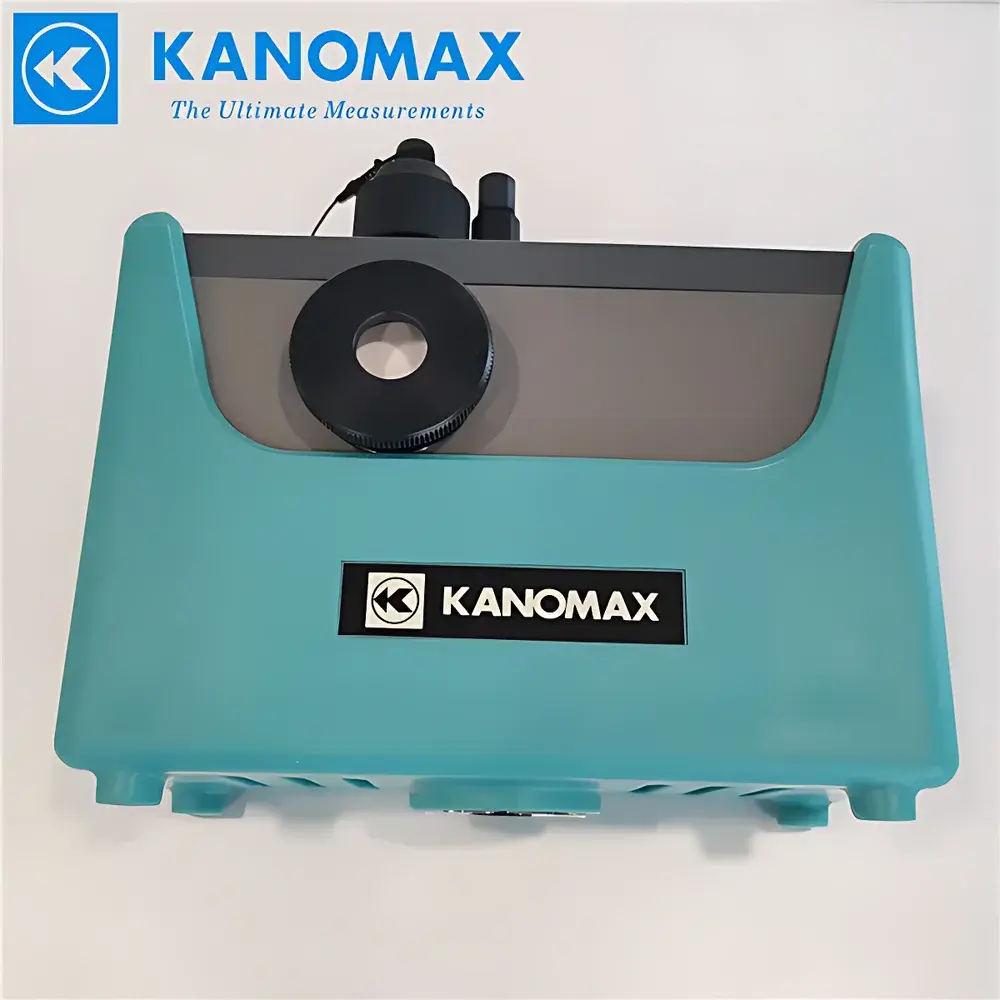
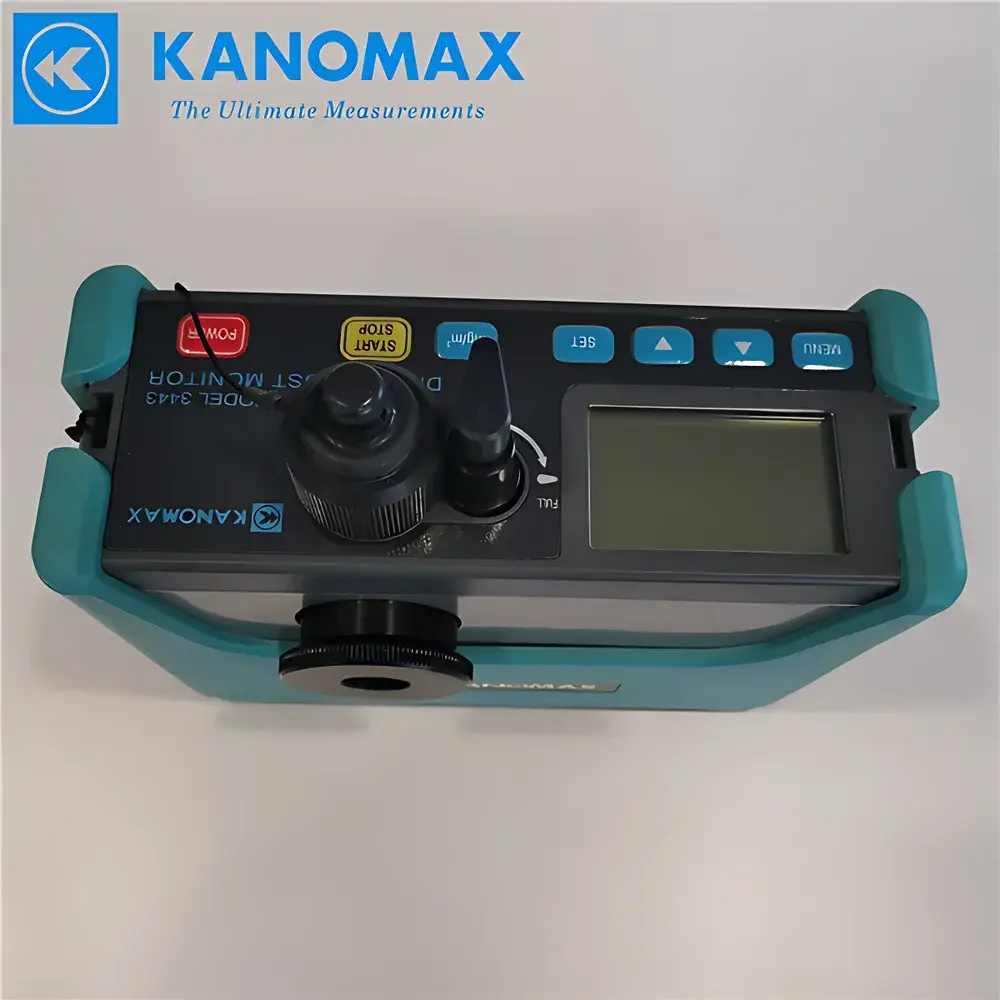
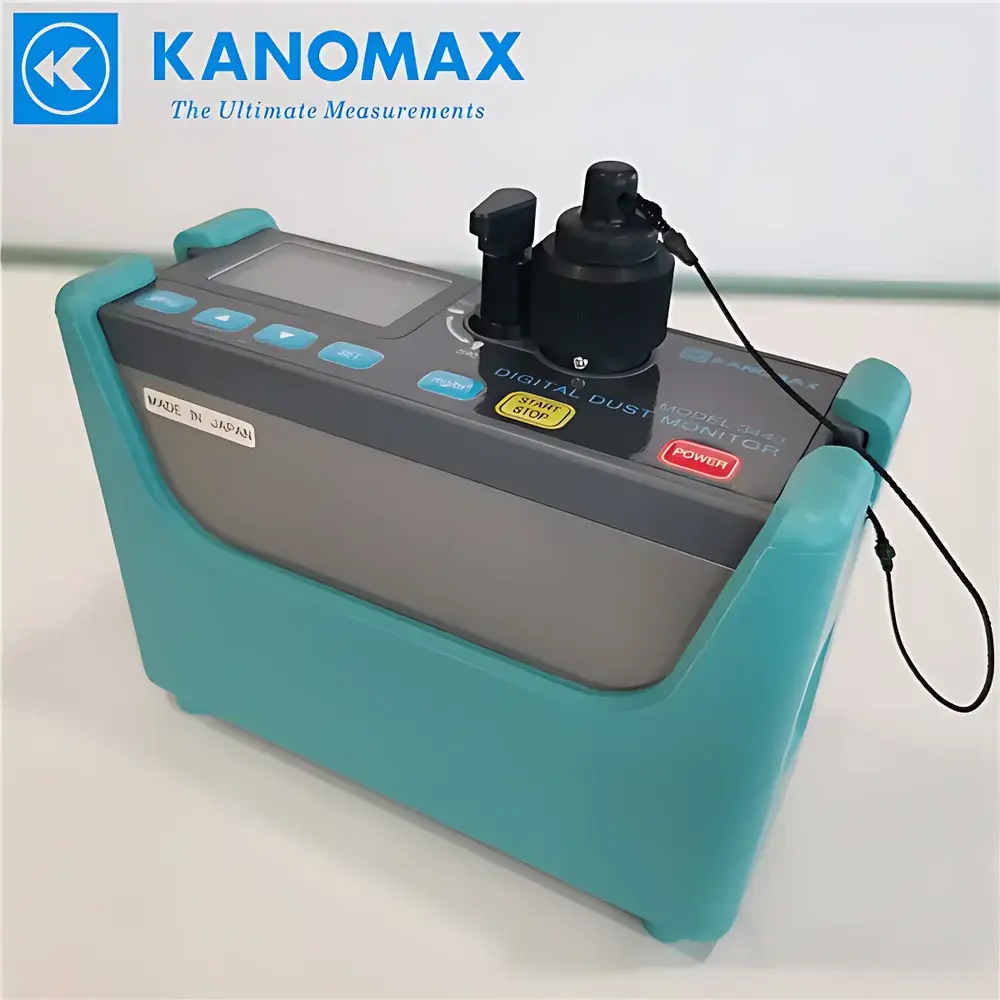
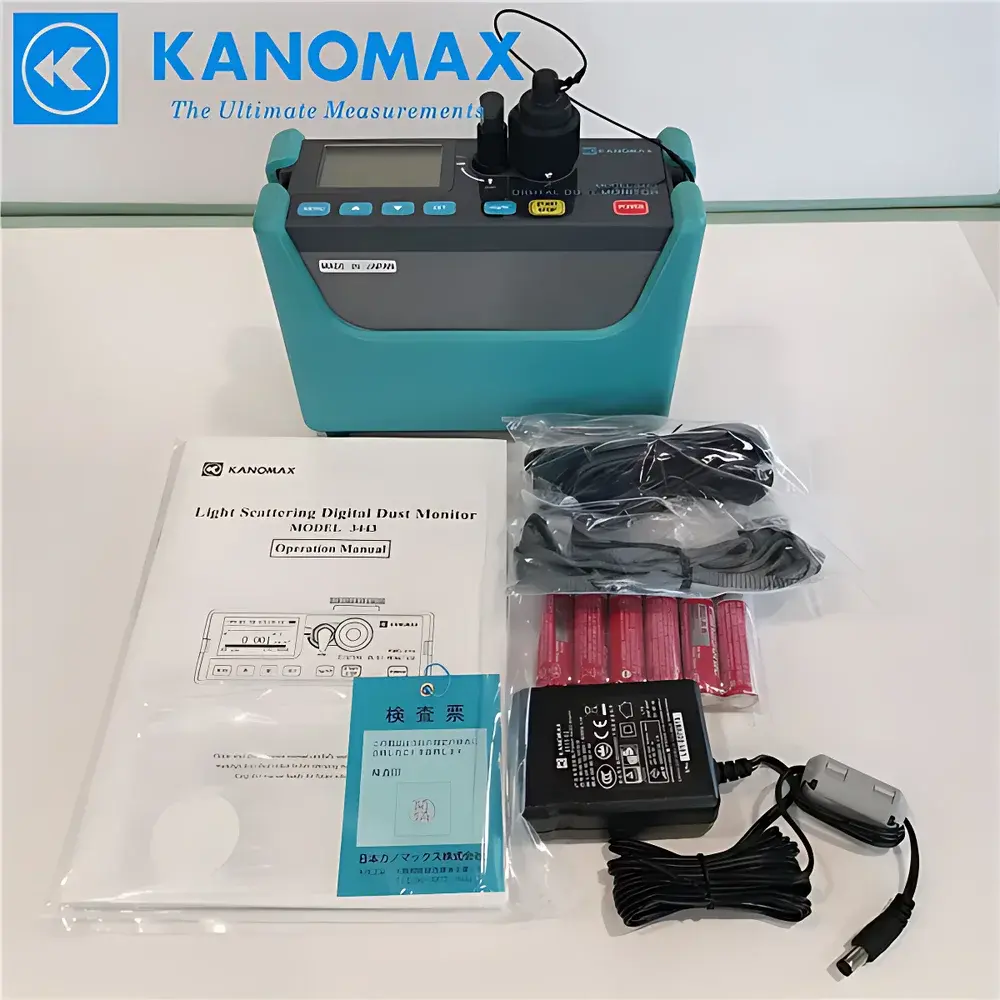
Kanomax Model 3443 Laser Scattering Dust Monitor
| Brand | Kanomax |
|---|---|
| Origin | Japan |
| Model | 3443 |
| Measurement Principle | Laser Light Scattering |
| Particle Size Range | 0.1–10 μm |
| Measurement Range | 0.001–10.000 mg/m³ |
| Resolution | 0.01 mg/m³ |
| Accuracy | ±10% |
| Relative Error | ≤±2% |
| Data Storage Capacity | 100,000 records |
| Communication Interface | USB |
| Analog Output | 0–1 V corresponding to 0–1000 CPM or 0–10,000 CPM |
| Dimensions | 162 mm (W) × 60 mm (D) × 109 mm (H) |
| Weight | Approx. 1.3 kg (including rechargeable battery) |
| Safety Classification | Non-explosion-proof |
| Compliance | Meets China’s Ministry of Health PM₁₀ monitoring requirements |
Overview
The Kanomax Model 3443 Laser Scattering Dust Monitor is a portable, high-precision particulate matter (PM) analyzer engineered for real-time ambient and occupational air quality assessment. It operates on the principle of laser light scattering—where a collimated 650 nm semiconductor laser beam interacts with airborne particles suspended in the sampling stream; the intensity and angular distribution of scattered light are quantitatively correlated to particle concentration and size distribution within the 0.1–10 μm aerodynamic diameter range. Unlike gravimetric or beta-attenuation methods, this optical technique enables second-level response time and continuous logging without consumables or filter media. The instrument is specifically calibrated and validated against Chinese national health standards for PM₁₀ monitoring, making it suitable for regulatory compliance in environmental supervision, workplace exposure assessment, and indoor air quality (IAQ) audits across industrial, healthcare, and research settings.
Key Features
- Real-time measurement of mass concentration (mg/m³) across the respirable and thoracic fraction (0.1–10 μm), supporting both PM₂.₅ and PM₁₀ equivalent reporting.
- High-resolution detection capability with 0.01 mg/m³ resolution and ±10% full-scale accuracy under ISO 21501-4 referenced calibration conditions.
- Integrated rechargeable lithium-ion battery enabling up to 8 hours of continuous operation; total system weight remains under 1.3 kg for field-deployable ergonomics.
- Dual-range analog output (0–1 V) configurable for either 0–1000 CPM or 0–10,000 CPM signal scaling—compatible with SCADA systems, PLCs, and third-party data loggers.
- Onboard statistical engine computes and displays real-time min/max/mean values post-measurement cycle, eliminating post-processing latency.
- Ruggedized housing with IP54-rated ingress protection ensures reliable performance in non-hazardous industrial environments (non-explosion-proof classification per IEC 60079-0).
Sample Compatibility & Compliance
The Model 3443 is designed for sampling undiluted ambient air, indoor ventilation streams, and low-turbulence process exhausts where particle concentrations remain below 10 mg/m³. It is not intended for high-humidity (>85% RH), corrosive gas-laden, or oil-mist environments without optional inlet conditioning. While not certified to EN 12341 or ISO 7708 for reference method equivalence, its optical design adheres to the fundamental metrological principles outlined in ISO 21501-4 (Calibration of particle counters) and aligns functionally with China’s WS/T 206–2001 standard for PM₁₀ field instrumentation. The device supports audit-ready data integrity through timestamped storage and USB-exportable CSV logs—facilitating GLP-aligned documentation workflows.
Software & Data Management
Data acquisition and analysis are supported via proprietary Kanomax PC software (Windows-compatible), which enables firmware updates, parameter configuration, and batch export of time-stamped datasets. All 100,000 stored records include date/time stamps, measurement duration, and statistical summaries. USB communication complies with USB 2.0 Full-Speed specifications and requires no external drivers on modern Windows OS versions. Raw CPM (counts per minute) and converted mg/m³ values are logged simultaneously, permitting retrospective recalibration if traceable reference aerosols (e.g., PSL, Arizona Test Dust) are used during field validation. Audit trails—including operator ID input and configuration change logs—are retained within the software environment to support 21 CFR Part 11–aligned QA/QC practices where applicable.
Applications
- Regulatory ambient air monitoring at municipal environmental protection bureaus and regional EPDs.
- Occupational hygiene surveys in construction, mining, pharmaceutical manufacturing, and cement production facilities.
- Indoor air quality verification in hospitals, cleanrooms, schools, and office buildings per GB/T 18883–2022 guidelines.
- Process control feedback in HVAC commissioning, filtration efficiency testing, and dust suppression system validation.
- Educational and research use in atmospheric science labs requiring portable, repeatable PM quantification without laboratory infrastructure dependency.
FAQ
Does the Model 3443 require annual factory recalibration?
Yes—Kanomax recommends traceable recalibration every 12 months using NIST-traceable polydisperse aerosol standards to maintain stated accuracy specifications.
Can it measure PM₂.₅ separately from PM₁₀?
No—the instrument reports total mass concentration across 0.1–10 μm; PM₂.₅ and PM₁₀ fractions are inferred via built-in size-response weighting, not physically segregated sampling.
Is the USB interface compatible with macOS or Linux?
The native Kanomax software is Windows-only; however, raw USB CDC-ACM serial output can be parsed on macOS/Linux using custom Python or LabVIEW scripts.
What maintenance is required between calibrations?
Routine cleaning of the optical chamber lens and inlet nozzle with isopropyl alcohol and lint-free swabs is recommended after every 50 hours of cumulative operation.
Does it meet EPA or EU reference method equivalency?
No—it is not designated as an FRM or FEM by the U.S. EPA nor certified under EU Directive 2008/50/EC; it serves as a screening-grade monitor aligned with national PM₁₀ operational protocols.
Related Products







