
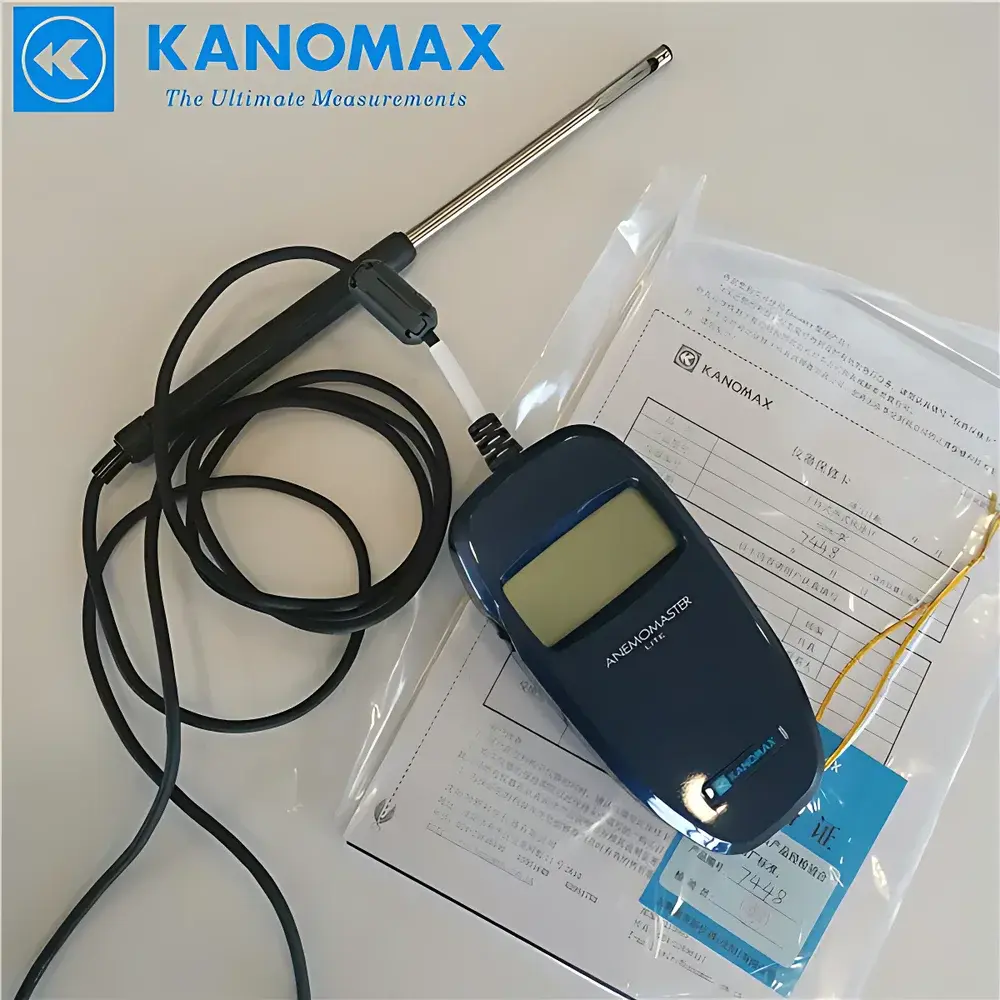
KANOMAX Model 6006 Portable Thermal Anemometer
| Brand | KANOMAX |
|---|---|
| Origin | Japan |
| Model | 6006 |
| Instrument Type | Thermal Anemometer |
| Measurement Range | 0.01–20.0 m/s |
| Resolution | 0.01 m/s (0.01–9.99 m/s), 0.1 m/s (10.0–20.0 m/s) |
| Accuracy | ±5% of reading (wind speed), ±1°C (temperature) |
| Operating Temperature | −20 to +70°C (air), 5 to 40°C (main unit), 0 to 50°C (probe) |
| Operating Humidity | 20–85% RH |
| Response Time | <1 s (90% for wind speed at 1 m/s), <30 s (90% for temperature at 1 m/s) |
| Display | Dual-parameter (wind speed & temperature), unit switchable (m/s/°C ↔ fpm/°F), FAST/SLOW averaging, battery level indicator (4-segment), hold function |
| Probe Dimensions | Ø6.1 mm (Ø10.6 mm with sheath) × 205 mm |
| cable | Ø3.3 mm × ~1.5 m |
| Main Unit Dimensions | 60 × 120 × 34 mm |
| Weight | ~180 g (including batteries) |
| Storage Temperature | −10 to +50°C |
Overview
The KANOMAX Model 6006 Portable Thermal Anemometer is a precision-engineered handheld instrument designed for reliable, real-time measurement of air velocity and ambient temperature in HVAC commissioning, indoor air quality (IAQ) assessments, cleanroom validation, laboratory ventilation studies, and industrial process airflow verification. Based on constant-temperature anemometry (CTA), the device employs a thermally sensitive platinum resistance sensor housed in a compact, interchangeable probe. As air flows across the heated sensing element, convective heat loss is quantified and converted into a linear wind speed output—enabling high reproducibility across its full 0.01–20.0 m/s range. Integrated temperature compensation circuitry ensures stable calibration performance within the critical 10–40°C operational window, while extended environmental tolerance (−20 to +70°C air temperature, 20–85% RH) supports field use in diverse climatic and mechanical environments.
Key Features
- Single-button operation interface optimized for rapid deployment and intuitive field use
- Interchangeable thermal probes—maintaining factory-calibrated accuracy without recalibration upon replacement
- Dual-parameter simultaneous display: wind speed and air temperature with selectable units (m/s or fpm; °C or °F)
- Configurable averaging modes: FAST (1-second moving average) and SLOW (5-second moving average) for dynamic or stabilized readings
- Real-time battery status indicator (4-segment LED) and auto-power-off function to extend operational life
- Compact, lightweight design (≈180 g with batteries) with ergonomic main unit (60 × 120 × 34 mm) and low-profile probe (Ø6.1 × 205 mm)
- Optional accessories include telescopic extension rod (166–909 mm) and certified spare probes for multi-point or redundant measurement workflows
Sample Compatibility & Compliance
The Model 6006 is validated for use with ambient air under standard atmospheric conditions (101.3 kPa, dry to moderately humid). It is not intended for corrosive, explosive, or particulate-laden gas streams without appropriate filtration or probe protection. While not certified to specific ISO or ASTM standards as a standalone device, its measurement methodology aligns with the physical principles referenced in ISO 7726 (Ergonomics of the thermal environment — Instruments for measuring physical quantities) and ASHRAE Guideline 12-2020 (Managing the Risk of Legionellosis Associated with Building Water Systems), particularly in airflow verification contexts. The instrument supports GLP-compliant documentation when paired with external logging software and timestamped manual records; however, it does not feature built-in audit trail or 21 CFR Part 11 compliance.
Software & Data Management
The KANOMAX Model 6006 operates as a stand-alone, battery-powered field instrument with no native Bluetooth, USB, or wireless data export capability. All measurements are displayed in real time on the integrated LCD and must be manually recorded or transcribed. For traceable data capture, users commonly integrate the device into broader QA/QC workflows using third-party digital logbooks or spreadsheet-based templates. Optional accessories—including the telescopic extension rod and calibrated spare probes—are supplied with individual serial-numbered calibration certificates traceable to JCSS (Japanese Calibration Service System), supporting metrological traceability requirements in regulated environments.
Applications
- HVAC system balancing and duct traverse surveys
- Cleanroom ISO Class verification (air change rate estimation via volumetric flow calculation)
- Local exhaust ventilation (LEV) hood face velocity testing per HSE HSG258 or OSHA guidelines
- Indoor environmental quality (IEQ) audits in offices, schools, and healthcare facilities
- Validation of laminar flow cabinets and biosafety cabinets (pre- and post-filter integrity checks)
- Field verification of fan coil unit outputs and diffuser performance
- Educational laboratories for fluid dynamics and thermodynamics instruction
FAQ
What is the recommended calibration interval for the KANOMAX Model 6006?
KANOMAX recommends annual calibration against a NIST-traceable reference standard, especially when used in regulated or quality-critical applications. Field verification using a zero-air check (still-air environment) and span check (with known-velocity source) is advised before each day’s measurements.
Can the Model 6006 measure gases other than air?
No—the instrument is factory-calibrated exclusively for dry to moderately humid ambient air. Density, thermal conductivity, and viscosity differences in other gases will introduce unquantified systematic error.
Does the probe require periodic cleaning or maintenance?
Yes—exposure to dust, oil mist, or condensation may coat the sensing element. Gently clean the probe tip with isopropyl alcohol and lint-free swab before recalibrating if drift is observed.
Is the device suitable for outdoor use in rain or direct sunlight?
The main unit is not IP-rated for moisture or UV exposure. Prolonged outdoor use requires shelter from precipitation and solar loading; probe operation remains valid within its specified temperature and humidity ranges only when protected.
How does temperature compensation affect wind speed accuracy?
The internal compensation circuit corrects for ambient temperature-induced resistance drift in the sensing element. Full accuracy (±5% of reading) is guaranteed only between 10–40°C; outside this band, wind speed uncertainty increases progressively due to uncompensated thermal effects.
Related Products







