
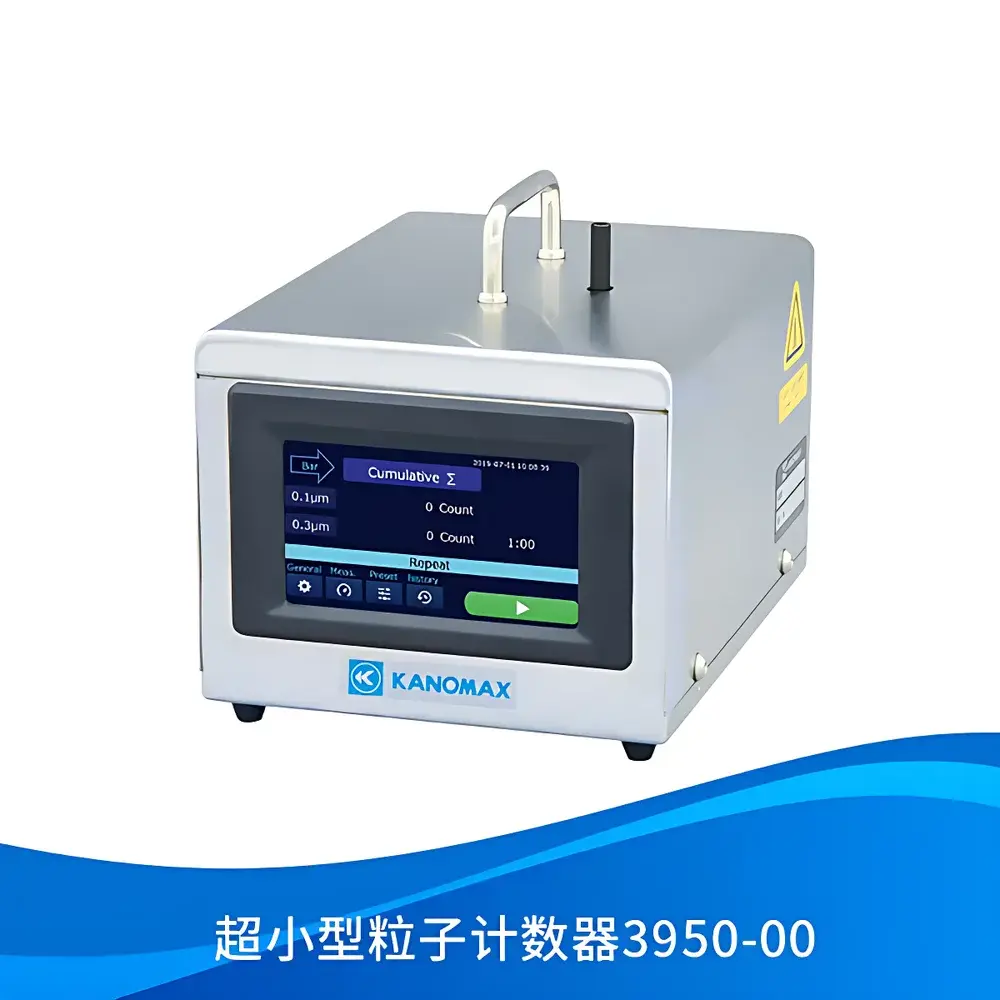
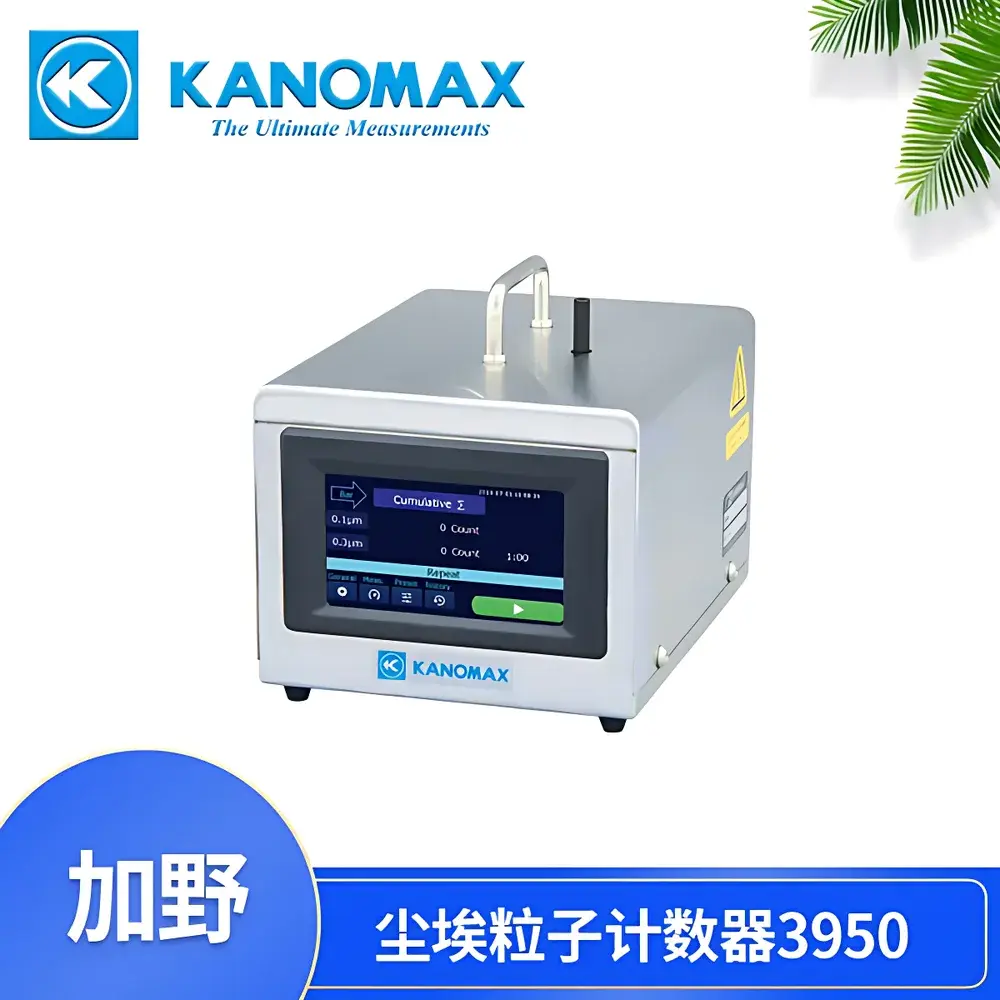
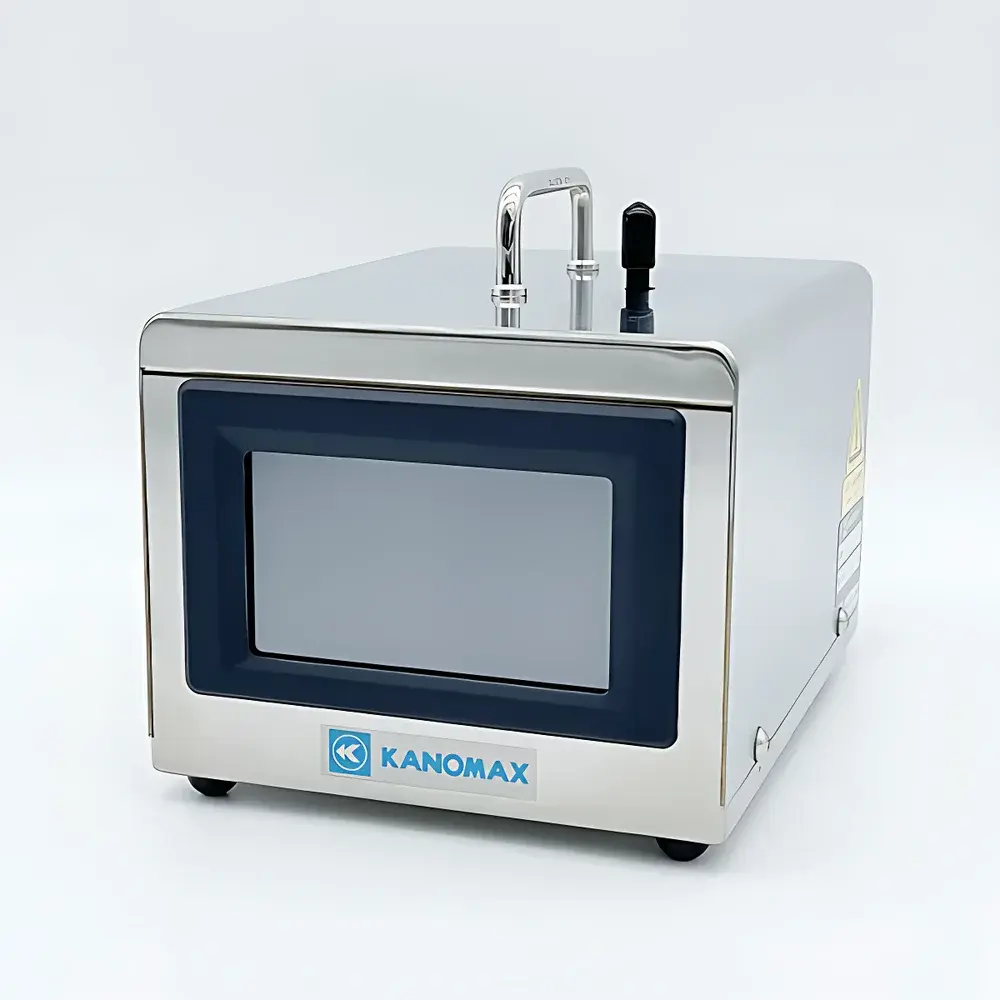
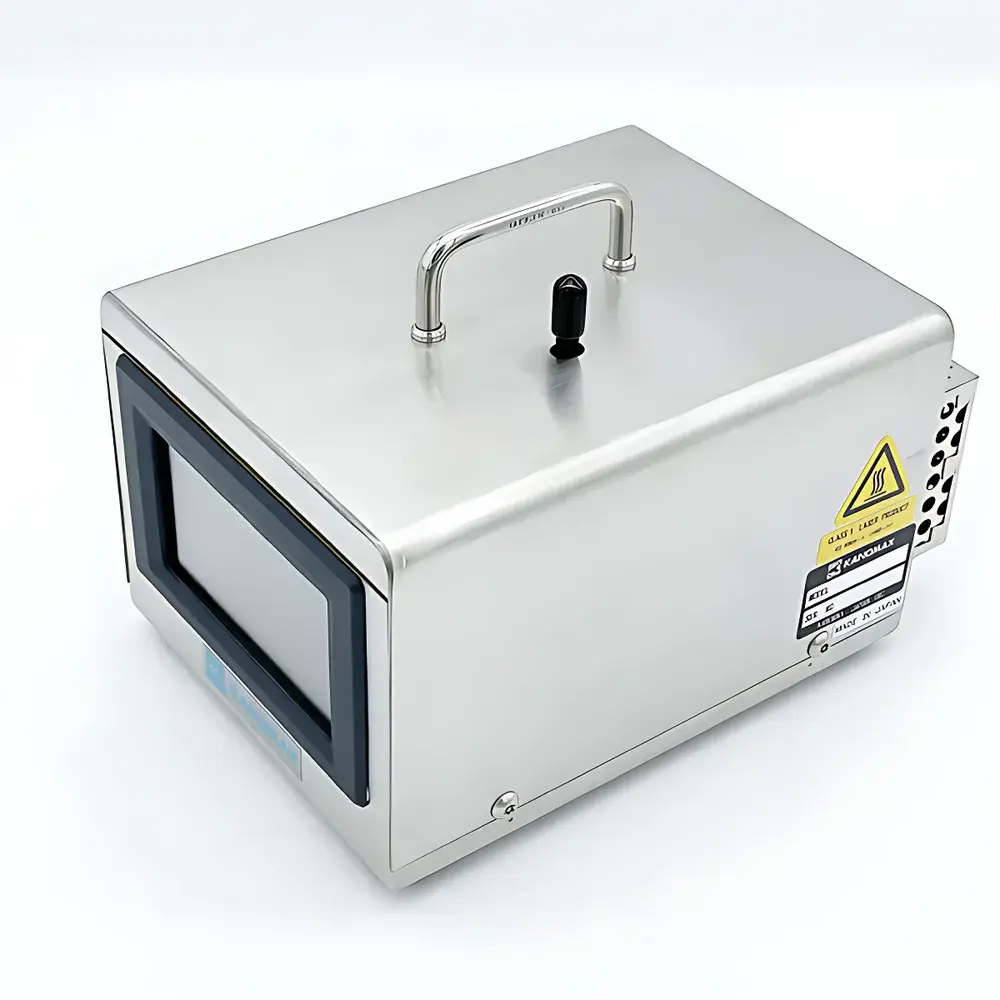
Kanomax Model 3950 Ultra-Compact Optical Particle Counter for Semiconductor Cleanroom Monitoring
| Brand | Kanomax |
|---|---|
| Origin | Japan |
| Model | 3950 |
| Flow Rate | 2.83 L/min (0.1 CFM) |
| Flow Accuracy | ±5% |
| Timing Accuracy | ±1 s per 6 min |
| Repeatability | ±5% |
| Size Distribution Error | ±15% |
| Indication Error | ±30% |
| Particle Detection Channels | 0.1 µm, 0.3 µm |
| Compliance | JIS B9921 & ISO 21501-4 |
| Display | 4.3" Color Touchscreen LCD |
| Communication | RS-485, Ethernet, USB (Host/Device) |
| Data Storage | Up to 10,000 records (CSV) |
| Operating Environment | 15–35 °C, 0–85% RH (non-condensing) |
| Dimensions | 150 × 163 × 228 mm |
| Weight | 3.4 kg |
Overview
The Kanomax Model 3950 is an ultra-compact, high-sensitivity optical particle counter engineered specifically for real-time airborne particulate monitoring in semiconductor fabrication environments. It operates on the principle of single-particle light scattering—illuminating aerosol particles with a stable laser diode and detecting scattered light intensity to classify and count particles by equivalent optical diameter. With dual-channel detection at 0.1 µm and 0.3 µm, the instrument meets the stringent sensitivity requirements of ISO Class 1–3 cleanrooms and supports continuous verification of contamination control during photolithography, etching, and deposition processes. Its compact footprint (150 × 163 × 228 mm) and low mass (3.4 kg) enable seamless integration as an embedded sensor within process tools, mini-environments, or FFUs—eliminating the need for external sampling manifolds or bulky standalone units. Designed and manufactured in Japan, the Model 3950 complies fully with JIS B9921 and ISO 21501-4 for calibration traceability, counting efficiency, and sizing accuracy—ensuring metrological integrity across qualification, routine monitoring, and troubleshooting applications.
Key Features
- Ultra-compact form factor optimized for OEM integration into semiconductor process equipment, track-in systems, and point-of-use monitoring stations
- Dual-size channel detection at 0.1 µm and 0.3 µm—enabling early detection of sub-100 nm defects critical to advanced node lithography (e.g., EUV mask handling)
- Integrated constant-flow pump delivering 2.83 L/min (0.1 CFM) with ±5% volumetric accuracy, certified per ISO 21501-4 Annex D
- 4.3-inch full-color resistive touchscreen display supporting real-time visualization of cumulative (∑), differential (Δ), and histogram-based particle concentration trends
- Multi-mode measurement operation: single-shot, repeat, continuous, calculated average, ISO 14644-1 compliance mode, and GB/T 16292 mode
- Robust communication architecture featuring isolated RS-485 (9600–38400 baud), 10/100BASE-T Ethernet (TCP/IP), and dual-role USB (device for PC connectivity; host for direct printing or USB flash logging)
- Built-in non-volatile memory storing up to 10,000 measurement records in CSV format—compatible with LIMS, MES, and SPC platforms via standard data export protocols
Sample Compatibility & Compliance
The Model 3950 is validated for use with ambient cleanroom air, nitrogen-purged tool environments, and dry compressed air lines where moisture content remains below dew point thresholds (≤85% RH, non-condensing). It is not intended for corrosive, explosive, or high-humidity (>90% RH) gas streams without pre-conditioning. All optical and pneumatic components are constructed from stainless steel and anodized aluminum to resist outgassing and surface contamination—critical for Class 10 and lower cleanrooms. Calibration is traceable to NIST-traceable PSL standards, with counting efficiency verified at 50±20% for 0.1 µm and 100±10% for 0.15–0.2 µm PSL particles, satisfying ISO 21501-4 Clause 6.3. The device supports audit-ready data integrity through timestamped records, user-accessible firmware versioning, and configurable password-protected configuration menus—facilitating alignment with FDA 21 CFR Part 11 and ISO/IEC 17025 documentation requirements.
Software & Data Management
Data acquisition and analysis are supported via Kanomax’s proprietary KAN-PC software (Windows-compatible), which enables remote configuration, real-time streaming, historical trend overlay, and automated report generation (PDF/CSV). Raw measurement files include full metadata: location ID (up to 99 predefined sites), operator ID, environmental conditions (temperature/humidity if externally logged), and instrument status flags (e.g., flow alarm, laser power drift). For enterprise deployment, the Ethernet interface supports Modbus TCP and HTTP GET/POST APIs—allowing direct ingestion into factory-wide SCADA, CMMS, or cloud-based digital twin platforms. All stored data retains native time stamps with microsecond resolution synchronized to internal RTC (±1 s per 6 minutes), ensuring temporal fidelity required for root-cause analysis of transient contamination events.
Applications
- Embedded particle monitoring in lithography steppers, wafer scanners, and reticle storage cabinets
- Continuous verification of ULPA filter performance in mini-environments and FOUP load ports
- Real-time feedback control for purge gas purity in CVD/ALD process chambers
- ISO 14644-1 classification and re-certification of cleanroom zones (Class 1–5)
- Contamination source tracing during tool preventive maintenance or chamber recovery cycles
- Qualification of glovebox and transfer tunnel integrity in advanced packaging facilities
FAQ
What is the minimum detectable particle size, and how is sizing accuracy validated?
The Model 3950 detects particles down to 0.1 µm using calibrated polystyrene latex (PSL) standards. Sizing resolution is ≤15% CV relative to 0.3 µm PSL, per ISO 21501-4 Clause 7.4.
Can the instrument operate continuously for 24/7 monitoring?
Yes—designed for unattended operation with thermal management optimized for 15–35 °C ambient conditions and built-in diagnostics for laser stability and flow consistency.
Does it support FDA 21 CFR Part 11-compliant electronic records?
While the device itself does not provide electronic signatures, its timestamped, immutable CSV logs and configurable user access levels enable compliant implementation when deployed with validated third-party data management software.
Is external calibration required annually?
Per ISO 21501-4, annual calibration against traceable PSL standards is recommended; Kanomax-certified service centers provide NIST-traceable recalibration with full uncertainty reporting.
How is cross-contamination between sampling locations prevented?
The internal flow path uses smooth-bore stainless steel tubing and a dedicated, self-contained pump—no shared manifolds or valves. A 60-second purge cycle is programmable between location measurements to eliminate carryover.
Related Products







