
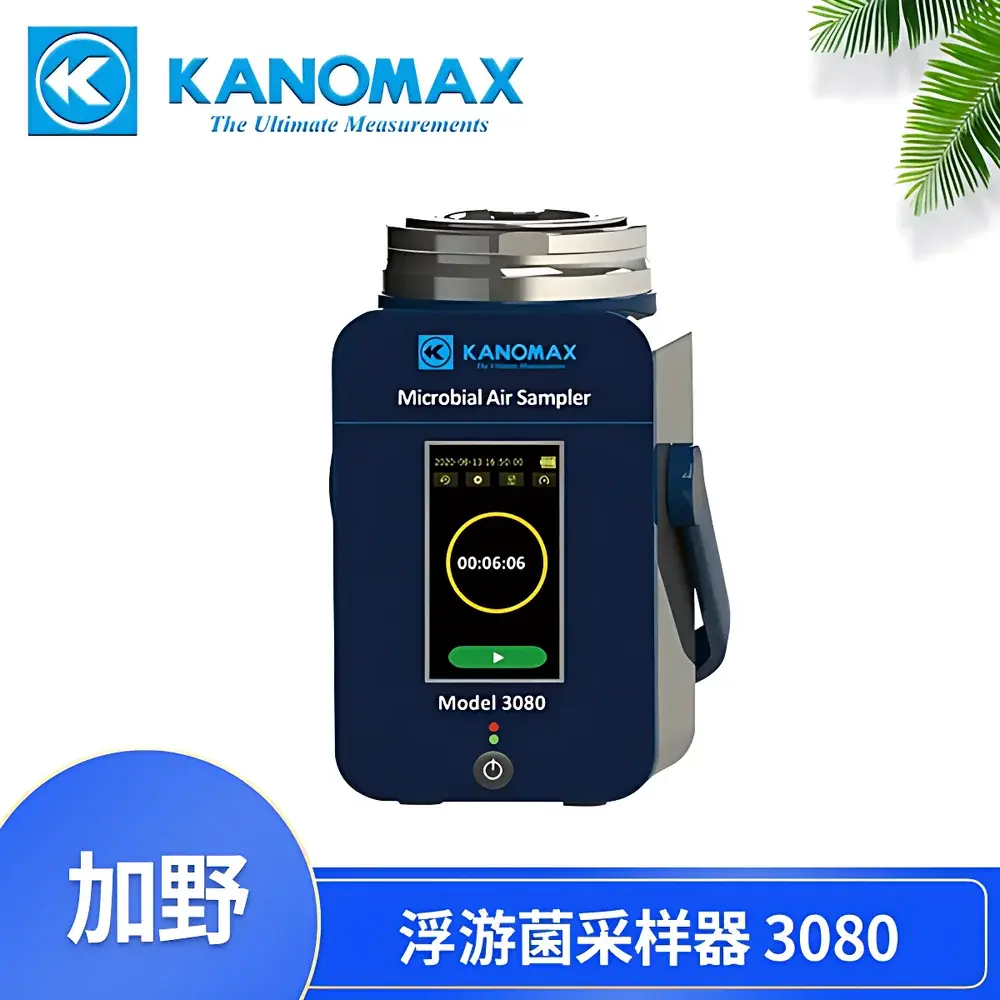
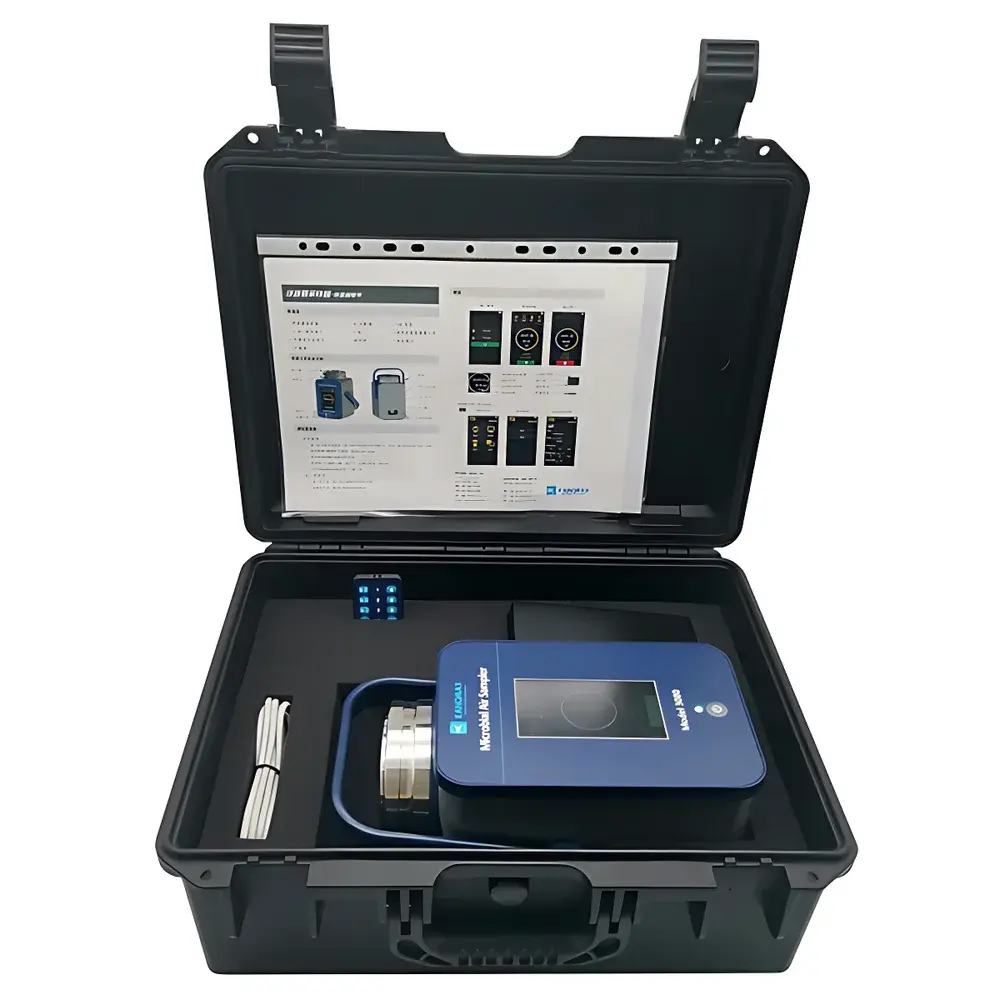
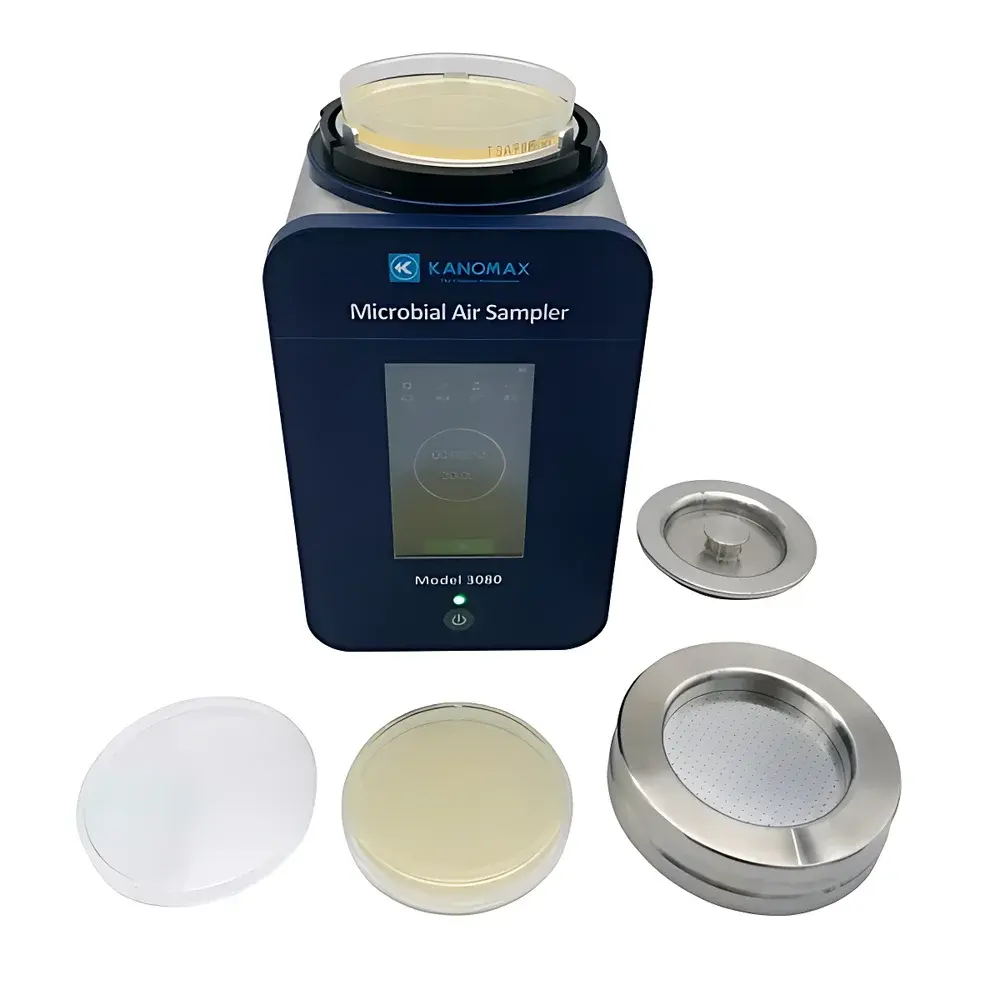
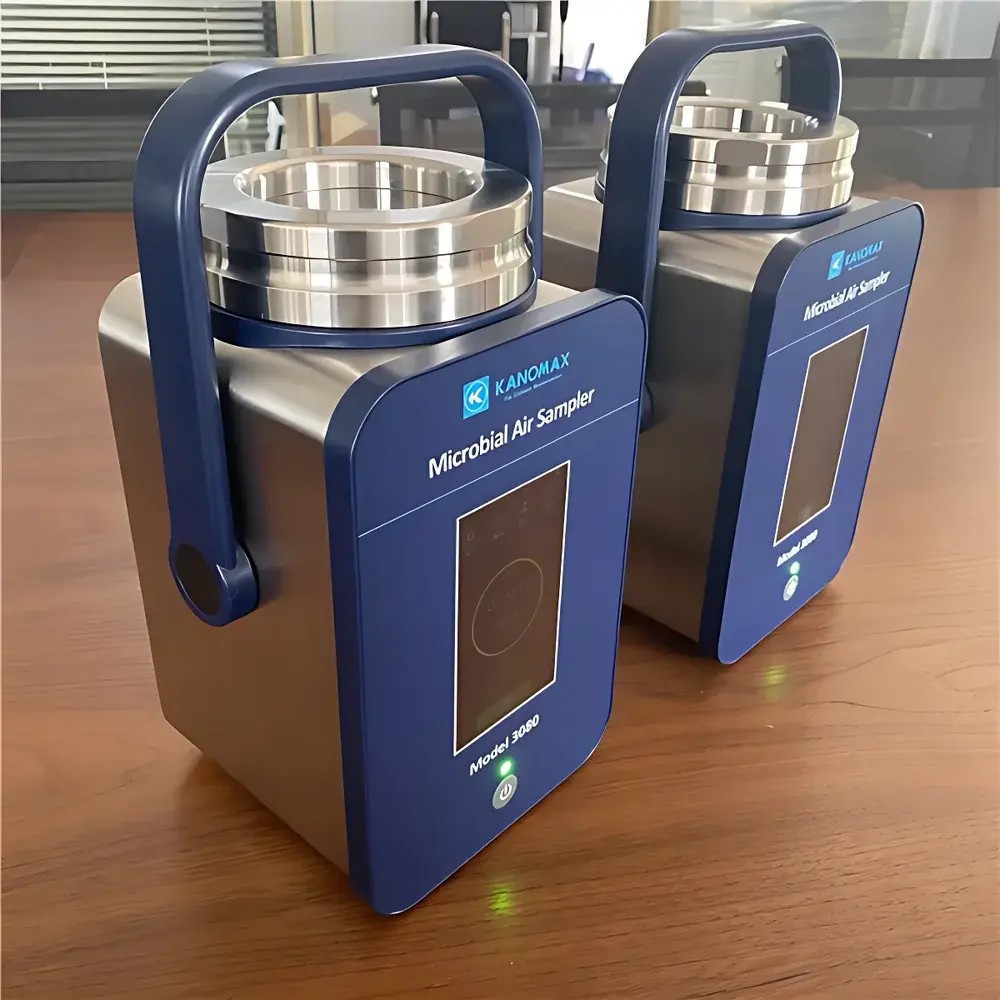
Kanomax Model 3080 Portable Andersen-Style Air Microbial Sampler
| Brand | Kanomax |
|---|---|
| Origin | Japan |
| Model | 3080 |
| Flow Rate | 100 L/min |
| Flow Accuracy | ±2.5% |
| Sampling Volume Range | 20–6000 L |
| Timing Range | 10 s to 1 h (delay: 0 s to 23 h 59 min 59 s) |
| Sampling Cycles | 2–300 or continuous |
| Operating Temperature | 0–40 °C |
| Operating Humidity | 0–90% RH (non-condensing) |
| Sampling Head Material | 316 Stainless Steel |
| Impactor Stages | 6-stage Andersen design |
| Impact Velocity | <20 m/s |
| Exhaust Filter Class | ISO Class 3 |
| Display | 4.3-inch color touchscreen |
| Data Storage | 10,000 internal records + USB export (CSV) |
| Communication | USB, RS-485 (Modbus RTU) |
| Power | Rechargeable Li-ion battery (7 h runtime) + AC adapter (100–240 V) |
| Dimensions | 136 × 235 × 133 mm |
| Weight | 3.2 kg |
| Language Support | English, Japanese, Chinese |
| User Management | 64 editable users with multi-level permission and audit trail |
Overview
The Kanomax Model 3080 is a portable, six-stage Andersen-style impactor air microbial sampler engineered for quantitative collection of viable airborne microorganisms in controlled and critical environments. It operates on the principle of inertial impaction: aerosol-laden air is drawn at a calibrated flow rate of 100 L/min through a precisely engineered cascade impactor, where particles are separated by aerodynamic size and deposited onto standard agar-filled Petri dishes (90–100 mm or 55–84 mm diameter) placed on each stage. With an impact velocity maintained below 20 m/s, the device ensures high microbial recovery efficiency while minimizing desiccation and mechanical damage to sensitive organisms. Designed for compliance with international microbiological monitoring standards—including ISO 14698-1 (Biocontamination control), ISO 14644-1 (Cleanroom classification), and EU GMP Annex 1—the Model 3080 delivers reproducible, traceable, and auditable sampling data essential for environmental monitoring programs in regulated industries.
Key Features
- Six-stage Andersen-type impactor with validated particle size cut-points per stage (e.g., >7.0 µm, 4.7–7.0 µm, 3.3–4.7 µm, etc.), enabling size-resolved microbial analysis.
- Integrated ISO Class 3 exhaust filtration system to prevent cross-contamination and ensure operator and ambient environment safety during sampling.
- Real-time volumetric flow monitoring with audible and visual alarms triggered upon deviation exceeding ±2.5% tolerance—critical for maintaining sampling integrity per ISO 8573-1 and USP <71> requirements.
- 316 stainless steel sampling head, autoclavable and compatible with common sterilants (e.g., 70% ethanol, hydrogen peroxide vapor), ensuring rapid turnaround between sampling locations.
- Intuitive 4.3-inch color touchscreen interface supporting English, Japanese, and Chinese—enabling seamless operation across multinational facilities without language barriers.
- Configurable sampling protocols: programmable volume (20–6000 L), timing intervals (10 s–1 h), delay start (up to 23 h 59 min), and cycle count (2–300) or continuous mode.
- Onboard audit trail with timestamped logs capturing operator ID, location tag, sampling volume, duration, status flags, and system events—fully compliant with FDA 21 CFR Part 11 and EU Annex 11 data integrity expectations.
Sample Compatibility & Compliance
The Model 3080 accommodates standard microbiological culture media in both 90–100 mm and 55–84 mm Petri dishes, facilitating compatibility with conventional incubation, colony counting, and identification workflows. Its impactor geometry and airflow dynamics have been validated against reference methods described in ISO 14698-2 and ASTM D6329. The instrument meets electromagnetic compatibility (EMC) requirements per IEC 61326-1 and carries CE marking for use in EU cleanroom and healthcare settings. All firmware and calibration parameters are protected by role-based access control (RBAC), and user actions—including parameter edits, sample initiation, and data export—are logged with immutable timestamps and operator identifiers, satisfying GLP/GMP documentation requirements.
Software & Data Management
Data is stored internally (10,000 records) and exportable via USB in CSV format for integration into LIMS or statistical process control platforms. The device supports Modbus RTU over RS-485 for centralized monitoring in distributed洁净室 (cleanroom) networks and can be synchronized with building management systems (BMS) or environmental monitoring systems (EMS). Optional thermal printer connectivity enables immediate hardcopy generation of sampling reports—including date, time, location, operator, volume, flow stability status, and pass/fail indicators—for on-site QA verification. Audit logs retain full metadata for regulatory inspections, including failed login attempts, configuration changes, and alarm acknowledgments.
Applications
The Model 3080 is routinely deployed in pharmaceutical aseptic processing suites, hospital isolation rooms, biotechnology cleanrooms (ISO Class 5–8), food and beverage production lines, museum climate-controlled storage vaults, and biosafety cabinet validation studies. Its portability and battery-powered operation (7-hour runtime) make it ideal for dynamic mapping of microbial hotspots, routine environmental monitoring (EM) rounds, and qualification of isolators, RABS, and transfer hatches. It also supports investigations of HVAC system performance, filter integrity testing, and post-decontamination verification following VHP or chlorine dioxide treatments.
FAQ
What microbial size fractions does the six-stage Andersen impactor resolve?
It separates viable particles into six aerodynamic diameter ranges: >7.0 µm, 4.7–7.0 µm, 3.3–4.7 µm, 2.1–3.3 µm, 1.1–2.1 µm, and <1.1 µm—enabling differential analysis of fungal spores, bacterial aggregates, and single-cell organisms.
Is the instrument suitable for ISO Class 5 (Class 100) cleanroom monitoring?
Yes—its low particle loss characteristics, ISO Class 3 exhaust filtration, and real-time flow verification meet the sensitivity and reliability thresholds required for Grade A/B environments per EU GMP Annex 1.
Can sampling data be integrated into an existing LIMS?
Yes—CSV exports and Modbus RTU protocol support enable direct ingestion into most laboratory information management systems without proprietary middleware.
Does the device support remote firmware updates?
Firmware updates are performed locally via USB; no network connectivity or cloud dependency is required—ensuring air-gapped security in high-assurance environments.
What is the calibration interval recommendation?
Kanomax recommends annual recalibration using NIST-traceable flow meters; field verification with primary standards is advised before critical sampling campaigns.
Related Products







