
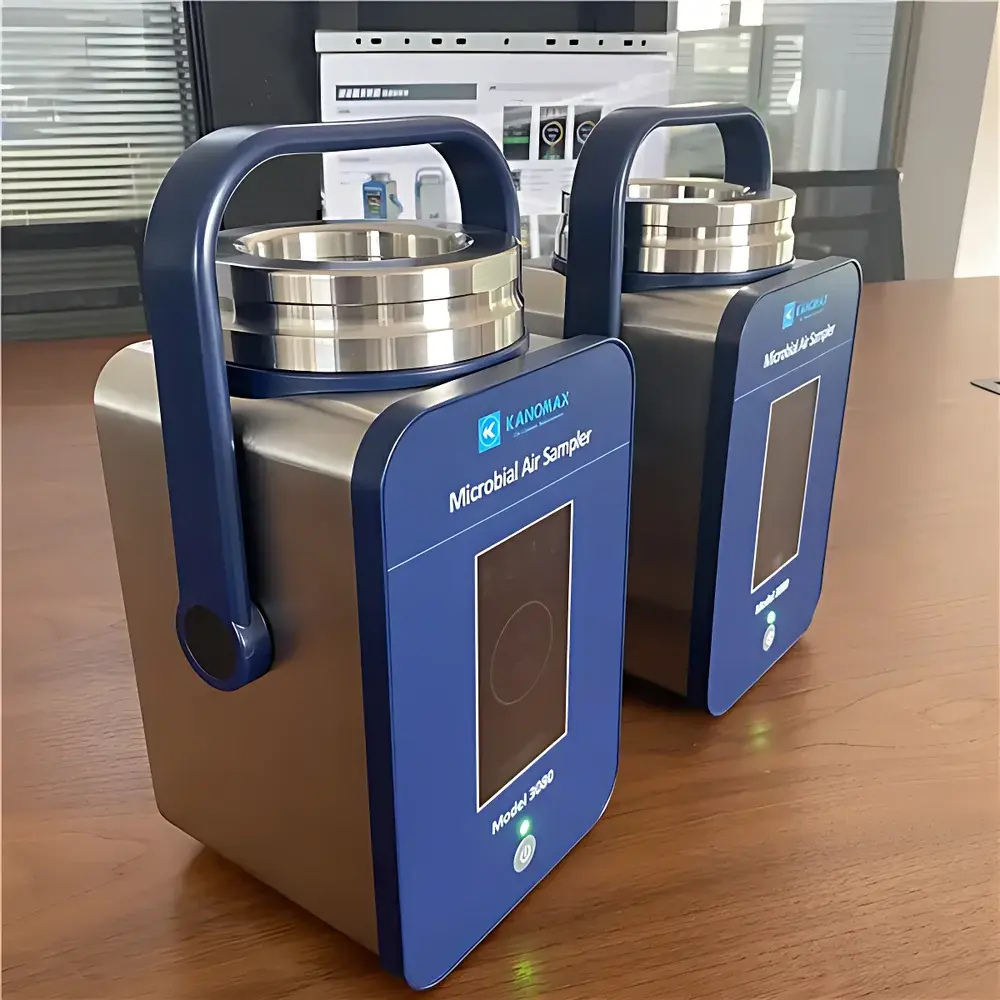
Kanomax Model 3080 Anderson Impactor Air Microbial Sampler
| Brand | Kanomax |
|---|---|
| Origin | Japan |
| Model | 3080 |
| Flow Rate | 100 L/min |
| Flow Accuracy | ±2.5% |
| Operating Temperature | 0–40 °C |
| Operating Humidity | 0–90% RH (non-condensing) |
| Battery Runtime | 7 h |
| Display | 4.3-inch color touchscreen |
| Data Storage | 10,000 internal records + USB export (CSV) |
| Communication | USB, RS-485 (Modbus RTU) |
| Sample Volume Range | 20–6000 L |
| Sampling Interval | 10 s–1 h |
| Delay Time | 0 s–23 h 59 min 59 s |
| Sampling Cycles | 2–300 or continuous |
| Petri Dish Compatibility | 90–100 mm and 55–84 mm |
| Exhaust Filter Class | ISO Class 3 |
| Power Supply | Li-ion rechargeable battery + AC 100–240 V adapter |
| Dimensions | 136 × 235 × 133 mm |
| Weight | 3.2 kg |
Overview
The Kanomax Model 3080 is a precision-engineered, portable Anderson impactor-based air microbial sampler designed for quantitative assessment of viable airborne microorganisms in controlled environments. Utilizing the well-established inertial impaction principle—where aerosolized particles are accelerated through calibrated nozzles onto nutrient agar surfaces—the instrument enables reproducible collection of culturable bacteria and fungi across defined volumetric airflow. Its fixed 100 L/min nominal flow rate, validated to ±2.5% accuracy per ISO 14698-1 and ISO 14698-2 guidance, ensures compliance with microbiological monitoring requirements in regulated settings including pharmaceutical cleanrooms (ISO 14644-1 Class 5–8), hospital isolation rooms, aseptic processing suites, and biosafety cabinets. The device operates independently of external vacuum sources, integrating a high-efficiency, low-pulsation pump and an ISO Class 3 exhaust filter to prevent cross-contamination and maintain operator safety during sampling.
Key Features
- 4.3-inch full-color resistive touchscreen interface supporting multilingual operation (English, Japanese, Chinese) with intuitive workflow navigation and real-time status feedback.
- Programmable sampling parameters: user-defined sample volume (20–6000 L), interval timing (10 s–1 h), delay start (0 s–23 h 59 min 59 s), and cycle count (2–300) or continuous mode.
- Multi-level permission management system enabling role-based access control for operators, supervisors, and administrators—supporting audit-ready workflows aligned with GMP Annex 1 and FDA 21 CFR Part 11 expectations.
- Stainless-steel sampling head compatible with autoclaving (121 °C, 20 min), eliminating carryover risk between sampling events and ensuring sterility integrity.
- Integrated lithium-ion battery providing up to 7 hours of uninterrupted field operation; dual-power capability via AC adapter (100–240 V) for lab or stationary use.
- Comprehensive data logging: 10,000 internal records storing date/time, location tag, operator ID, sampled volume, cycle status, flow stability flag, and alarm events—all exportable via USB in CSV format with optional timestamped operation logs.
Sample Compatibility & Compliance
The Model 3080 accommodates standard Petri dishes (90–100 mm diameter) and compact formats (55–84 mm), facilitating compatibility with common microbiological culture media such as Tryptic Soy Agar (TSA), Sabouraud Dextrose Agar (SDA), and malt extract agar. Its impactor geometry conforms to the six-stage Andersen design, enabling size-resolved particle deposition consistent with aerodynamic diameter classifications (0.65–>7 µm). The unit meets mechanical and performance criteria referenced in ISO 14698-1 (Biocontamination control — General principles and methods) and supports validation protocols required under EU GMP Annex 1 (Manufacture of Sterile Medicinal Products). Exhaust filtration complies with ISO 14644-3 Class 3 specifications, minimizing environmental release of viable agents. Device calibration and factory verification documentation—including traceable NIST-traceable flow certification—is supplied with each unit.
Software & Data Management
Data acquisition and reporting are fully embedded within the onboard firmware—no proprietary PC software is required for routine operation. All measurement metadata, including customizable site identifiers and operator annotations, are stored with ISO 8601 timestamps. USB exports generate compliant CSV files readable in Excel, LIMS, or statistical analysis platforms (e.g., JMP, Minitab). Optional Modbus RTU over RS-485 enables integration into building management systems (BMS) or centralized environmental monitoring systems (EMS) for automated alarm triggering and trend analysis. Audit trail functionality captures all parameter changes, user logins, and critical events—supporting GLP/GMP-aligned data integrity frameworks.
Applications
The Model 3080 serves as a core tool for environmental monitoring programs across highly regulated industries: sterile pharmaceutical manufacturing (grade A–D zones), hospital infection control (ORs, ICU air handling units), food and beverage production (filling lines, packaging areas), biotechnology R&D labs, museum climate-controlled storage vaults, and cleanroom validation studies. It is routinely deployed for routine surveillance, media fill investigations, isolator qualification, and post-maintenance requalification per ISO 14644-2. Its portability and battery autonomy make it especially suitable for mapping spatial contamination gradients or conducting unannounced audits without infrastructure dependency.
FAQ
Does the Model 3080 require annual recalibration?
Yes—recommended annually or after any physical impact or maintenance affecting flow path integrity; calibration must be performed using a traceable primary standard flowmeter per ISO/IEC 17025-accredited laboratory procedures.
Can the device operate inside a laminar flow hood without disrupting airflow patterns?
Yes—its compact footprint (136 × 235 × 133 mm) and low acoustic emission (<55 dB(A)) allow placement at designated sampling points without compromising unidirectional airflow velocity or uniformity.
Is remote operation supported beyond the included infrared remote control?
Yes—RS-485 Modbus RTU protocol enables integration with SCADA or EMS platforms for scheduled start/stop commands and real-time flow monitoring.
What sterilization methods are validated for the stainless-steel impactor head?
Autoclaving at 121 °C for 20 minutes (gravity displacement cycle) is validated; dry heat (>160 °C) and ethylene oxide are not recommended due to potential seal degradation.
How does the unit handle high-humidity environments near saturation?
The internal humidity sensor triggers automatic flow compensation logic when RH exceeds 85%, and condensation prevention is ensured by thermal management of the impactor surface—validated for continuous operation up to 90% RH non-condensing.







